React vs Next.js vs Angular in 2026: A Framework Decision Tree for Founders
A plain-English decision tree for founders choosing React, Next.js or Angular in 2026, based on SEO, app type, team, hiring and lifespan.

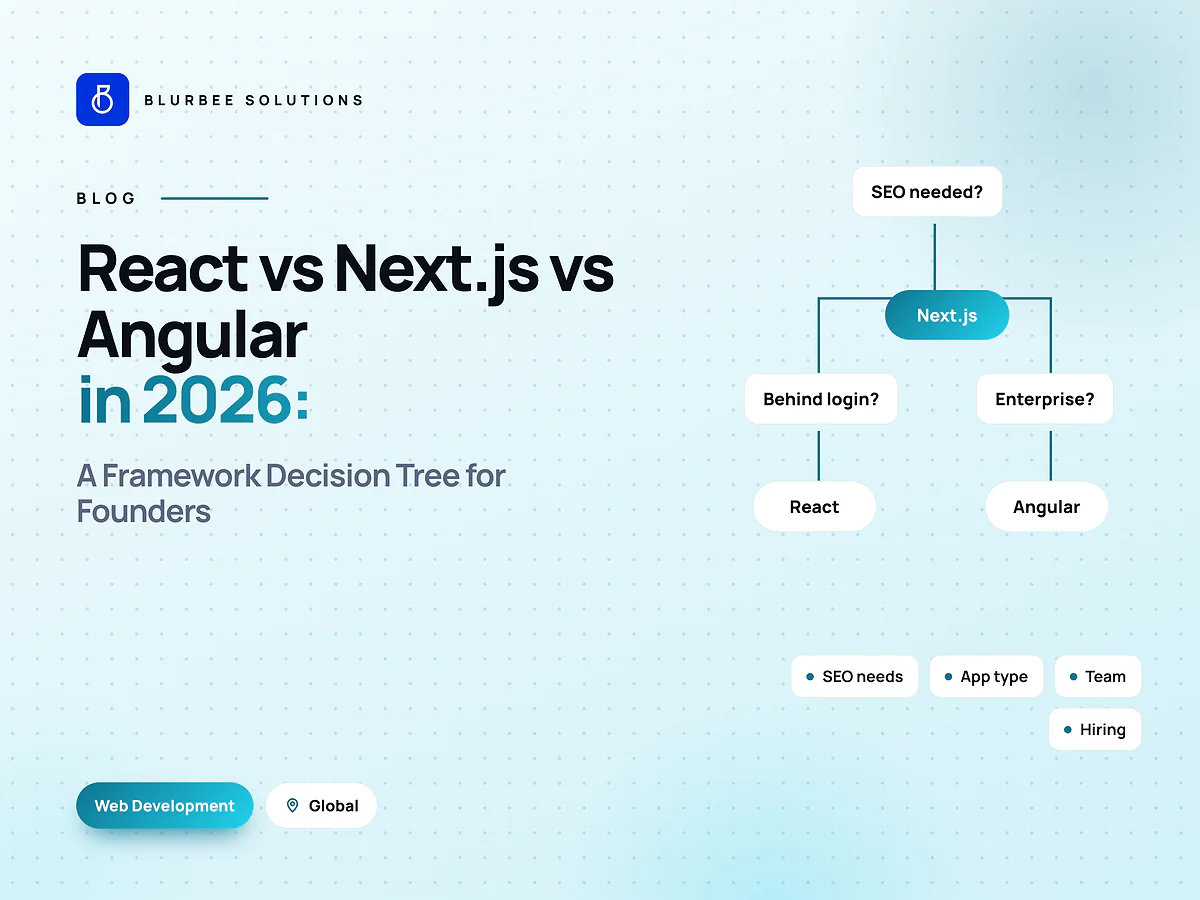
Founders ask us this question more than almost any other: React, Next.js or Angular? The honest answer is that all three are good, and the right one depends on five things about your product and team. This guide turns those five things into a decision tree.
For deeper dives, see why we default to Next.js and when Angular still wins.
First, what each one is
React is a library for building interfaces from components. On its own, it handles the view layer; routing, data fetching and rendering strategy are up to you. Most React-only apps today use Vite as the build tool.
Next.js is a framework built on React. It adds server rendering, routing, data fetching conventions, image and font optimisation, and a build pipeline. You still write React components.
Angular is a complete, opinionated framework written in TypeScript. It includes routing, forms, an HTTP client, dependency injection and testing tools, with one consistent way of doing each.
So React versus Next.js is really "React alone or React with a framework". Angular is a different family.
The decision tree
Answer these in order.
1. Does the product need search engines or AI assistants to read it?
Marketing pages, content, product listings, public profiles, documentation: if people should find it through Google or an AI answer, you want server-rendered HTML.
Yes → lean strongly towards Next.js. No, everything is behind a login → go to question 2.
2. Is it a large, form-heavy application that will live for many years?
Think insurance quoting, banking back offices, claims processing, internal enterprise tools with hundreds of screens and complex validation.
Yes → consider Angular, especially if question 3 points the same way. No → React with Vite is usually simplest for a logged-in product.
3. Who will maintain it?
Many engineers, rotating over the years, who need one consistent way of doing things → Angular's opinions help. A small team that wants flexibility → React or Next.js. Your existing team already knows one well → that counts for a lot.
4. How important is hiring volume?
React has the largest talent pool, and Next.js draws from it. Angular's pool is smaller but experienced. If you expect to hire many front-end engineers quickly, React-based stacks are easier.
5. Will it be embedded in other sites?
Widgets, plugins and embedded tools are usually best as small React builds, not full Next.js or Angular applications.
Common founder scenarios
Marketing site plus a logged-in product. Next.js for both, or Next.js for the public site and React for the app if they are separate. One stack keeps things simple for a small team.
B2B SaaS dashboard, no public content. React with Vite. Server rendering adds little behind a login.
Content or SEO-led product, such as a marketplace, directory or publisher. Next.js, with careful attention to caching and Core Web Vitals.
Enterprise application for a bank or insurer. Angular, or React with strict conventions if the client's team prefers it.
Internal tool built quickly. React with a component library, or whatever your team already knows.
What matters more than the framework
In the projects we inherit, the problems are rarely the framework itself. They are:
- Heavy JavaScript bundles and unoptimised images.
- Too many third-party scripts.
- No design system, so every screen is built differently.
- No tests and no performance budget.
- Unclear data fetching and caching.
Next.js makes good defaults easier, and Angular enforces consistency, but any framework can be made slow and messy. Google treats a Largest Contentful Paint within 2.5 seconds as good; we enforce budgets like that in CI regardless of framework.
Switching later
Moving from React to Next.js is the easiest migration, because components carry over. Moving between React and Angular means rewriting the front end. Upgrading Angular regularly, since it releases a major version roughly every six months, is far cheaper than jumping several versions at once.
Questions to ask any agency recommending a framework
Before accepting a recommendation, ask:
- Why this framework for our product, specifically? Listen for reasons tied to your SEO needs, app type and team, not general enthusiasm.
- What would make you recommend something else? A good answer shows they considered alternatives.
- Who will maintain it after you, and can they? The framework should suit the team you will actually have.
- How will you keep it fast? Look for performance budgets in CI, not promises.
- What does upgrading look like over two years? Especially relevant for Angular's release cadence and Next.js major versions.
An agency that only ever recommends the framework it happens to use is choosing for itself, not for you.
A note on the back end
The front-end choice is only half the stack. For how we choose the Node.js backend behind it, see Node.js vs NestJS.
Our recommendation, most of the time
- Public-facing product → Next.js.
- Logged-in-only product → React with Vite.
- Large enterprise application with rotating teams → Angular.
Then write the decision down with the reasoning, so the next engineer understands it.
We build with all three for teams across India, the United States, the United Kingdom, the UAE and Canada; see web development services.
Choosing a frontend, in numbers
Blurbee's assessment, scored out of 10 for fit. Opinion based on our engagements; your constraints may change the answer.
Why founders ask Blurbee to choose the stack
We build in React, Next.js and Angular, so we have no reason to push one. We recommend based on your product, your team and your next eighteen months, and we write the reasoning down.
- Fixed-scope first projectTwo to four weeks, priced as a number rather than an estimate, so you have evidence before a longer commitment.
- One delivery lead, namedYou always know who to ask. No account manager relaying questions to a team you never meet.
- Code and IP are yoursAssigned in writing, handed over with repositories, infrastructure definitions and documentation whether or not you continue with us.
- Performance budgets in CICore Web Vitals and bundle size gate the build. Slow does not ship.
- Accessibility to WCAG 2.2 AAReviewed with automated and manual passes, not claimed on a slide.
- Written overlap disciplineStanding calls inside your working window, everything else asynchronous with a decision log.