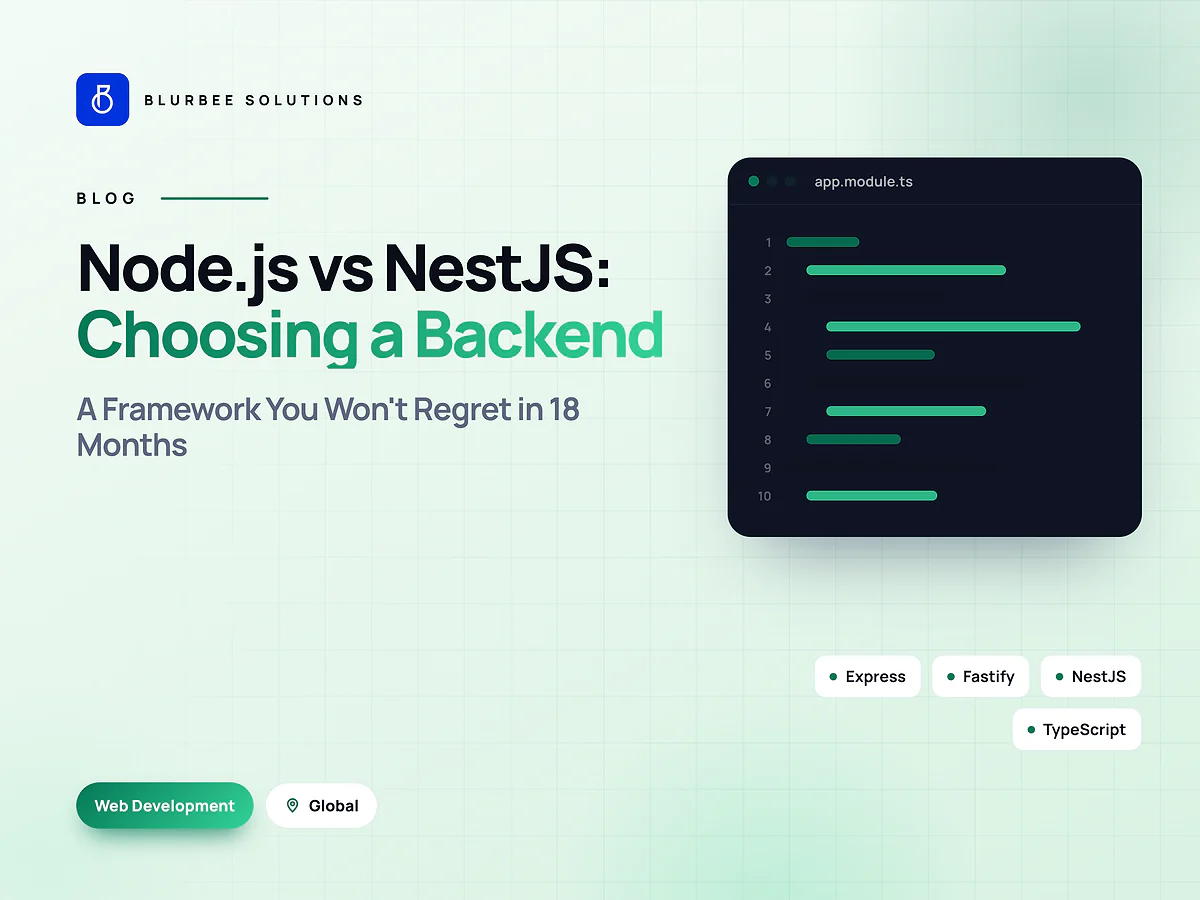
Node.js vs NestJS: Choosing a Backend Framework You Won't Regret in 18 Months
Express, Fastify or NestJS for a Node.js backend: when structure pays off, when it slows you down, and what matters more than the framework.

Framework debates in the Node.js world usually happen in week one and matter in month eighteen. At the start, every option feels productive. Eighteen months later, with five engineers, forty endpoints and a new hire who needs to ship on day three, the choice shows up in how long it takes to find anything and how consistent the code is.
This is how we decide between plain Node.js frameworks such as Express and Fastify, and NestJS.
What you are actually choosing between
Node.js is the runtime. On its own, it gives you an HTTP server and not much else.
Express is the long-standing minimal web framework: routing and middleware, with everything else up to you. It has the largest ecosystem and every Node developer knows it.
Fastify is a minimal framework designed for performance, with built-in schema-based validation and serialisation.
NestJS is a structured framework written in TypeScript. It gives you modules, controllers, providers, dependency injection and decorators, and it runs on top of Express by default or Fastify if you choose.
So the real question is not "Node.js or NestJS". It is "minimal framework plus our own conventions, or an opinionated framework that supplies the conventions".
When NestJS pays off
NestJS earns its learning curve when:
- Several engineers will work on the backend, and consistency matters more than individual preference.
- The product will live for years, with engineers joining and leaving.
- The domain is broad, with many modules such as billing, users, notifications and integrations that benefit from clear boundaries.
- The team already knows Angular or Spring, where the patterns are familiar.
The key benefit is predictability. Every module is laid out the same way. A new engineer who has seen one module has effectively seen them all, which is exactly what you want at month eighteen.
When a minimal framework is better
Express or Fastify is the better choice when:
- The service is small and focused, such as a webhook handler, a proxy or a single-purpose API.
- You are prototyping and speed of first delivery matters most.
- The team prefers minimal tools and is disciplined about conventions.
- Performance is critical, in which case Fastify's design and schema handling help.
The risk with minimal frameworks is not the framework. It is the absence of agreed structure. Two years of different engineers each organising things their own way produces a codebase nobody fully understands.
Performance, honestly
For typical business APIs, database queries and network calls dominate response time, and framework overhead is a small fraction. NestJS on Express is fast enough for the vast majority of products. If throughput genuinely matters, NestJS can run on Fastify, or you can use Fastify directly.
Measure your own workload before choosing a framework for benchmark numbers.
What matters more than the framework
In the backends we inherit, the problems are rarely the framework. They are:
- No validation at the boundaries, so bad data travels deep before failing.
- Database access scattered everywhere instead of a clear data layer.
- No tests, or tests nobody runs.
- Unstructured logs and no tracing, so production issues are guesswork.
- Configuration and secrets handled inconsistently.
- Errors swallowed or returned in a different shape by every endpoint.
A disciplined Express codebase beats an undisciplined NestJS one. NestJS simply makes the discipline easier to maintain.
Our defaults
For a product backend with more than two or three engineers, we usually recommend:
- NestJS with strict TypeScript.
- A modular monolith, one module per domain area, splitting into services only when there is a clear reason.
- Validated DTOs for every input and output.
- A data access layer with a well-supported ORM or query builder, and migrations in version control.
- Structured logging and tracing from the first endpoint.
- Automated tests in CI and dependency updates on a schedule.
- An architecture decision record for every significant choice, including the framework.
For small, focused services, we use Fastify or Express with the same rules on validation, logging, tests and configuration.
Node.js versions and upgrades
Use an Active LTS release. Even-numbered Node.js versions become LTS and are supported for roughly 30 months in total. Plan an upgrade every year or two, while it is routine, rather than waiting until end of life forces a rushed one.
Common mistakes we see at month eighteen
Business logic in controllers. Route handlers that query the database, call three APIs and apply pricing rules directly. Move logic into services that can be tested without HTTP.
No boundary validation. Requests reach the database with fields nobody checked. Validate every input with a schema, and reject early with clear errors.
One giant module. Even in NestJS, teams sometimes put everything in the app module. Split by domain: users, billing, orders, notifications.
Circular dependencies. A sign that module boundaries are wrong. Fix the design rather than working around it.
Unpinned dependencies and no update routine. Packages drift, then a security fix requires a painful jump across several major versions. Update on a schedule.
Logs you cannot search. Plain text logs with no request IDs make production issues slow to diagnose. Use structured logs with correlation IDs, and add tracing across services.
A quick decision checklist
- More than three engineers on the backend within a year? → Lean NestJS.
- Single-purpose service with a small surface? → Fastify or Express.
- Team already fluent in Angular or Spring? → NestJS will feel natural.
- Throughput-critical API? → Fastify, directly or as the NestJS adapter.
- Unsure? → NestJS for the core product, minimal frameworks for small satellite services.
The 18-month test
When choosing, picture the backend eighteen months from now, with the team you will actually have. If a new engineer will need to find their way around quickly, and several people will change the same code, choose structure. If it will stay small and owned by one or two people, choose simplicity.
Either way, write the decision down. The next engineer will want to know why.
We build Node.js backends for teams across India, the United States, the United Kingdom, the UAE and Canada. For a market-specific view, see web development services by location.
Node.js backends, in numbers
Blurbee's assessment of fit, scored out of 10 for a product backend with several engineers. Opinion based on our engagements.
Why teams build Node.js backends with Blurbee
We choose the framework for the team that will maintain it, not for our own preference, and we write the decision down so the next engineer knows why. Structure, tests and observability come with every service we ship.
- Fixed-scope first projectTwo to four weeks, priced as a number rather than an estimate, so you have evidence before a longer commitment.
- One delivery lead, namedYou always know who to ask. No account manager relaying questions to a team you never meet.
- Code and IP are yoursAssigned in writing, handed over with repositories, infrastructure definitions and documentation whether or not you continue with us.
- Performance budgets in CICore Web Vitals and bundle size gate the build. Slow does not ship.
- Accessibility to WCAG 2.2 AAReviewed with automated and manual passes, not claimed on a slide.
- Written overlap disciplineStanding calls inside your working window, everything else asynchronous with a decision log.