Refactoring and Modernization in Abu Dhabi: Modernizing a Legacy Codebase Without Breaking Production
Modernising legacy systems for Abu Dhabi govtech and energy teams: incremental refactoring, in-country hosting, ADGM rules, UAE PASS and AED budgets.

Abu Dhabi runs on systems that cannot simply be switched off. Government services on Al Maryah Island and energy operations around Masdar City depend on applications built years ago: licensing portals, asset registers, case management, billing. They work, mostly. Changes are slow, the original developers have moved on, Arabic support is patchy, and the platform may be approaching end of support.
Replacing them in one go is tempting and usually a mistake. This is how we modernise legacy systems in Abu Dhabi while they keep running. For the general method, see refactoring a legacy codebase without breaking production.
Why big-bang rewrites fail here
A rewrite spends months rebuilding what already works while the business waits. It misses undocumented rules the old system handled for years: exemptions, edge cases, workarounds that became policy. And it launches all at once, the riskiest way to release anything, often in front of the public or regulators.
Incremental modernisation delivers improvements every few weeks and keeps every step reversible.
Step 1: map the risk
Before changing anything:
- Which parts change most often and which break most often, from version history and incident records.
- Undocumented rules, found by tracing real requests and talking to the people who use the system daily.
- Hosting and data constraints that apply to your entity.
- Integrations: other government systems, SAP or Oracle, payment gateways, identity providers.
Start where change and failure are both high; that is where modernisation pays back fastest.
Step 2: lock in current behaviour
Characterisation tests record what the system does today for representative inputs, not what the documentation says it should do. They protect behaviour, including the odd behaviour users rely on, through every later change.
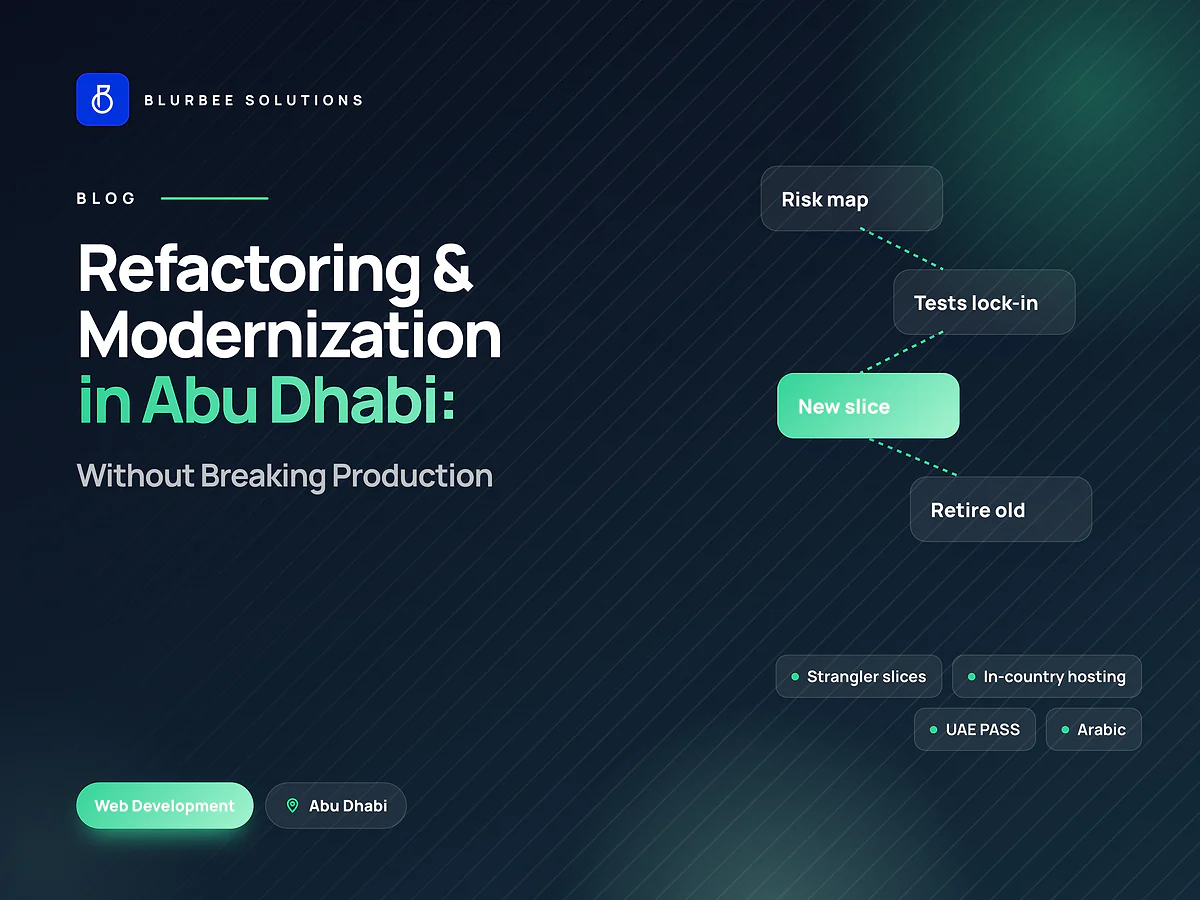
Step 3: modernise in slices
A routing layer in front of the old system lets one route, module or screen move to new code at a time. New features are built in the modern code, which advances the migration instead of competing with it. Feature flags let each slice reach a small group first.
Data changes use expand-and-contract migrations, so old and new code can run side by side with no single moment where everything must change.
Abu Dhabi constraints, designed in
Data regimes. ADGM-registered entities follow the ADGM Data Protection Regulations 2021. Onshore private entities follow the federal PDPL. Government entities follow Abu Dhabi government data and cloud policies. Which applies determines what can move where.
In-country hosting. Government and many government-linked entities require UAE-resident hosting. AWS, Azure and Oracle operate UAE regions, and sovereign local options exist, so modernisation can change platforms without data leaving the country. Every component counts: backups, logs, email, analytics and any AI services.
Vendor access. Some entities require access only from within the UAE or by registered vendors; others allow remote work through secure, audited environments. We confirm this before scoping.
UAE PASS. Replacing local passwords with the national digital identity is often a strong early slice: visible to users, contained in scope, and a clear security improvement.
Arabic. Legacy systems often mishandle Arabic: encoding errors, broken right-to-left layouts, search that ignores spelling variation. Modernised screens use direction-aware layouts and proper bilingual data fields.
Rates in Abu Dhabi
Abu Dhabi agencies typically charge AED 190-420 per hour. Our blended team is AED 81-165. Each slice typically takes two to six weeks. IST is only 1.5 hours ahead of Gulf Standard Time, so we share a full working day with your team.
A typical slice sequence
For a government-linked licensing portal, a sensible order might be:
- UAE PASS sign-in, replacing local passwords: visible, contained, a security gain.
- The application form most often changed by policy updates, rebuilt bilingual with validation.
- Document upload and storage, moved to compliant in-country storage.
- Payments, migrated to the current gateway with reconciliation.
- The back-office review screens, last, once the public side is stable.
Each slice ships behind a flag, runs alongside the old version, and is reversible until the old path is retired.
Start with the risk map
The first fixed-scope project maps risk, writes characterisation tests for the first slice and ships it behind a flag. You end with a safer system and a costed modernisation plan. For related Abu Dhabi work, see custom CRM vs off-the-shelf and vendor registration and delivery.
Modernisation in Abu Dhabi, in numbers
Blurbee's assessment for a typical government-linked or energy-sector system, scored out of 10 where 10 is best. Opinion based on our engagements.
Why Abu Dhabi teams modernise with Blurbee
We modernise in small, reversible slices while the system keeps running, inside the hosting and data rules your entity is bound by. Arabic, UAE PASS and in-country hosting are part of the plan from day one.
- Fixed-scope first projectTwo to four weeks, priced as a number rather than an estimate, so you have evidence before a longer commitment.
- One delivery lead, namedYou always know who to ask. No account manager relaying questions to a team you never meet.
- Code and IP are yoursAssigned in writing, handed over with repositories, infrastructure definitions and documentation whether or not you continue with us.
- Performance budgets in CICore Web Vitals and bundle size gate the build. Slow does not ship.
- Accessibility to WCAG 2.2 AAReviewed with automated and manual passes, not claimed on a slide.
- Written overlap disciplineStanding calls inside your working window, everything else asynchronous with a decision log.