Node.js and NestJS Backend Development in Glasgow: Backend Architecture That Survives Your First 10x Growth Spurt
Node.js and NestJS architecture that survives 10x growth for Glasgow teams: modular monolith, database, queues, caching and Cyber Essentials Plus.

Glasgow's tech scene is unusually mixed. Energy companies, public bodies and a growing fintech community share the city centre and Finnieston, and many of their products started small: a portal, an internal tool, a customer app. Then usage grows tenfold, and the backend that worked perfectly at launch starts timing out at nine in the morning.
This is how we design Node.js and NestJS backends to survive that first 10x growth spurt, without over-engineering for a scale you may never reach. For the framework choice itself, see Node.js vs NestJS.
What actually breaks at 10x
In load tests of early-stage Node.js backends, the first bottleneck is rarely Node.js itself. In order of frequency, it is usually:
- The database. Slow queries, missing indexes, and N+1 patterns where one request triggers hundreds of queries.
- Slow work inside requests. Sending emails, generating PDFs, calling third-party APIs while the user waits.
- Third-party limits. Payment, messaging or mapping APIs that throttle at higher volume.
- Connection pool exhaustion. Too many concurrent requests for the database connections available.
- CPU-bound code blocking the event loop, such as large JSON processing or image work.
Fix these and most backends handle 10x comfortably.
Architecture: a modular monolith first
Microservices are often proposed as the answer to growth. At this stage they usually add network calls, deployment complexity and distributed failures without solving the real bottleneck.
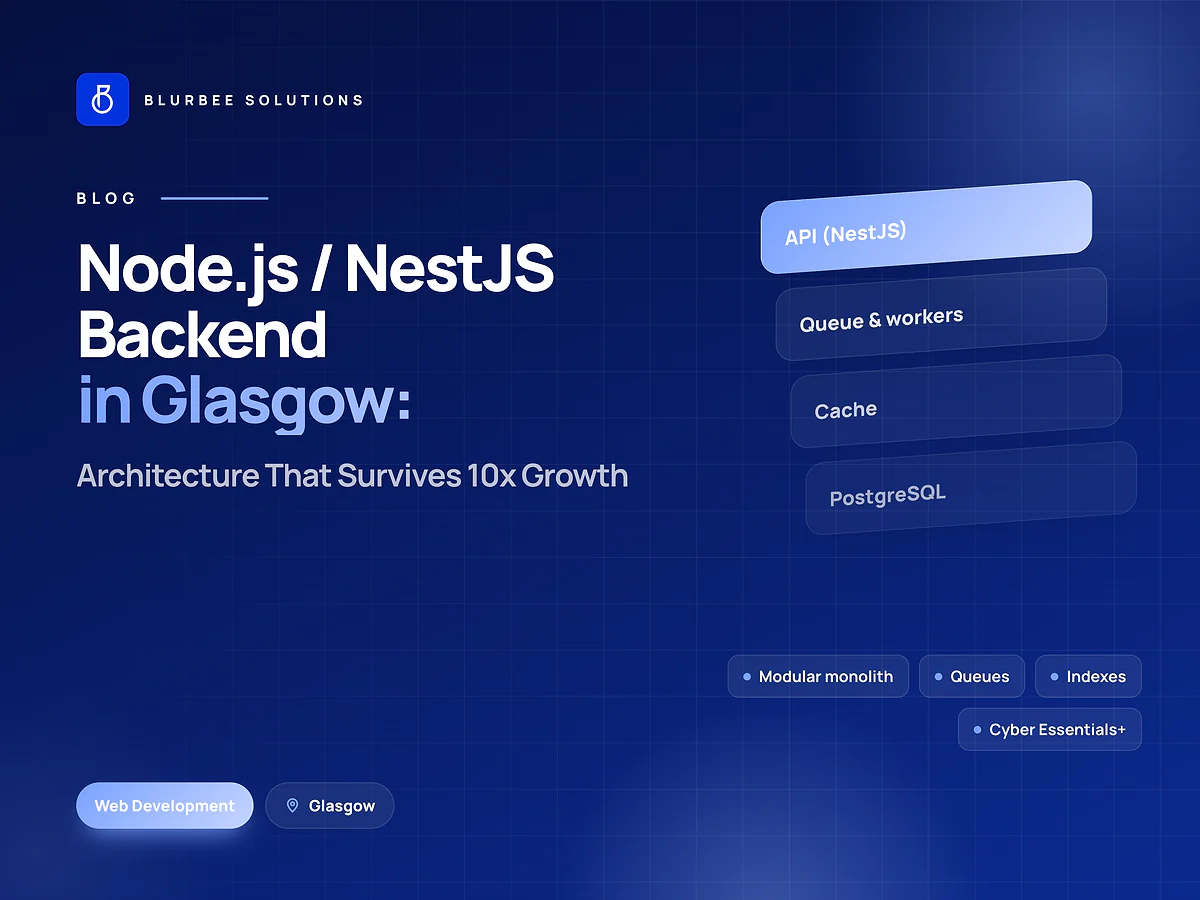
A modular monolith in NestJS gives most of the benefit:
- One module per domain: users, billing, orders, notifications.
- Clear boundaries: modules talk through defined services, not each other's tables.
- One deployment, easy to run and debug.
When a module genuinely needs independent scaling or a separate team, its boundaries make it straightforward to extract.
The database is the backbone
- Index for real queries, checked against the slow query log.
- Eliminate N+1 patterns with joins or batched loading.
- Paginate everything that returns lists.
- Connection pooling sized for your concurrency, with a pooler such as PgBouncer for PostgreSQL where needed.
- Read replicas for heavy reporting, once the primary is tuned.
Move slow work to background jobs
Anything slow or unreliable moves out of the request into a queue processed by workers: emails, notifications, imports, exports, document generation, third-party calls. Responses stay fast, failures retry automatically, and spikes are smoothed.
Cache deliberately
After queries are fixed, cache data that is read often and changes rarely, with explicit invalidation. Caching first hides bad queries and creates stale-data bugs that are harder to find.
Observability before optimisation
You cannot fix what you cannot see:
- Structured logs with request IDs.
- Metrics for latency percentiles and error rates per endpoint.
- Distributed tracing across database calls, queues and external services.
- Load tests that find the limit before customers do.
Security evidence for Glasgow buyers
Public bodies and critical-infrastructure firms in Glasgow commonly require Cyber Essentials Plus and alignment with the NCSC Cyber Assessment Framework. For a backend that means patched dependencies, least-privilege database and cloud access, secrets management, encryption in transit and at rest, and audit logs. We keep Node.js on a supported LTS release, since each even-numbered release is supported for roughly 30 months.
Rates in Glasgow
Glasgow agencies typically charge £50-95 per hour for mid to senior backend work. Our blended web team is £18-36. We share five hours of live overlap with UK working hours.
A worked example: the 9am slowdown
A Glasgow public-sector portal slows to a crawl every weekday at 9am. A load test reproduces it: the dashboard endpoint runs one query per item in a list, and with more users each page triggers hundreds of queries. The database connection pool fills, and everything else waits.
The fix is unglamorous: one joined query with the right index, the dashboard summary cached for sixty seconds, report exports moved to a background job, and the connection pool sized for real concurrency. Response times drop back under target, and the next load test shows where the following bottleneck will be, long before users reach it.
Start with a load test
The first fixed-scope project is a load test of your critical paths, a report on where the backend breaks and why, and fixes for the first bottleneck. Two to four weeks, and a costed plan for the next ones. For backends that have already grown messy, see refactoring legacy code safely.
Backend growth, in numbers
Blurbee's assessment of the first bottleneck found in load tests of early-stage Node.js backends, share of cases. Indicative.
Why Glasgow teams build backends with Blurbee
We design Node.js and NestJS backends for the load you will have, not the load you have today, without building for a scale you may never reach. Security accreditation evidence comes with the code.
- Fixed-scope first projectTwo to four weeks, priced as a number rather than an estimate, so you have evidence before a longer commitment.
- One delivery lead, namedYou always know who to ask. No account manager relaying questions to a team you never meet.
- Code and IP are yoursAssigned in writing, handed over with repositories, infrastructure definitions and documentation whether or not you continue with us.
- Performance budgets in CICore Web Vitals and bundle size gate the build. Slow does not ship.
- Accessibility to WCAG 2.2 AAReviewed with automated and manual passes, not claimed on a slide.
- Written overlap disciplineStanding calls inside your working window, everything else asynchronous with a decision log.