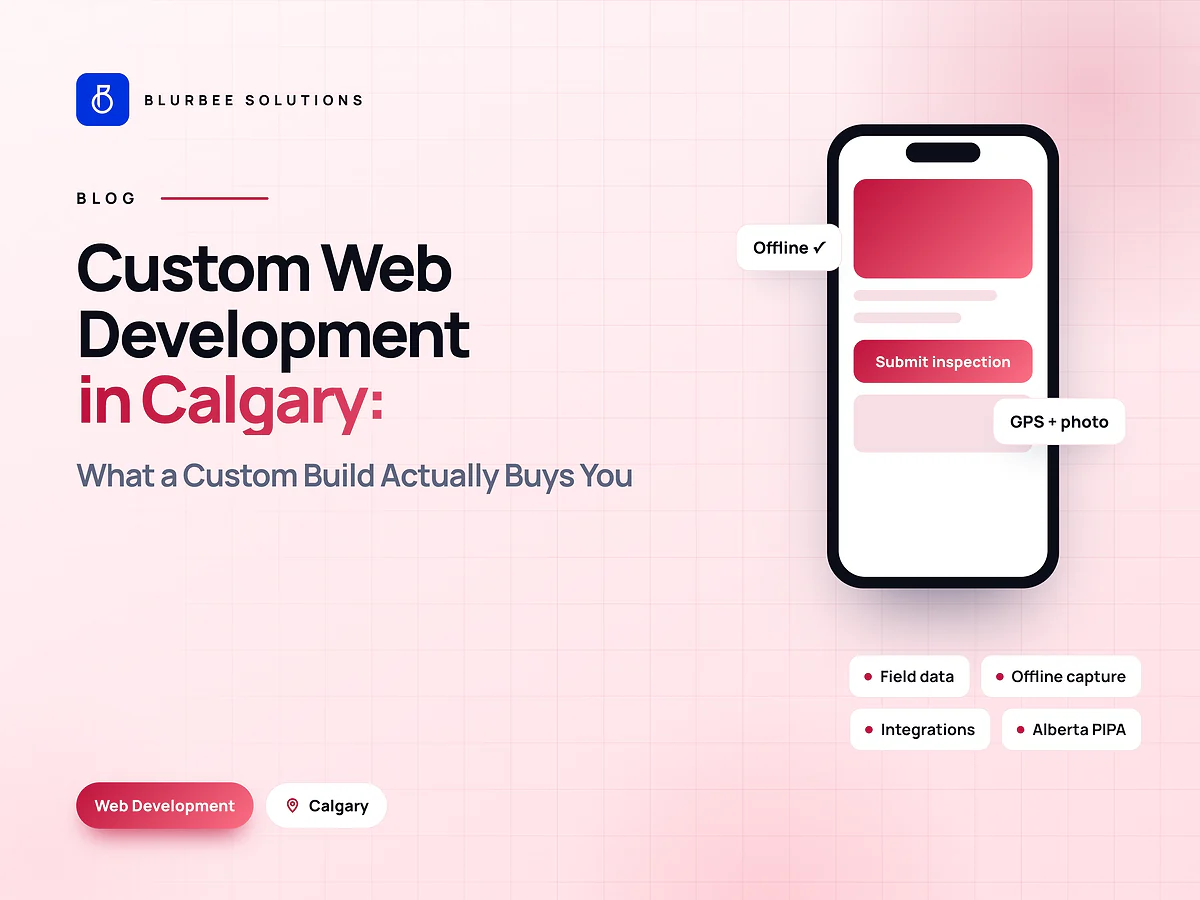
Custom Web Development in Calgary: Beyond Templates, What a Custom Build Actually Buys You
When a custom web app beats templates and SaaS for Calgary energy and agtech teams: field data, offline use, Alberta PIPA, ownership and CAD costs.

Calgary teams are pragmatic about software. Energy companies downtown and agtech startups in the Beltline will happily use a template, a SaaS product or a spreadsheet if it does the job. Custom development only comes up when those options start forcing workarounds, usually around field data: readings from wells and pipelines, inspections, crop and equipment records, captured somewhere without a reliable connection.
This guide covers when a custom build is worth it in Calgary, and what you actually get for the money.
Start by trying not to build
For a marketing site, use a template or a CMS. For standard processes such as accounting, HR or a sales pipeline, use SaaS. Both are cheaper, faster and maintained by someone else.
Custom web development earns its cost when:
- Your workflow is specific to how you operate, and SaaS forces people into workarounds.
- Data comes from the field, often offline, and needs validation at capture.
- Integrations are central: the app must talk to SCADA historians, ERP, land and lease systems or regulatory reporting.
- Per-seat licensing makes no sense for large numbers of occasional users, such as contractors, landowners or seasonal staff.
If none of those apply, don't build.
What a custom build actually buys you
A data model that matches your operation. Wells, sites, fields, equipment and inspections modelled the way you think about them, not forced into "deals" or "tickets".
Integrations without middleware glue. Direct, monitored connections to the systems you already run.
Workflows without workarounds. Approval chains, validation rules and exceptions built in rather than handled by email.
Ownership. Code, cloud accounts and documentation are yours. No licence fees, no vendor deciding your roadmap.
The ability to change. When the business changes, the software changes with it.
What it costs you
Custom is not free after launch. Budget roughly 15-20% of the build cost per year for maintenance, security updates and small improvements. You also give up features SaaS includes by default, such as mobile apps, reporting and integrations with common tools, unless you build them. The decision should compare three years of cost, not just year one.
Field data and offline use
Many Calgary workflows happen where connectivity is poor: well sites, pipelines, ranches, fields. Custom web apps handle this with:
- Offline capture, caching data and queuing changes on the device.
- Validation at capture, so bad readings are caught on site, not in the office.
- Sync with conflict rules, decided deliberately for records edited by two people.
- Photos and GPS attached to records for audit.
Integrations decide the timeline
In energy and agtech, the interface is rarely the hard part. The integrations are: SCADA historians for production data, ERP for costs and work orders, land and lease systems, and regulatory reporting such as Petrinex, the Alberta-Saskatchewan petroleum data registry. We investigate each integration in the first weeks, because it sets the real schedule.
Alberta PIPA and data handling
In Alberta, private-sector personal information falls under PIPA rather than PIPEDA. Apps that hold employee, landowner or customer data need consent for reasonable purposes, safeguards, access controls and breach processes. We design role-based access and retention rules from the start.
Rates in Calgary
Calgary agencies typically charge CA$80-155 per hour for mid to senior web development. Our blended web team is CA$30-62. A focused first release covering one core workflow and its integrations usually takes eight to fourteen weeks. We keep about 1.5 hours of live overlap with Mountain time and run the rest asynchronously with written daily handoffs.
A worked example: field inspections
A Calgary operator runs monthly inspections across a few hundred sites. Today inspectors fill in paper or spreadsheet forms, photos live on phones, and the office re-types everything into the maintenance system weeks later.
A custom web app replaces that with an offline-capable form on a tablet: site details pre-loaded, required fields enforced, readings validated against expected ranges, photos and GPS attached. When the tablet reconnects, records sync to the office, raise work orders automatically for failed checks, and feed the maintenance system through its API.
The value is not the form. It is that bad readings are caught on site, work orders appear the same day, and the office stops re-typing.
Start with one workflow
The first fixed-scope project is one core workflow end to end, such as field inspections or work orders, including the integration it depends on and offline capture if needed. Two to four weeks, and a priced plan for the rest. For the cost comparison method, see custom CRM vs HubSpot vs Zoho; for the wider region, see web and app development in British Columbia and Alberta.
Custom builds in Calgary, in numbers
Blurbee's assessment, scored out of 10 for fit. Opinion based on our engagements; your workflow decides.
Why Calgary teams build custom with Blurbee
We recommend templates and SaaS when they fit. When they don't, we build around your field data and existing systems, and everything we build is yours: code, cloud accounts and documentation.
- Fixed-scope first projectTwo to four weeks, priced as a number rather than an estimate, so you have evidence before a longer commitment.
- One delivery lead, namedYou always know who to ask. No account manager relaying questions to a team you never meet.
- Code and IP are yoursAssigned in writing, handed over with repositories, infrastructure definitions and documentation whether or not you continue with us.
- Performance budgets in CICore Web Vitals and bundle size gate the build. Slow does not ship.
- Accessibility to WCAG 2.2 AAReviewed with automated and manual passes, not claimed on a slide.
- Written overlap disciplineStanding calls inside your working window, everything else asynchronous with a decision log.