Custom CRM vs HubSpot vs Zoho: When Building Your Own Is Actually Cheaper
A three-year cost model for custom CRM vs HubSpot or Zoho: licences by user type, customisation, integrations, admin time and maintenance.

"Should we build our own CRM?" is a question that deserves a spreadsheet, not an opinion. Platform CRMs such as HubSpot and Zoho are excellent for most businesses. Custom CRMs are cheaper in a specific set of situations. The only way to know which you are in is to model three years of cost, honestly.
For regional takes on the same decision, see our Ahmedabad CRM guide and Abu Dhabi custom CRM guide.
Why year one misleads
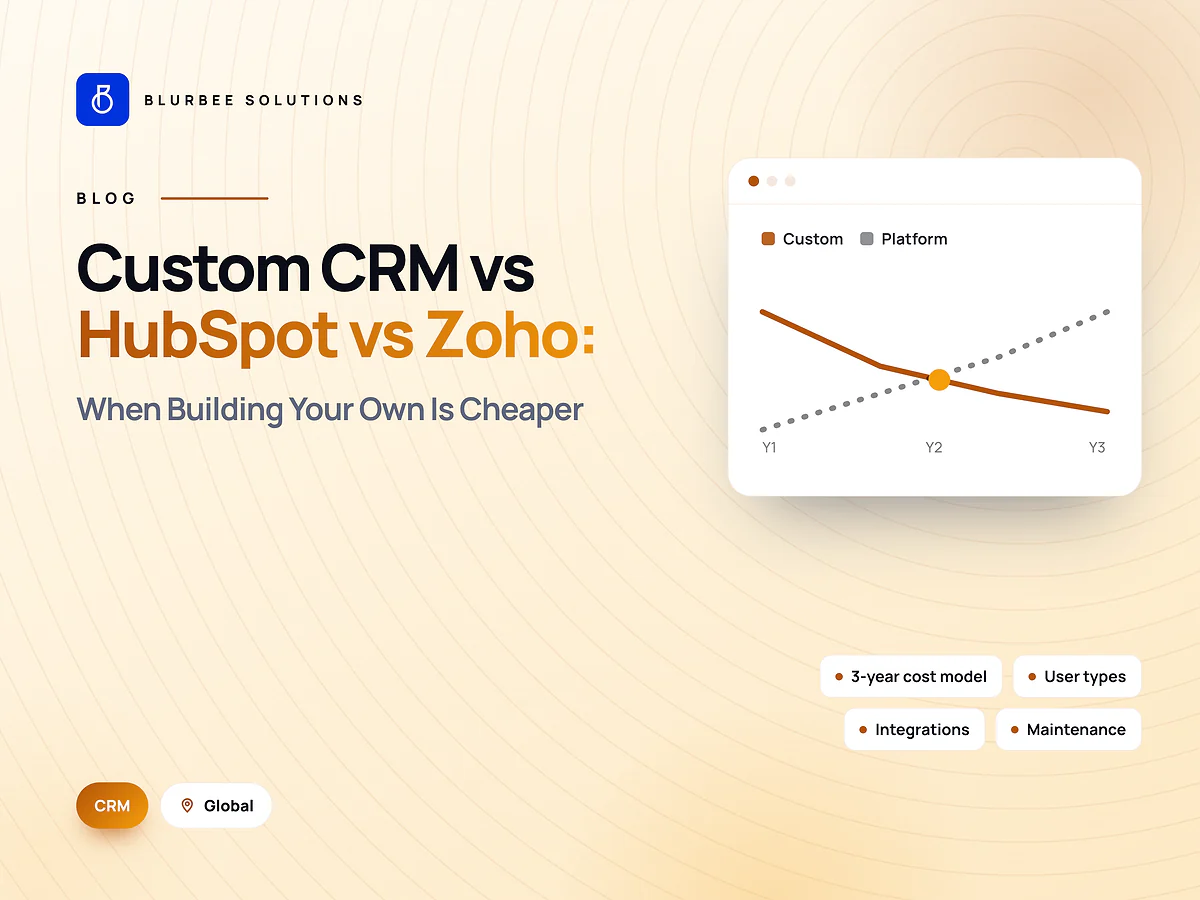
In year one, a platform looks cheap: a few months of licences and some setup. A custom build looks expensive: months of development before anyone uses it. Compare only year one and the platform wins almost every time.
By year three, the picture can flip. Platform licences recur and usually grow with seats and tier upgrades. Custom costs drop to maintenance and improvements. Whether they cross, and when, depends on your users and processes.
The platform cost lines
- Licences for every user type, at the tier that includes the features you need.
- Add-ons for features outside the base tier.
- Implementation, often by a partner.
- Customisation: custom objects, workflows and fields.
- Integrations, sometimes through paid middleware.
- Admin time: someone internal who configures and maintains it.
- Upgrade testing: re-checking customisations after platform updates.
List prices change, so always model with current published prices for the specific editions you would need.
The custom cost lines
- Build: design, development, testing and data migration.
- Hosting and monitoring.
- Maintenance: security and dependency updates, fixes. Typically 15-20% of the build cost a year.
- Improvements: the features you add as needs grow.
- Features you give up: mobile apps, email tracking, marketing automation and reporting that platforms include and you must build or live without.
Where custom actually wins
Many light users. Per-seat pricing suits a sales team of twenty. It becomes expensive for hundreds of field staff, partners, contractors or customers who each need a small slice of access. A custom system has no per-user licence, so this is often where the lines cross first.
An unusual core process. When your central workflow does not look like a sales pipeline, such as permitting, asset-linked accounts, multi-party approvals or complex service scheduling, platforms can model it only with heavy customisation. That customisation is expensive to build and to maintain through upgrades.
Hosting and data constraints. Some government, healthcare and regulated organisations need data in a specific country or environment. If a platform cannot meet that for the modules you need, custom may be the only option.
Deep integration. When the CRM must live inside another product, such as a customer portal or an operations app, a separate platform with its own interface can be a poor fit.
Where custom clearly loses
- A standard sales pipeline.
- A small team.
- Heavy need for marketing automation and email tooling.
- No budget for ongoing maintenance.
In these cases, configure a platform and spend the money on data quality and adoption, which decide whether any CRM succeeds.
Zoho or HubSpot
If the answer is a platform, the usual shortlist is Zoho and HubSpot. Zoho is generally cheaper per seat and very broad, popular with cost-conscious SMEs. HubSpot generally offers a more polished experience and stronger marketing tools, at a higher price as you scale. Both are sound. Model them with your user counts and the tiers you actually need.
A sensible path
Many businesses start on a platform, learn what they need, and move to custom later only if costs or limitations justify it. That path has a big advantage: by the time you build, your requirements are clear and your data is clean, so the custom system is smaller, cheaper and safer to build.
Keep the custom build narrow
If custom wins, the most important cost control is scope. The first release should cover one core process properly, with the integrations it needs and the reports leadership actually uses. Everything else waits until the system is in daily use.
How to build the model yourself
A simple spreadsheet is enough:
- List user types, such as full sales users, service agents, managers, field staff, partners and customers, with counts for today and in three years.
- Price the platform at the tier each user type needs, from current published price lists, plus add-ons, for each of the three years.
- Add implementation, customisation and integration as one-off costs, and admin time as a recurring cost.
- Estimate the custom build for a narrow first release, plus 15-20% a year for maintenance, hosting and a budget for improvements.
- Add the features you would give up with custom, and either cost building them or accept living without them.
- Compare totals by year and find where, if anywhere, the lines cross.
If custom only wins in year three under optimistic assumptions, buy. If it wins clearly by year two under realistic ones, it is worth a serious look.
The factor that decides success either way
Neither a platform nor a custom build succeeds without clean data and real adoption. Budget time for data migration and cleanup, and design the first release around what users need every day. A CRM nobody updates is expensive whichever way you built it.
Run the numbers first
Our first fixed-scope project for CRM is the decision itself: map your user types, processes and integrations, then build a three-year cost model comparing a configured platform with a custom build. Two to four weeks. If the answer is "buy", we will say so.
We deliver this for teams across India, the United States, the United Kingdom, the UAE and Canada; see our locations.
CRM costs, in numbers
Blurbee cost model, relative scores out of 10 where 10 is most expensive over three years. Illustrative; run the model with current list prices and your user counts.
Why teams run the CRM numbers with Blurbee
We build custom CRMs, and we still tell most clients to buy one. The cost model decides, not our order book. When custom wins, we build it narrow, in your accounts, with no licence to us.
- Fixed-scope first projectTwo to four weeks, priced as a number rather than an estimate, so you have evidence before a longer commitment.
- One delivery lead, namedYou always know who to ask. No account manager relaying questions to a team you never meet.
- Code and IP are yoursAssigned in writing, handed over with repositories, infrastructure definitions and documentation whether or not you continue with us.
- Performance budgets in CICore Web Vitals and bundle size gate the build. Slow does not ship.
- Accessibility to WCAG 2.2 AAReviewed with automated and manual passes, not claimed on a slide.
- Written overlap disciplineStanding calls inside your working window, everything else asynchronous with a decision log.