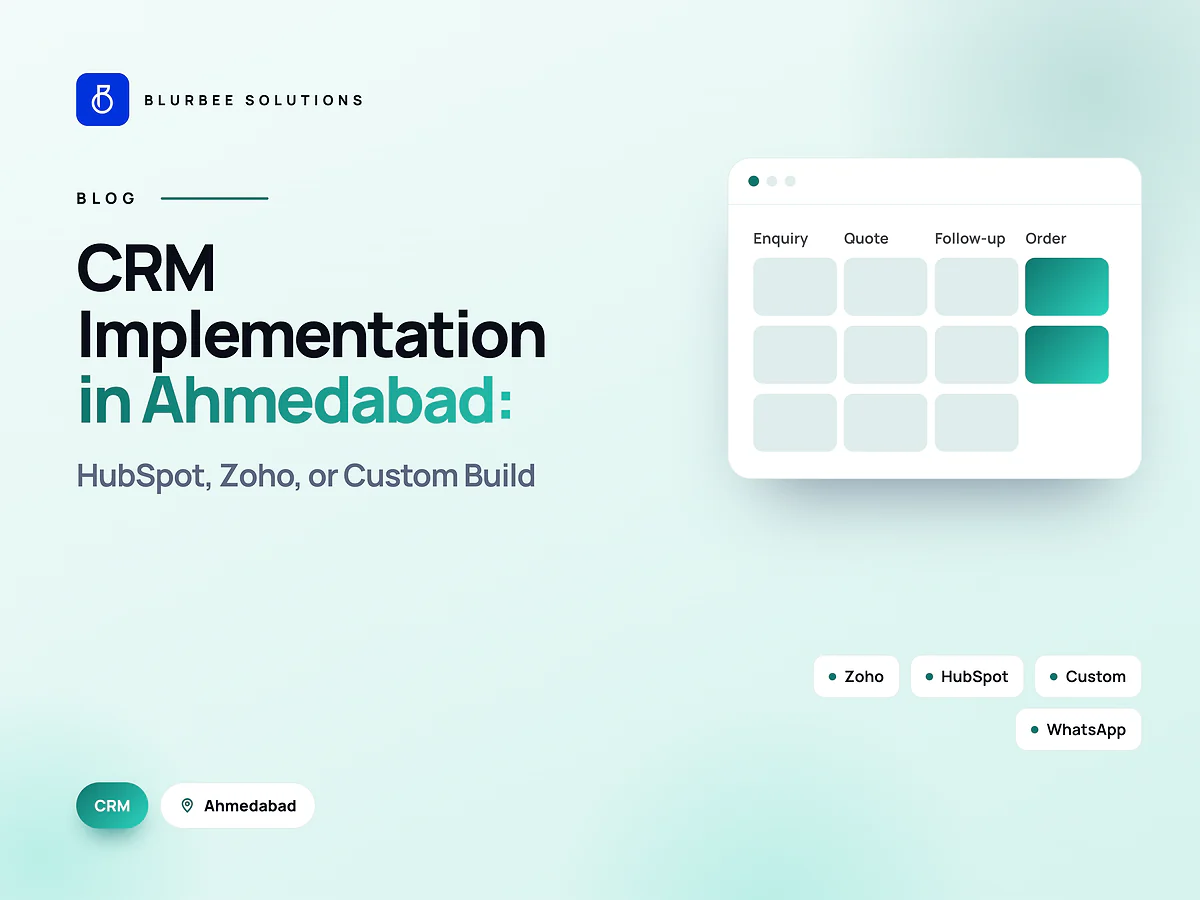
CRM Implementation in Ahmedabad: HubSpot, Zoho, or Custom Build
An honest comparison of CRM options for Ahmedabad businesses: what each platform costs at scale, where each one breaks, and when a custom build is genuinely cheaper.

Most CRM projects in Ahmedabad fail for the same reason: the platform gets configured to match an idealised sales process that nobody follows, and within four months the team is back to WhatsApp and a spreadsheet, with the CRM as a reporting chore performed on Friday afternoons.
The platform choice matters less than that dynamic. But it does matter, so here is the honest comparison.
Zoho: the default for most Gujarat SMEs
Zoho wins here for reasons that have little to do with feature checklists. Pricing suits Indian budgets at a level that makes a 25-seat rollout uncontroversial. GST and Indian tax handling is native rather than bolted on, including e-invoicing through the IRP for businesses above the turnover threshold. And the surrounding ecosystem — Books for accounting, Inventory, Desk for support — means the integrations you would otherwise build already exist.
Where it frustrates: the interface is dense and the surface area is enormous, so a badly configured Zoho is genuinely unpleasant to use. Reporting is capable but takes work to make readable. And the breadth that makes the ecosystem valuable also means it is easy to end up with five Zoho products where two would do.
HubSpot: better product, higher bill
HubSpot is the better-designed product. Adoption is easier because the interface explains itself, reporting is presentable without effort, and marketing automation is genuinely strong rather than adequate.
The problem is cost trajectory. Pricing scales with both seats and contacts, and the tier you actually need — the one with the workflow automation and reporting your team was sold on — is materially more expensive than the entry plan. For a 25-seat Indian sales team, five-year licensing is the largest line in the model.
It also does not handle Indian GST or e-invoicing, so those obligations have to live in an integrated accounting system or a custom bridge.
HubSpot is the right choice when marketing automation drives real revenue, when a polished interface is the difference between adoption and abandonment, and when the licence cost is small relative to deal size.
Custom: right in three specific situations
A custom CRM is the correct answer less often than vendors of custom CRMs suggest, and more often than SaaS vendors admit. Three situations qualify.
Your process has no off-the-shelf model. Multi-party brokerage with commission splits across intermediaries. Trading with unit-of-measure conversions and quality grading per lot. Textile order flows where a single order becomes fifteen production lots with independent status. Ahmedabad and Surat generate this class of requirement regularly, and configuring a platform to fit it produces something fragile.
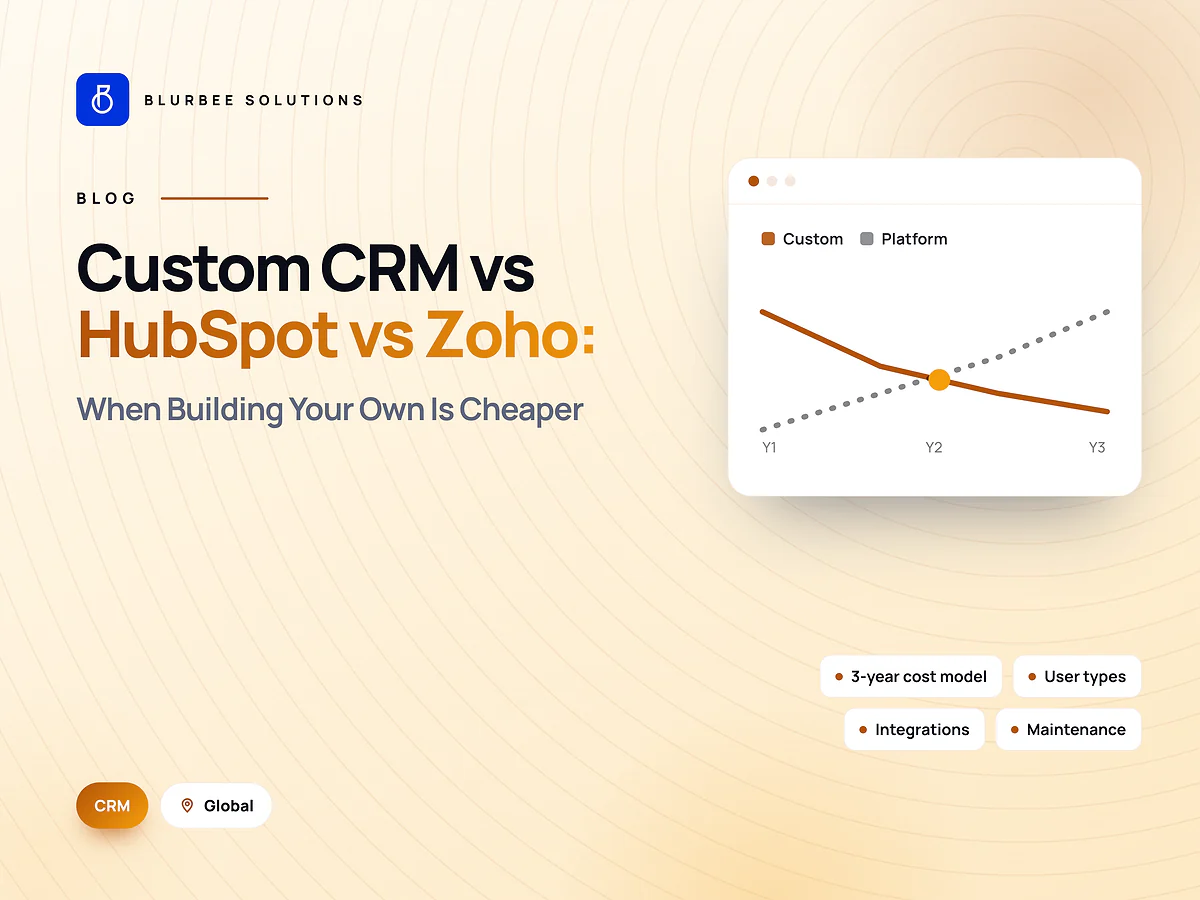
Licensing arithmetic. Above roughly 40-50 seats, five years of mid-tier per-seat licensing exceeds the cost of building and hosting something purpose-built. That calculation should be done honestly, including the maintenance and the fact that your build will not have their reporting.
The CRM is the operational core. If the system needs to run production scheduling, dispatch and receivables as well as sales, you are building an operations platform. Doing that inside someone else's CRM means inheriting their constraints on the parts that matter most.
Against all three: you own it forever. No vendor ships you improvements. Every integration is yours to build and maintain. Budget maintenance at 15-20% of build cost annually, and mean it.
The part that decides the project: data and process
Sixty to seventy percent of a CRM engagement is not configuration. It is data migration and process mapping.
The data is always worse than described. Company names spelled four ways. The same contact in three spreadsheets with different phone numbers. Dates in DD/MM, MM/DD and text. A decade of context in free-text notes that nobody wants to lose and nobody can structure. We run a data audit in week one, before quoting the migration, because the difference between clean and typical is weeks.
Process mapping means watching what actually happens, not documenting what should. In Gujarat that almost always means discovering that the real pipeline lives in WhatsApp — the enquiry, the negotiation, the sample photos, the final price. A CRM that does not account for this is a CRM that competes with WhatsApp and loses.
Make WhatsApp part of the system
This is the highest-value integration for most businesses here, and it is usually done last or not at all.
Using the WhatsApp Business API rather than staff personal phones means conversations attach to the contact record, survive employee turnover, and are visible to whoever picks up the account next. It also means templated follow-ups can be sent without anyone typing them.
The alternative — a sales team whose entire customer history lives on personal devices — is a business continuity risk that most owners have not priced.
Adoption: the only metric that matters in month three
A CRM nobody uses is a subscription, not a system. Three things drive adoption more than training does.
Entering a lead must be faster than the message it replaces. Fewer required fields than you want. Mobile-first, because the sales team is not at a desk. Sensible defaults.
Something must come back the other way. If the CRM only takes information and gives nothing, it is a tax. Reminders that actually fire, a call list that saves thinking, order status the salesperson would otherwise have to ask production for.
One person owns data quality. Named, with authority. Not a committee, not "everyone." This is the difference between a useful system in year two and a database nobody trusts.
What we would recommend, most of the time
Start with Zoho, configured narrowly. Migrate only the data you will actually use, not everything you have. Integrate WhatsApp and Tally in the first phase, not a later one. Require six fields, not sixteen. Give the sales team something useful back in week one. Name the data owner before go-live.
Revisit in a year with real usage data. That is the point at which a custom build, if it is warranted, can be justified with evidence rather than a demo.
What decides a CRM project
Modelled from published list pricing for mid-tier plans plus Blurbee implementation quotes, 2026. Actual licensing varies with negotiation, region and add-ons; treat as indicative shape rather than a quotation.
Why Gujarat businesses bring us CRM work
We are in Surat, four hours from Ahmedabad, and most of our CRM work is for family-owned manufacturing and trading groups. That means we start with how your sales team actually works today, including the WhatsApp threads and the paper, rather than with a platform demo.
- Fixed-scope first projectTwo to four weeks, priced as a number rather than an estimate, so you have evidence before a longer commitment.
- One delivery lead, namedYou always know who to ask. No account manager relaying questions to a team you never meet.
- Code and IP are yoursAssigned in writing, handed over with repositories, infrastructure definitions and documentation whether or not you continue with us.
- Performance budgets in CICore Web Vitals and bundle size gate the build. Slow does not ship.
- Accessibility to WCAG 2.2 AAReviewed with automated and manual passes, not claimed on a slide.
- Written overlap disciplineStanding calls inside your working window, everything else asynchronous with a decision log.