Web and CRM Development for Plains States Businesses: A Practical Guide
How agriculture, logistics and insurance businesses across Iowa, Missouri, Kansas, Nebraska and the Dakotas modernise websites and CRM without disrupting operations.

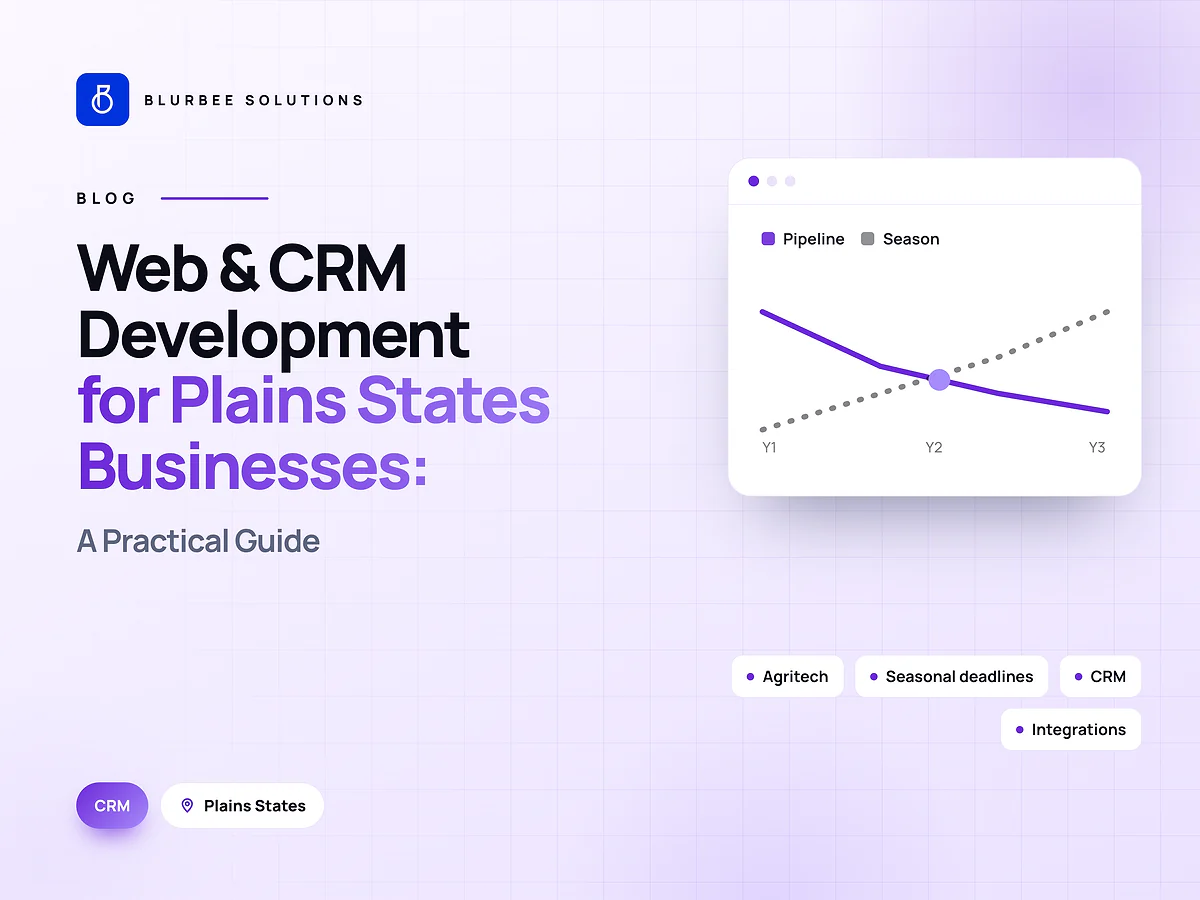
Software projects in the Plains states fail for a reason that has nothing to do with technology: they are scheduled against a sprint calendar rather than a season.
A grain marketing tool delivered in June missed its year. A field data app tested in the office and deployed in April discovers that half the acreage has no signal. A CRM rolled out three weeks before harvest gets abandoned because nobody has time to learn anything in September.
Everything below follows from taking the season seriously.
Plan backwards from the season
For agricultural clients, the deadline is not a date we agree. It is planting, or harvest, or contracting season, and it does not move.
The practical structure: launch before the window, freeze all non-critical change during it, and schedule the larger work for the off-season. That means the useful conversation in November is about what needs to exist by March, and the useful conversation in April is nothing at all.
This is scheduling discipline rather than a technical constraint, and it is the thing most vendors get wrong. A team that proposes a twelve-week engagement starting in May has not understood the business.
Offline-first is the default, not a feature
Any tool used in a field, a yard, an elevator or a truck in this region has to work without connectivity. Not degrade gracefully — work.
That means four decisions taken before the data model exists:
Local storage is the source of truth, with the server as the eventual reconciler. Writes queue and survive an app restart or a dead battery. Sync status is visible, so the user knows what has been sent and what has not — silently showing stale data is worse than showing nothing. And there are explicit rules for what happens when two devices modified the same record, because in practice they will.
Retrofitting offline tolerance onto an online-first app is close to a rewrite. If any of your users are away from reliable coverage, that is a week-one conversation.
CRM: what actually fits
For most agriculture, logistics and services businesses in the region, HubSpot or Zoho configured narrowly beats an industry-specific platform. Industry CRMs are worth evaluating when grower-level or acre-level tracking is genuinely central, but they are frequently thin on the sales pipeline side and expensive to change.
The deciding question is what your records are organised around. If it is companies and contacts, a general CRM fits. If it is fields, acres and contracts, you need something that models that natively or a custom build.
Costs: configuration and rollout of an off-the-shelf CRM is typically $12,000-45,000 over three to nine weeks depending on migration complexity, with licences separate. A custom build starts around $60,000 and is only warranted when the process has no off-the-shelf model.
Data migration is the project
As everywhere, sixty to seventy percent of a CRM engagement is data migration and process mapping, and the data is always worse than described.
In this region specifically: the same farm operation recorded under the operator's name, the entity name, and the spouse's name. Contacts whose only reliable identifier is a landline. Decades of context in free-text notes that nobody will agree to discard. Records organised by field or bin rather than by customer.
We run a data audit in week one, before quoting the migration, because the difference between clean and typical is measured in weeks.
The migration principle worth holding: migrate what you will use, not everything you have. A CRM containing fifteen years of unusable records is a CRM nobody trusts.
Websites: fix, usually, rather than rebuild
A rebuild is warranted when the platform blocks something you need, or the content architecture is fundamentally wrong — categories that do not match how customers think, or a structure that cannot accommodate the products you now sell.
Much more often the actual problems are narrower: three specific pages that do not answer the question a buyer arrives with, page speed on mobile connections, and the fact that nobody internally can update content without calling a developer. Those are cheaper to fix and pay back faster.
Page speed deserves emphasis here. A meaningful share of your traffic is on rural mobile connections, and the Core Web Vitals thresholds — LCP under 2.5 seconds, CLS under 0.1, INP under 200 milliseconds — are measured against real users, not a lab test on fibre. A site that feels fine in the office can be genuinely unusable in a truck.
The regulatory notes that matter
Iowa and Nebraska both have consumer data privacy acts in force, creating access, deletion and opt-out duties. Less onerous than California, but real. Practically that means a privacy notice that describes what you actually do, a deletion process someone can execute, and consent recorded rather than assumed.
South Dakota's card-issuing industry brings full PCI DSS scope to businesses in that sector — worth stating because most vendors assume the state is agriculture only. For everyone else, using a tokenising payment provider so card data never touches your systems is the single most useful scope-reducing decision available.
Missouri splits between St. Louis agtech and Kansas City fintech, which pull compliance in entirely different directions. Establish which you are early.
Adoption, in a business where nobody is at a desk
Three things decide whether the system survives past month three.
Entering a record must be faster than the phone call or text it replaces. That means six required fields, not sixteen, and a phone-first interface designed for someone in a truck cab.
Something must come back the other way. A call list that saves thinking. A reminder that actually fires. Contract or load status the field person would otherwise have to ring the office for. A system that only takes is a tax.
One named person owns data quality, with the authority to enforce it. Not a committee. This is the difference between a useful system in year two and a database nobody believes.
Working with us across the time difference
Central time gives 2.5 hours of live overlap with our Surat day, 09:00-11:30 CT. One standing call inside that window, then asynchronous work with a written handoff at the end of each India day covering what moved, what is blocked, and what needs a decision.
This suits regional businesses better than it sounds. The people who know why a field means what it means are usually not at a desk, and getting time with them is scheduled anyway. A written question they can answer between other tasks often works better than a call neither party had time for.
What shapes a Plains states project
Blurbee delivery data across regional engagements, 2019-2026. Agricultural projects compress into the off-season, which changes this distribution.
Why Plains states businesses work with Blurbee
We build around your season, not our sprint calendar. That means the hard deadline is planting or harvest, the field app works without signal, and nothing consequential ships in the eight weeks when your business cannot absorb disruption.
- Fixed-scope first projectTwo to four weeks, priced as a number rather than an estimate, so you have evidence before a longer commitment.
- One delivery lead, namedYou always know who to ask. No account manager relaying questions to a team you never meet.
- Code and IP are yoursAssigned in writing, handed over with repositories, infrastructure definitions and documentation whether or not you continue with us.
- Performance budgets in CICore Web Vitals and bundle size gate the build. Slow does not ship.
- Accessibility to WCAG 2.2 AAReviewed with automated and manual passes, not claimed on a slide.
- Written overlap disciplineStanding calls inside your working window, everything else asynchronous with a decision log.