React and Next.js App Development in New York City: What We Build and Why We Default to Next.js
Why we default to Next.js for New York fintech and media products, when we don't, what NYC buyers expect before kickoff, and realistic USD rates.

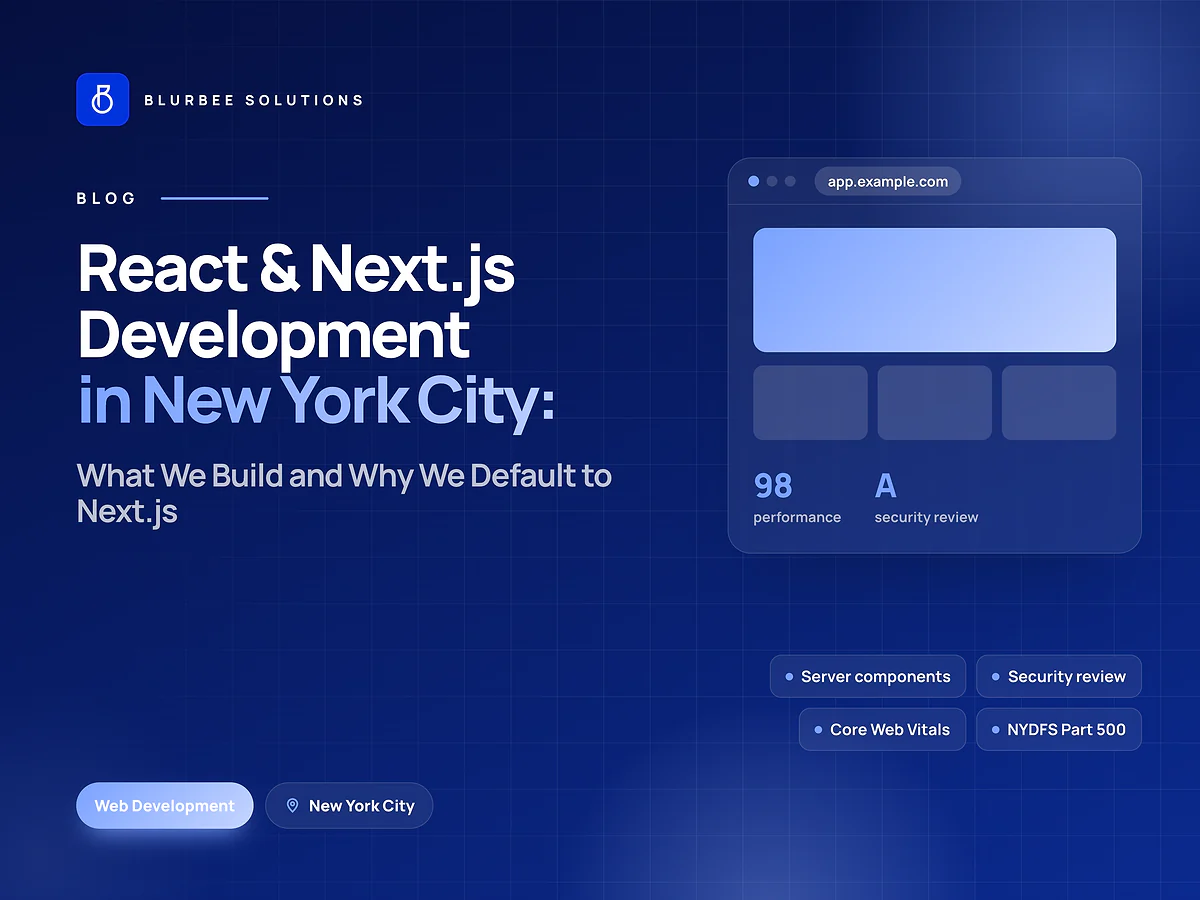
Most New York briefs we see for React work fall into two groups. Fintech teams in Manhattan who need a secure, audited web application, and media and publishing teams who need pages that load fast under a traffic spike and rank in search. Both end up on the same stack for different reasons, and both expect a particular kind of vendor behaviour before any code gets written.
Why we default to Next.js
For most products we build on React, Next.js is the starting point because it has already made good decisions about the problems every product hits:
- Server rendering for fast first loads and pages search engines can read without running JavaScript.
- File-based routing and layouts that keep a large app navigable.
- Image and font optimisation, which quietly fixes a large share of performance issues.
- Server components, which keep data fetching and heavy logic off the user's device.
- A build pipeline that does not need to be assembled by hand.
On plain React you make each of those decisions yourself, and a year later the codebase reflects the preferences of whoever happened to set it up. Next.js gives new engineers a structure they already recognise.
When we don't use it
Defaulting is not the same as always. We choose a plain React single-page app with Vite for:
- Internal dashboards behind a login, where SEO is irrelevant and server rendering adds operational weight for nothing.
- Embeddable widgets that ship inside someone else's page.
- Existing apps already working well on another framework, where migration would cost more than it returns.
The deciding question is whether server rendering and routing conventions help this product. If not, the simpler tool wins.
The parts of Next.js that bite
Next.js is productive, but a few areas cause most of the incidents we are called in to fix:
Caching. Next.js caches at several layers, and the defaults have changed between major versions. Stale prices on a fintech dashboard or stale headlines on a news page usually trace back to an unexamined cache. We document the caching strategy for each route explicitly.
Server and client boundaries. Marking a high-level component as a client component pulls everything below it into the browser bundle. We keep interactivity at the leaves.
Third-party scripts. Analytics, ad tech and consent tools routinely undo the performance work. Each is loaded with a deliberate strategy and counted against the budget.
What New York buyers ask for before kickoff
This is the most distinctive thing about the market. Before a kickoff date is discussed, expect requests for:
- A completed security questionnaire, often a long one.
- Evidence of controls, typically SOC 2 or an equivalent framework.
- A data processing agreement and incident-notification terms.
- Insurance certificates for cyber and professional indemnity.
- Policies on background checks and production access.
We keep this pack ready. Handing it over on the first call shortens procurement by weeks, and it signals that the vendor has been through this before.
Fintech: NYDFS and the audit trail
If you are regulated by the New York Department of Financial Services, 23 NYCRR Part 500 requires you to manage the cybersecurity risk of third-party service providers. For a development partner with access to your systems, that means contract terms on access control, multi-factor authentication, encryption and incident notification.
In the product itself, fintech work needs an audit trail from day one: who changed what, when, and from where. We build that as a feature with its own tests rather than as application logs someone might search later.
Separately, the New York SHIELD Act requires reasonable safeguards for the private information of New York residents, which applies well beyond financial services.
Media: speed under a spike
Media and publishing products are judged on the one day traffic multiplies. Incremental static regeneration, edge caching and a disciplined approach to ad and analytics scripts keep pages fast when it matters.
We enforce performance budgets in CI. Largest Contentful Paint, Interaction to Next Paint, layout shift and JavaScript bundle size are checked on every pull request, and a build that breaches the budget does not merge. Google treats an LCP of 2.5 seconds or less at the 75th percentile as good, and that is the floor, not the target.
Rates
Manhattan agencies typically quote $150-210 per hour for mid to senior React work. Brooklyn studios run $110-160. Senior freelancers are $90-150, though you are buying one person's availability rather than a team.
Our blended team, including QA and a delivery lead, is $22-45. The comparison worth making is total cost of ownership: onboarding time, rework in the first six months, and whether someone who did not build it can maintain it.
Working across the time difference
We keep 3.5 hours of live overlap with Eastern time. Standups, design reviews and decisions happen there. Everything else is asynchronous, with a written handoff at the end of each India day covering what moved, what is blocked, and what needs a decision. Work progresses while New York sleeps rather than waiting for the next call.
Start with one route, fully built
Our recommended first project is a single production route or feature, built to your standards and deployed through your pipeline: two to four weeks, fixed scope, fixed price. You see our code in your repository, our pull requests in your review process and our performance numbers in your CI before committing to anything larger.
Building for New York, in numbers
Composite of published New York agency rate cards and Blurbee quoted rates, 2026. Indicative bands only.
Why New York teams build on React with Blurbee
We arrive at the first call with a security questionnaire already answered, a DPA ready to sign and performance budgets enforced in CI. New York buyers ask for all three before scoping; we would rather hand them over than be chased for them.
- Fixed-scope first projectTwo to four weeks, priced as a number rather than an estimate, so you have evidence before a longer commitment.
- One delivery lead, namedYou always know who to ask. No account manager relaying questions to a team you never meet.
- Code and IP are yoursAssigned in writing, handed over with repositories, infrastructure definitions and documentation whether or not you continue with us.
- Performance budgets in CICore Web Vitals and bundle size gate the build. Slow does not ship.
- Accessibility to WCAG 2.2 AAReviewed with automated and manual passes, not claimed on a slide.
- Written overlap disciplineStanding calls inside your working window, everything else asynchronous with a decision log.