Angular App Development in Toronto: When Angular Still Wins in 2026
When Angular beats React for Toronto banks and health tech, how to upgrade an ageing AngularJS or Angular app, PIPEDA and OSFI B-10, and CAD rates.

Every year someone declares Angular finished, and every year Toronto's banks, insurers and hospitals keep shipping on it. That is not inertia. For a particular kind of application, Angular is still the better tool, and knowing which kind saves a lot of money on rewrites nobody needed.
Where Angular still wins
Angular is opinionated. It ships with dependency injection, routing, forms, an HTTP client, testing tools and a command-line tool that generates code in one consistent style. In a small product, that can feel heavy. In a large one, it is the point.
Angular tends to win when:
- The app is form-heavy. Back-office banking, insurance quoting and claims, and clinical administration are mostly forms with complex validation, and Angular's reactive forms handle that well.
- The app will live for a decade. Consistent structure matters more than elegance when engineers rotate through every few years.
- Many teams work in one codebase. One approved way to do routing, state and HTTP means fewer arguments and easier reviews.
- Procurement prefers a single supported framework with a published release and support policy.
That profile describes a great deal of software in Toronto's Financial District and in the health-tech companies around MaRS.
Where React wins instead
React is the better default for content-led sites, consumer products that need to move fast, and teams that want to choose their own libraries. It also has the larger hiring pool. If your product is a marketing site, a startup MVP or something where search visibility drives the business, we will usually recommend React with Next.js, or plain server rendering.
The wrong move is choosing on fashion. The right one is choosing on the shape of the app and the team that will maintain it.
The AngularJS problem
AngularJS, the 1.x framework, lost long-term support on 31 December 2021. Any AngularJS app still in production is running code that no longer receives security fixes upstream. In a bank or health system, that shows up in audit findings sooner or later.
Three realistic options:
- Incremental migration. Run modern Angular alongside AngularJS and move route by route. Slowest, but lowest risk, and the business keeps shipping.
- Rewrite. Faster to a clean result, but you rebuild everything that works while new features wait.
- Paid extended support from a third party, as a bridge while one of the above happens.
For most apps we recommend incremental migration, starting with the routes that change most often.
Upgrading modern Angular
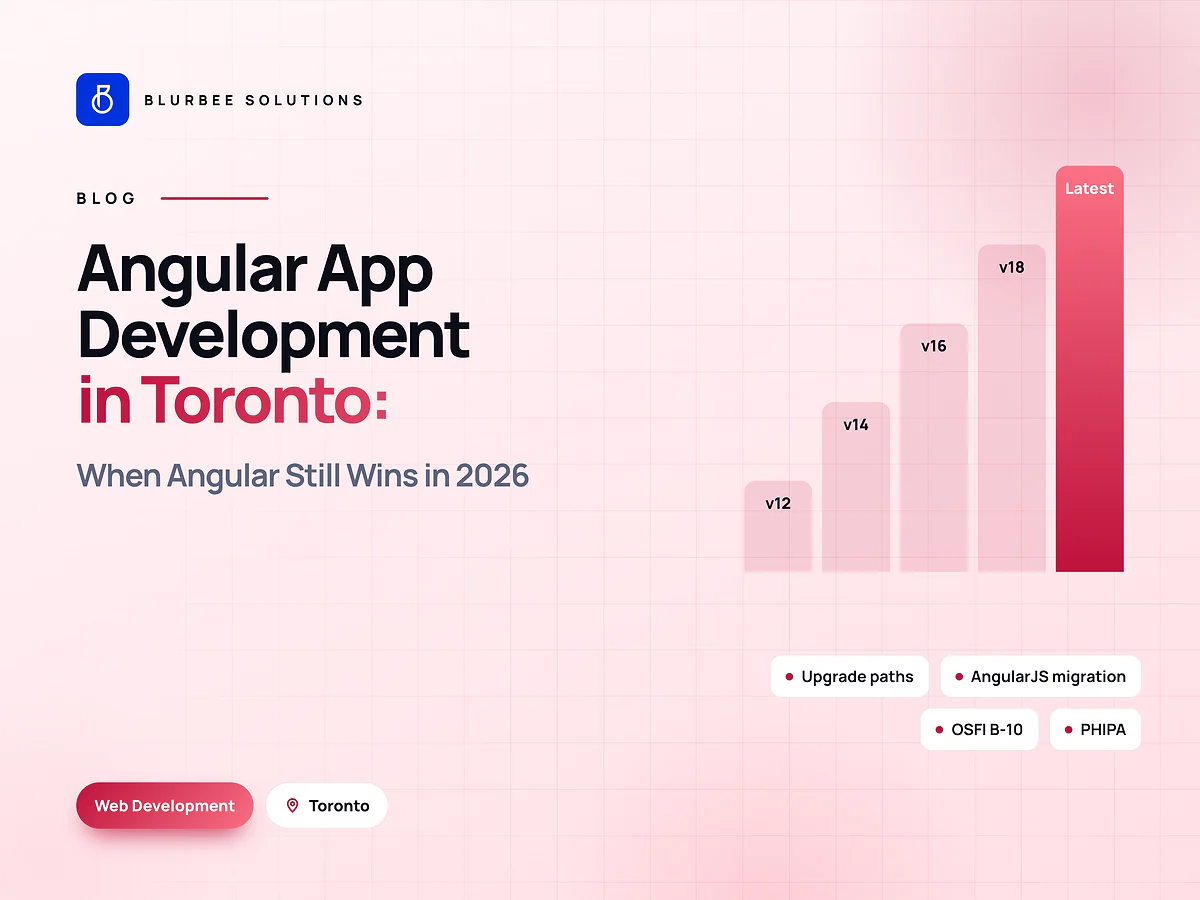
Angular releases a major version roughly every six months, and each is supported for about 18 months: six months of active support, then twelve months of long-term support. Teams that upgrade one major version at a time, soon after release, find it routine; the Angular CLI's update tooling handles much of the mechanical work.
Teams that skip several versions face a project. Deprecated APIs pile up, third-party libraries stop matching, and build tooling has moved on. We see this constantly: a Toronto app four majors behind, with a component library that has been abandoned.
Our approach is to upgrade one major at a time, run the full test suite at each step, replace abandoned dependencies as we go, and adopt newer patterns such as standalone components and signals where they simplify code, not everywhere at once. Then we set a standing upgrade slot twice a year so the debt does not return.
Banking: OSFI B-10
Federally regulated financial institutions follow OSFI Guideline B-10 on third-party risk, effective May 2024. For a development partner, expect due diligence before signing, contract terms covering security, audit rights, data location and subcontracting, ongoing monitoring, and a documented exit plan. We keep this evidence ready so procurement is not the critical path.
Health tech: PHIPA
Personal health information in Ontario falls under PHIPA. Health-tech products need role-based access, audit logs of who viewed what, and breach processes designed in from the start. Angular's structure helps here: guards, interceptors and services give one consistent place to enforce access and logging.
PIPEDA and processing from India
PIPEDA does not prohibit processing personal data outside Canada. You remain accountable, must protect it through contracts and other means, and should tell individuals it may be processed abroad. Some public-sector and health contracts add residency requirements; confirm yours before architecture decisions.
What an upgrade assessment covers
Before quoting an upgrade, we check:
- Current Angular version and the path to the latest, one major at a time.
- Third-party libraries: which are maintained, which are abandoned, and what replaces them.
- Test coverage and whether the tests actually run in CI.
- Build tooling and anything custom that will break.
- Deprecated APIs in use, counted and located.
- Security findings from dependency scanning.
- Risky areas: the modules that change most often and break most often.
The output is a stepwise plan with effort per step, so procurement can approve the first slice without committing to the whole programme.
Rates in Toronto
Toronto consultancies typically charge CA$140-175 per hour for Angular work, agencies CA$90-140 and contractors CA$80-120. Our blended team, including QA and a delivery lead, is CA$30-62. A multi-version upgrade on a mid-sized app often takes six to twelve weeks.
We keep 3.5 hours of live overlap with Eastern time and run the rest asynchronously with written daily handoffs.
Start with an upgrade assessment
The first fixed-scope project is an assessment plus one slice: we review the codebase, map the upgrade path, list the risks and abandoned dependencies, and complete the first version step with tests passing. Two to four weeks, a fixed price in CAD, and a plan your procurement team can approve in stages.
Angular in Toronto, in numbers
Composite of published Toronto consultancy and agency rate cards, contractor rates and Blurbee quoted rates converted at prevailing rates, 2026.
Why Toronto teams keep Angular with Blurbee
We do not push rewrites. Most Angular apps we see in Toronto need upgrading and untangling, not replacing, and we price that work in slices a bank or hospital procurement team can approve.
- Fixed-scope first projectTwo to four weeks, priced as a number rather than an estimate, so you have evidence before a longer commitment.
- One delivery lead, namedYou always know who to ask. No account manager relaying questions to a team you never meet.
- Code and IP are yoursAssigned in writing, handed over with repositories, infrastructure definitions and documentation whether or not you continue with us.
- Performance budgets in CICore Web Vitals and bundle size gate the build. Slow does not ship.
- Accessibility to WCAG 2.2 AAReviewed with automated and manual passes, not claimed on a slide.
- Written overlap disciplineStanding calls inside your working window, everything else asynchronous with a decision log.