Staff Augmentation vs Outsourcing in 2026: How to Choose the Right Engineering Model
A decision guide for US CTOs and founders: what each model really costs, who carries delivery risk, and the signals that tell you which one fits your team today.

When a US engineering team falls behind its roadmap, the question is rarely whether to get outside help. It is how. You can add individual engineers to your own team (staff augmentation), hand a defined project to a partner (project outsourcing), or contract a stable team that a partner manages for you (a dedicated or managed team).
Each model moves cost, control and risk to a different place. Choosing the wrong one is how companies end up paying for engineers they can't manage, or for projects they can't steer. This guide compares the three honestly.
Why the question matters more now
Engineering talent remains expensive and slow to hire in the US. The Bureau of Labor Statistics reports a median annual wage of $133,080 for software developers in May 2024, and projects employment to grow 15% from 2024 to 2034, much faster than the average for all occupations (BLS).
The reasons companies go outside have also shifted. Deloitte's Global Outsourcing Survey 2024 found that access to talent has become the number-one driver of outsourcing decisions (Deloitte). Companies are buying skills and speed, not only lower rates, and that changes which model makes sense.
The three models in one table
| Staff augmentation | Dedicated / managed team | Project outsourcing | |
|---|---|---|---|
| What you buy | Individual engineers' time | A stable team's capacity | A defined outcome |
| Who manages daily work | You | Shared: your priorities, partner's delivery lead | The partner |
| Who carries delivery risk | You | Shared | Mostly the partner |
| Typical pricing | Hourly or monthly per person | Monthly per team | Fixed price per phase, or time and materials |
| Best for | Filling skill gaps in a strong team | Ongoing products and roadmaps | Clear, bounded work |
| Your management effort | High | Medium | Low to medium |
Staff augmentation: more hands, your direction
With staff augmentation, engineers from a partner join your team. They use your tools, attend your standups and follow your processes. You decide what they work on every day.
It works well when:
- You have strong engineering leadership and clear processes already.
- You need a specific skill quickly, such as React, Python, DevOps or AI engineering.
- The work is ongoing and changes frequently.
- You want to keep architecture and product decisions fully in-house.
It struggles when:
- Your team is already overloaded, so nobody has time to onboard and direct new people.
- You expected the partner to own outcomes. In this model, they own hours.
- Requirements aren't written down, so new engineers spend weeks guessing.
You can hire dedicated developers for US teams in 22 roles this way, from React developers to AI and ML engineers.
Project outsourcing: pay for an outcome
With project outsourcing, you define what you need, such as a first release, a migration or a new module, and the partner delivers it. You manage the result, not the people.
It works well when:
- The scope can be written down with acceptance criteria.
- You lack in-house engineering capacity or leadership for this work.
- You want price certainty, usually through fixed-price phases.
It struggles when:
- Requirements change every week. Constant change requests erode both trust and budget.
- The work is core to your product and needs deep, continuous product knowledge.
- Nobody on your side has time to answer questions and review progress.
Our software development outsourcing guide covers how to run this model well.
Dedicated teams: the middle path
A dedicated team is a stable group, often developers, QA and a delivery lead, working only on your product. You set priorities; the partner handles hiring, retention, day-to-day coordination and quality. Over time the team builds deep knowledge of your codebase and business.
It works well when:
- You have a long-running product with a steady backlog.
- You want predictable monthly cost without managing every individual.
- You need a mix of skills that would be hard to hire one by one.
It struggles when:
- The work is a short, one-off project.
- You can't commit to a regular backlog, so the team sits idle.
Our article on dedicated development teams for US companies goes deeper.
What each model really costs
Rates vary far more by market than by model. These are the local agency ranges published across our location pages:
| Market | Typical local agency rate (per hour) |
|---|---|
| United States | $75–$220 |
| United Kingdom | £45–£130 |
| United Arab Emirates | AED 120–420 |
| Canada | CA$60–175 |
| India | ₹800–3,600 |
Blurbee's published rates are $22 to $45 per hour for web development, $24 to $48 for mobile apps and $30 to $60 for AI and ML work, depending on seniority.
The hourly rate is only part of the cost. Add:
- Management time. In staff augmentation, your leads spend real hours onboarding, reviewing and directing. In outsourcing, much of that sits with the partner.
- Ramp-up time. Every new engineer needs time to learn your codebase. Stable teams pay this once; frequent rotation pays it repeatedly.
- Rework. Poorly specified outsourced projects and poorly supervised augmented engineers both create it.
- Turnover. Replacing an engineer mid-project costs weeks. Ask partners how they retain people and handle replacements.
A useful comparison is total cost to deliver a defined result, including your own team's time, not the hourly rate alone.
Risk: who is accountable when things go wrong?
- Augmentation: you are. The partner is responsible for providing qualified people who show up and work; the quality of the result depends on your direction and review.
- Dedicated team: shared. The partner should own delivery practices, quality and staffing; you own priorities and product decisions.
- Project outsourcing: mostly the partner, within the agreed scope. Changes outside it shift risk back to you.
Whatever the model, protect yourself with written IP assignment, repositories and cloud accounts in your name, and clear exit and handover terms. Our contract questions article lists what to check.
Time zones and communication
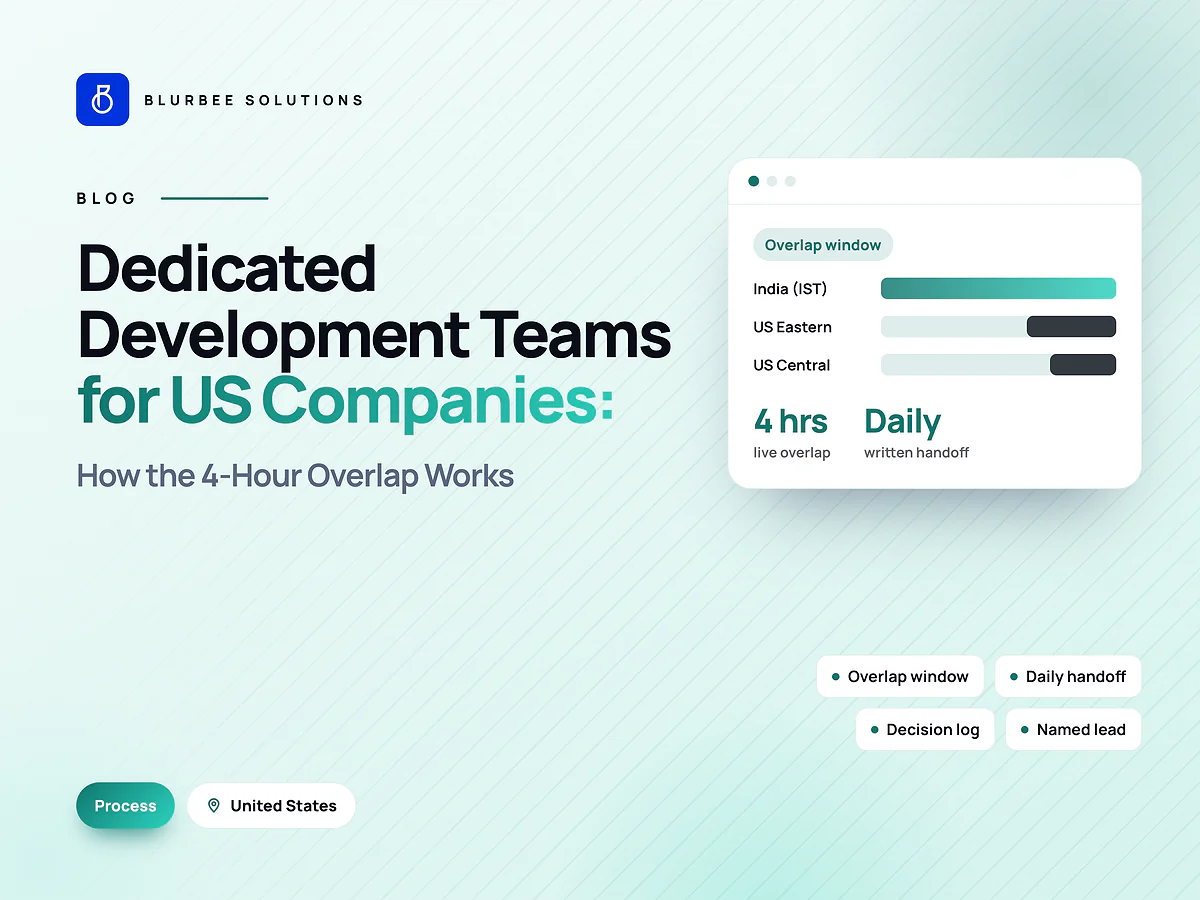
For US companies working with an India-based team, overlap and written discipline matter more than distance. Blurbee's US clients usually get one to three and a half hours of live overlap each working day, more on the East Coast and less on the West Coast.
- Augmented engineers should join your standup during the overlap window and post written updates at the end of their day.
- Dedicated teams usually hold their own standup, then sync with you for priorities and reviews.
- Outsourced projects typically need a weekly demo and a short daily written handoff.
Our article on time-zone overlap explains how to plan the working day.
A simple decision guide
Ask these five questions:
- Do we have engineering leaders with time to direct more people? If yes, augmentation is viable. If no, choose a dedicated team or project outsourcing.
- Can we write down the scope with acceptance criteria? If yes, project outsourcing fits. If the work is open-ended, choose augmentation or a dedicated team.
- Is this work ongoing for more than six months? If yes, a dedicated team usually beats repeated projects.
- Do we need one specific skill, or a whole capability? One skill points to augmentation; a capability (for example, a mobile team or an AI team) points to a dedicated team.
- How much delivery risk do we want to keep? Keep it with augmentation; share it with a dedicated team; transfer most of it with project outsourcing.
Hybrid models
Many companies combine models over time:
- Start with a fixed-scope project to test a partner, then move to a dedicated team for the ongoing roadmap.
- Keep core architecture in-house, augment with specialists for front-end, QA or DevOps.
- Outsource a self-contained product, such as a mobile app or internal tool, while your team stays focused on the core platform.
The key is to choose deliberately, and to review the model every six to twelve months as your team and roadmap change.
Red flags with any partner
- Unnamed people. You should meet and interview the engineers who will work with you.
- Hidden subcontracting. Ask directly who employs the engineers.
- No repository access until delivery.
- Vague replacement terms when someone leaves.
- Rates that seem too good for the stated seniority.
Key takeaways
Staff augmentation buys engineers' time under your direction; project outsourcing buys an outcome; a dedicated team sits between the two. Choose based on your leaders' capacity to manage, how clearly the scope can be written down and how long the work will last. Whatever the model, keep code, accounts and IP in your name, and start with a small paid project.
A note on budgets
Whichever model you choose, budget for the first month as a learning period. New engineers, teams and partners all need time to understand your product. Judge the arrangement on months two and three, not week one.
How Blurbee works
Blurbee is a team of 35+ in Surat, India, working with US companies since 2019. We offer individual developers, dedicated teams and fixed-scope projects, always with a named delivery lead. We sign an NDA first, start with a two to four week fixed-scope project, and assign code and IP to you in writing. See hire developers for US teams, our web development services and our pages for New York City and Texas.