Timezone Math: Making a 4-to-9-Hour Overlap Actually Work
How to make overlap with an India-based team work for clients in the US, UK, Canada and UAE: overlap windows, daily handoffs and a decision log.

The first concern most clients in the US, UK and Canada raise about an India-based team is the time difference. It is a fair concern. Badly managed, a large gap means questions wait a day, decisions stall and small misunderstandings cost a week. Well managed, it means work moves forward while you sleep.
The difference is not the size of the gap. It is the working model around it. This is the model we use.
The actual arithmetic
India Standard Time is UTC+5:30 all year, with no daylight saving. Against our clients' markets:
- UAE: IST is 1.5 hours ahead of Gulf Standard Time. The working days almost fully overlap.
- UK: IST is 5.5 hours ahead of GMT in winter and 4.5 hours ahead of BST in summer.
- US and Canada Eastern: IST is 10.5 hours ahead in winter and 9.5 in summer.
- US Central, Mountain and Pacific: one, two and three hours further again.
- Atlantic and Newfoundland Canada: between Eastern and the UK.
With a standard India office day, overlap with the UK is natural and overlap with North America is thin. That is why the window has to be designed rather than assumed.
Designing the overlap window
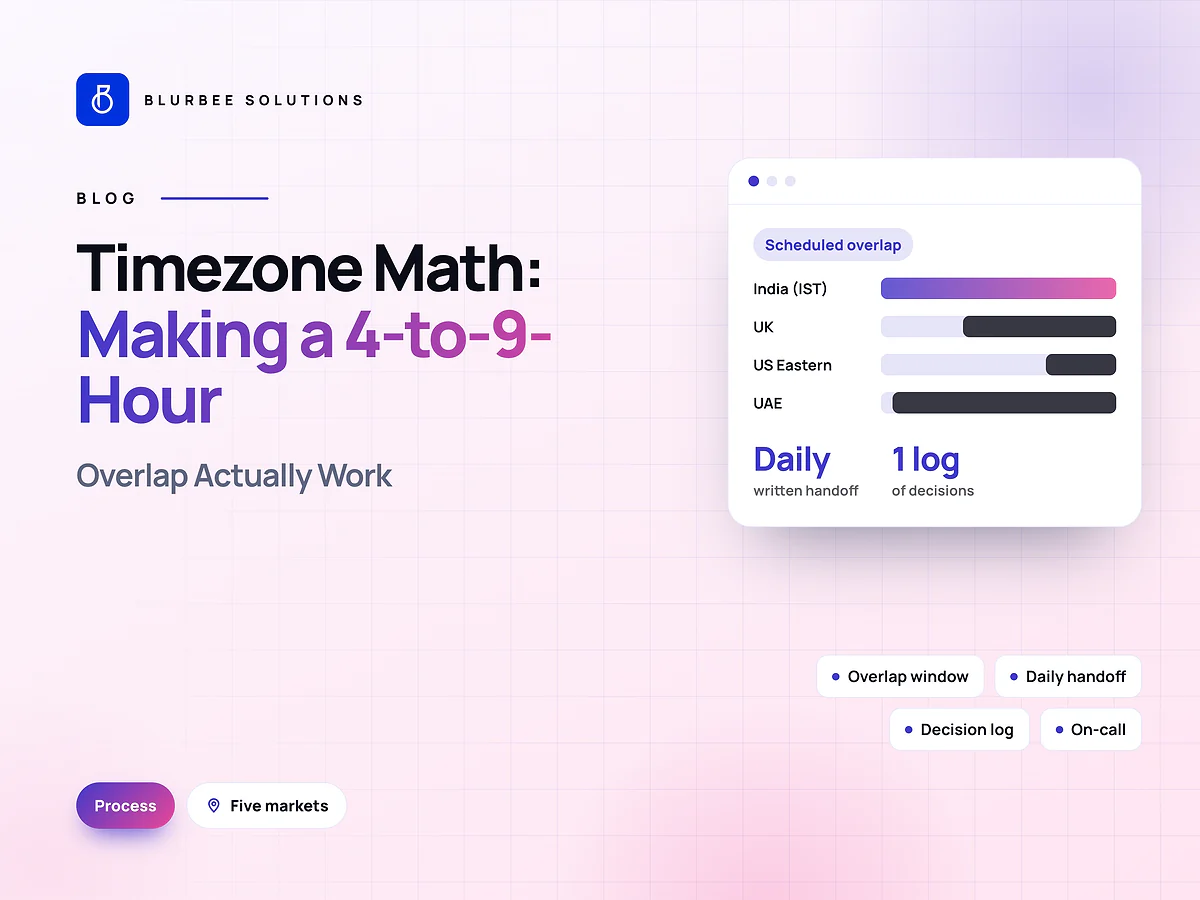
For Western clients, we stagger the India working day so part of it falls in the client's morning, and schedule recurring calls inside that window. The windows we schedule per market are listed on each location page: roughly five hours with the UK, three and a half with US and Canadian Eastern time, two and a half with Central, and one with Pacific plus an early-evening IST slot.
The exact window is agreed per engagement in week one, in writing, along with what happens around daylight saving changes.
What belongs inside the window
Overlap time is scarce, so it is reserved for what genuinely needs real-time conversation:
- A short standup, fifteen minutes, focused on blockers.
- Reviews and demos of work in progress.
- Decisions that are blocking work.
- Pairing on hard problems, when useful.
Status updates, routine questions and long discussions belong in writing.
The end-of-day handoff
This is the most important ritual. At the end of each India day, the delivery lead sends a short written note:
- What moved today, with links.
- What is blocked, and on whom.
- What needs a decision from the client, framed as a clear question with options.
- What happens next.
The client reads it in their morning, answers the decisions, and the team picks up the answers at the start of their next day. Done consistently, the time difference becomes overnight progress rather than overnight delay.
The decision log
A running document of decisions: date, decision, reasoning, owner. It ends the "I thought we agreed on the call" problem, helps new team members onboard, and gives auditors and stakeholders a clear record. Decisions made in the overlap window are written up the same day.
Documentation standards
Asynchronous work depends on good writing:
- Tickets with acceptance criteria, not one-line titles.
- Pull requests that explain why, not just what.
- Architecture decisions recorded briefly when made.
- Recorded demos for anyone who missed the call.
Teams that write well hardly notice the time difference. Teams that rely on calls feel every hour of it.
Urgent issues
Production problems do not respect overlap windows. Every engagement defines:
- Severity levels with response targets.
- An on-call rota and contact path.
- Runbooks for common incidents.
- Explicit handover between time zones when round-the-clock cover is needed.
Daylight saving
The UK, US and Canada change clocks on different dates, and India does not change at all. Twice a year, overlap windows shift by an hour, and for a week or two the shift is different for different clients. We confirm meeting times in writing ahead of each change.
Market by market
UAE. The easiest: a near-full working day of overlap. The UAE weekend is Saturday and Sunday, with a half day on Friday in the public sector, so Friday afternoons need planning.
UK. Comfortable overlap for standups, reviews and pairing, with the India evening and UK morning both productive.
US and Canada. Thinner overlap, so the handoff discipline matters most. Done well, US clients start each day with yesterday's work finished and questions ready to answer.
Common mistakes
- Using overlap time for status updates that could be written.
- Decisions made on calls and never written down.
- One person as the only link between teams.
- No agreed escalation path for production issues.
- Ignoring daylight saving until a meeting is missed.
A sample week
Monday: 15-minute standup in the overlap window; sprint priorities confirmed; decisions from last week logged. Tuesday to Thursday: standup; one review or demo session; end-of-day handoff each evening India time. Friday: sprint demo in the overlap window, recorded for anyone who missed it; next week's decisions listed in the handoff.
Most of the week's communication is written. The overlap hours are protected for the conversations that need them.
Start with the working agreement
In the first week of every engagement, we agree the overlap window, the handoff format, the decision log location and the escalation path, in writing. It takes an hour and prevents most of the problems people associate with offshore teams. For the wider vetting process, see how to vet a software development partner; for working models with US companies specifically, see dedicated development teams for US companies.
Working across time zones, in numbers
Blurbee scheduled overlap windows as listed on our location pages, achieved by staggering India working hours for Western clients. Hours per working day.
Why time zones work in our clients' favour
Every engagement has an agreed overlap window, a written handoff at the end of each India day and a decision log. Work moves forward while you sleep instead of waiting for the next call.
- Fixed-scope first projectTwo to four weeks, priced as a number rather than an estimate, so you have evidence before a longer commitment.
- One delivery lead, namedYou always know who to ask. No account manager relaying questions to a team you never meet.
- Code and IP are yoursAssigned in writing, handed over with repositories, infrastructure definitions and documentation whether or not you continue with us.
- Performance budgets in CICore Web Vitals and bundle size gate the build. Slow does not ship.
- Accessibility to WCAG 2.2 AAReviewed with automated and manual passes, not claimed on a slide.
- Written overlap disciplineStanding calls inside your working window, everything else asynchronous with a decision log.