Dedicated Development Teams for US Companies: How the 4-Hour Overlap Works
A working model for US-India collaboration: the daily overlap window, the handoff ritual, the decision log, and which meetings are worth keeping.

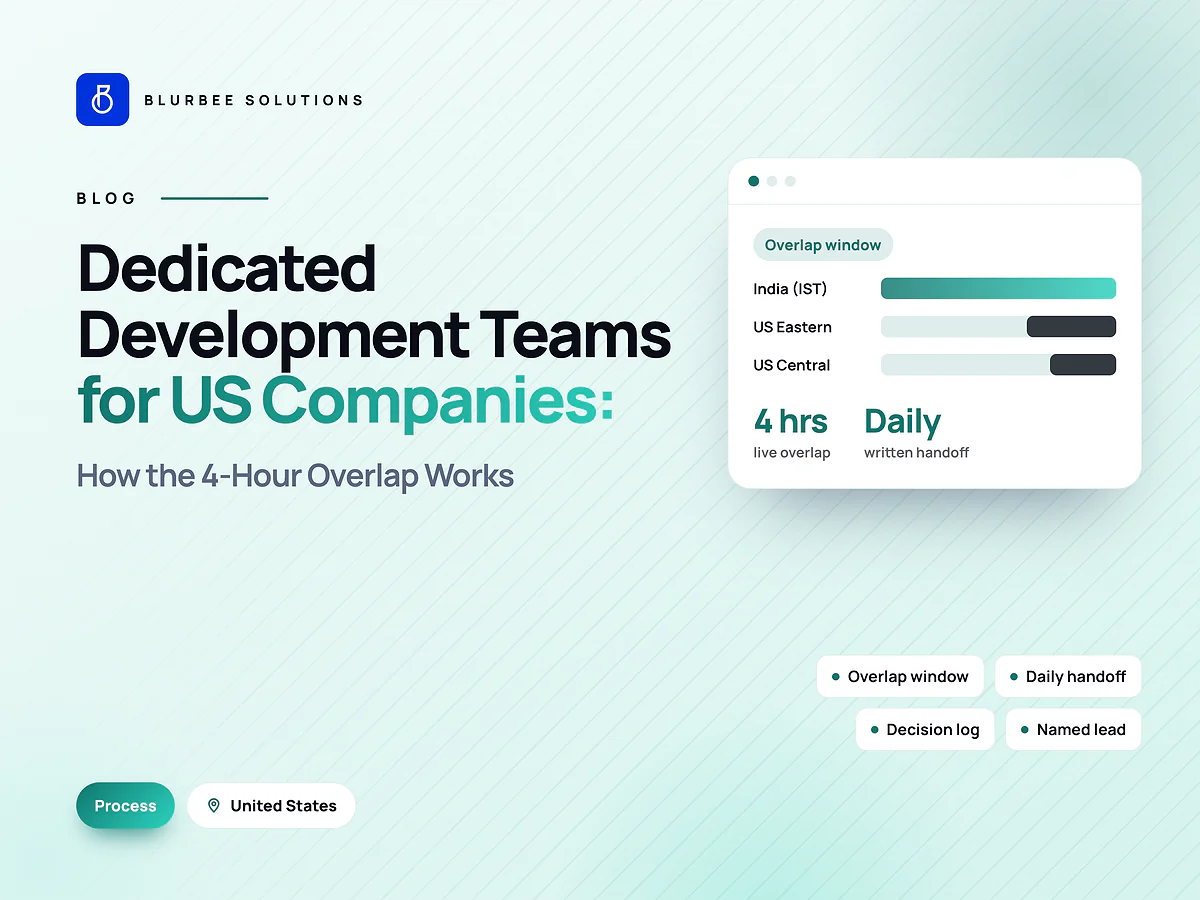
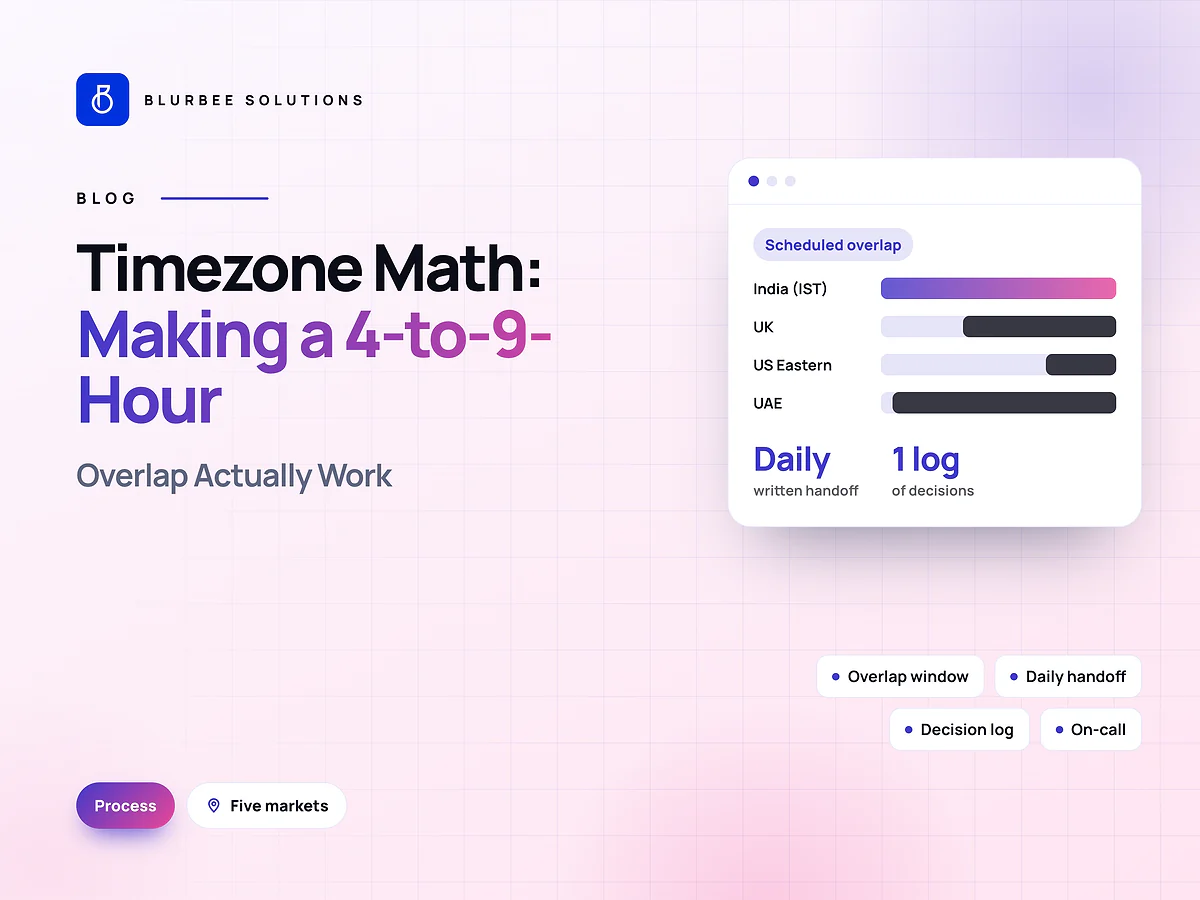
The phrase "four-hour overlap" gets used as though the hours themselves were the product. They are not. Overlap is only useful if decisions get made inside it and recorded outside it, and teams with ninety minutes of overlap plus written discipline consistently outperform teams with four hours and none.
This is the operating model, in detail, and it is what we actually do.
The windows, by timezone
With a 10:00-20:00 IST working day:
Eastern, 09:30-13:00 ET — 3.5 hours. The most comfortable of the four. Central, 09:00-11:30 CT — 2.5 hours. Mountain, 08:30-10:00 MT — 1.5 hours. Pacific, 08:30-09:30 PT — one hour, plus an early-morning IST slot that covers Pacific late afternoon when something genuinely needs it.
Daylight saving shifts each window by an hour without changing its length. We adjust rather than pretending it has not happened.
Do not make the offshore team work US hours
This is the most common mistake and the most reliable way to destroy a good team.
A team working 14:00-23:00 IST to accommodate Pacific meetings has no evening, gets progressively tired, and leaves within two quarters. You then pay for recruitment, onboarding and the lost context, which costs considerably more than the meeting convenience was worth.
The exception is a genuine, temporary, agreed push — a launch week, an incident. Agreed in advance, compensated, and ended.
The end-of-day handoff
The single highest-value artefact in a distributed engagement, and it takes five minutes to write.
At the end of each India working day, a short note:
- What moved today
- What is blocked, and on whom
- What needs a decision from you
- What is next tomorrow
Three to ten lines. Posted where you will see it first thing.
What this does is convert the time difference from a pure cost into overnight progress you can act on. You read it with your coffee, answer the decision question, and the team picks it up at the start of their day. The nine-and-a-half-hour gap becomes a handoff rather than a delay.
Teams that skip this end up with a standing call that is entirely status recitation, which wastes the one window where real problem-solving is possible.
The decision log
Every material decision, with date, reasoning and alternatives considered. Architecture choices, scope changes, tradeoffs deliberately accepted, things postponed and why.
Across a time difference, "we agreed that on a call" is not a record. The same question resurfacing in month four with no written answer — and two people remembering different outcomes — is exactly how distributed engagements erode into mistrust.
The log does not need to be elaborate. A markdown file in the repository with dated entries is sufficient and better than a tool nobody opens.
Which meetings survive
One standing call inside the window. Thirty minutes. Decisions and blockers, not status. Status is in the handoff, and reading it aloud is the most expensive possible use of the overlap.
A demo every two weeks. On real infrastructure, not a local machine. This is where scope misunderstandings surface, and it surfaces them cheaply.
Everything else is a document. Design proposals, architecture options, scope changes — written, circulated, commented on asynchronously. This is slower for the first day and considerably faster over a month, because the reasoning survives.
We do not run a daily standup across the time difference. It costs a meaningful fraction of the overlap window and returns what the handoff already provided.
Escalation, with an actual threshold
An agreed path for urgent problems, with a defined trigger and a named person on each side.
Not "message anyone anytime" — that trains everyone to escalate everything and exhausts the offshore team. A clear rule: production down, or a customer-visible defect at a stated severity. A channel that is genuinely monitored. And a review afterwards, because repeated escalations usually indicate a systemic problem rather than bad luck.
What we need from you
Written scope. Not a full specification, but the intent and the constraints in writing. Ambiguity costs double across a time difference, because the clarification cycle is a day.
One person who can answer product questions within a business day. This is the strongest single predictor of whether a distributed engagement succeeds. Not a committee, not someone who needs to consult three people.
Access to the systems the work depends on, arranged in advance. Access requests sitting with a security team are the most common cause of a stalled first sprint.
Priorities that do not change mid-iteration without a conversation. Changing direction is fine; changing it silently while the team builds the previous version is not.
Onboarding determines the ramp
Two to four weeks to productive with good onboarding. Six to eight without. The difference is almost entirely your documentation.
A README that works from a clean checkout on a machine that has never seen your project. Test this on someone new; it is rarely true the first time.
An architecture note explaining why things are as they are — which decisions were deliberate and which are accidents nobody has cleaned up. This is the document that most reduces the number of questions, and almost nobody has it.
A first task that is small, real and ships in week one. Not a tutorial. Something that goes to production while the stakes are low, exercising the whole pipeline.
Keeping judgement in the relationship
A dedicated team that only executes is a team whose judgement you are paying for and not receiving.
Three things preserve it. Ask for disagreement explicitly, and respond well when it arrives. Share the reasoning behind priorities, not just the priorities — a team that understands why will make better small decisions in the hundred cases you never hear about. And give the offshore lead real authority over technical decisions within agreed boundaries.
The test: in the last month, did the offshore team tell you something you did not want to hear? If not, either everything is genuinely fine or the relationship has quietly become order-taking.
When a dedicated team is the wrong model
When you do not have continuous work, because you pay for capacity that waits on your approvals. When nobody internally sets product direction, because the team will build what it guessed. And when the work is genuinely a bounded project with a defined end — that should be a fixed-scope engagement, priced as one.
We say so when we think that is the case. A retained team on a project that should have been fixed-scope is worse for both sides.
The overlap window by US timezone
Standard time. Daylight saving shifts each window by an hour without changing its length.
Why the overlap model works when it is written down
The difference between a distributed team that compounds and one that leaks is two documents: an end-of-day handoff and a decision log. Neither is elaborate. Both are non-negotiable, and we maintain them without being asked.
- Fixed-scope first projectTwo to four weeks, priced as a number rather than an estimate, so you have evidence before a longer commitment.
- One delivery lead, namedYou always know who to ask. No account manager relaying questions to a team you never meet.
- Code and IP are yoursAssigned in writing, handed over with repositories, infrastructure definitions and documentation whether or not you continue with us.
- Performance budgets in CICore Web Vitals and bundle size gate the build. Slow does not ship.
- Accessibility to WCAG 2.2 AAReviewed with automated and manual passes, not claimed on a slide.
- Written overlap disciplineStanding calls inside your working window, everything else asynchronous with a decision log.