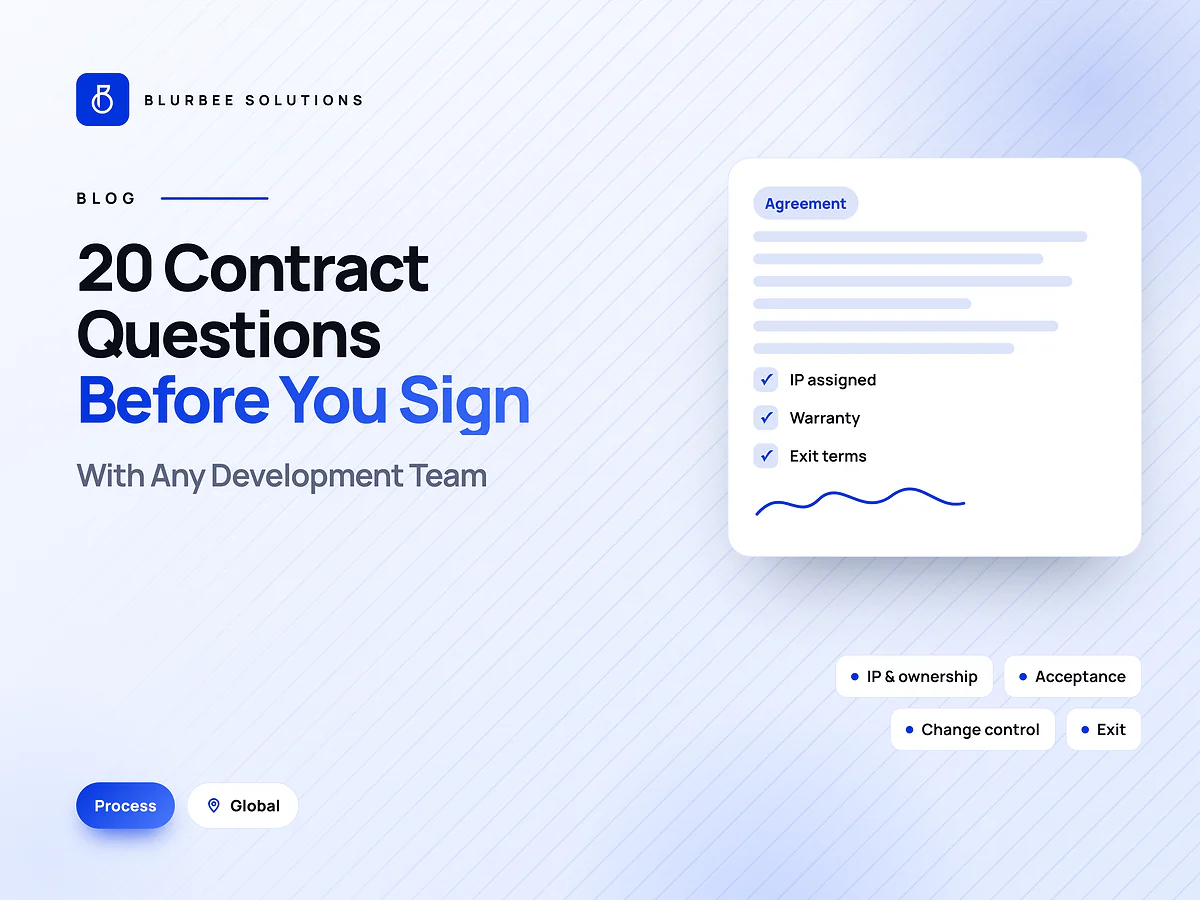
20 Contract Questions to Ask Before You Sign With Any Development Team
The contract clauses that decide how a software engagement ends: IP, open source, warranty, acceptance, liability, change control and exit.

Most software engagements are decided by the contract long before anyone notices. When things go well, nobody reads it. When a deadline slips, a feature is disputed or the relationship ends, the contract is all that matters, and by then it is too late to change it.
These are the twenty contract questions we would ask as a buyer. For questions about the vendor's people and practices rather than the paperwork, see how to vet a software development partner and 20 questions before signing an offshore team. This is not legal advice; have a lawyer review the final agreement.
Ownership
1. Is IP assigned to us in writing, and when? Expect assignment of all project work, including code, designs and documentation, on payment. Read the actual clause.
2. What pre-existing material does the vendor keep, and how is it licensed? Vendors often reuse their own libraries. Fine, as long as you receive a perpetual licence to use and modify it as part of the delivered work.
3. What open-source and third-party components are used, under what licences? Ask for a list. Some licences carry obligations that matter for commercial products.
4. Whose accounts hold the code, cloud, domains and app stores? Yours, from day one. The contract should say so.
Quality
5. What are the acceptance criteria, and how long do we have to test? Testable criteria, a defined testing window, and a clear process when something fails.
6. Is there a warranty period? Commonly 30 to 90 days after acceptance, during which defects are fixed at no charge. It should define a defect versus a new requirement.
7. What quality standards are contractual? Such as automated tests, code review, accessibility level or performance budgets, if they matter to you.
Money and scope
8. What are the payment milestones? A reasonable mobilisation advance, often 20-30%, then payment against delivered and accepted work. Avoid full payment up front.
9. How is change handled? A written change process: what counts as a change, how it is estimated, who approves it and how it affects timelines and price. This is the clause most disputes come back to.
10. What happens to rates over a long engagement? Rate reviews should be predictable, such as annual with notice, not at the vendor's discretion.
People
11. Are key people named, and what happens if they leave? Named delivery lead and senior roles, notice of changes, a handover period and your approval of replacements.
12. Can the vendor subcontract, and to whom? Subcontracting should require your consent, and the same obligations should flow down.
13. Is there a non-solicitation clause, and is it fair? Reasonable mutual limits are common. Check it does not stop you ever hiring someone who worked on your project.
Data and security
14. Is there a data processing agreement? Required if the vendor touches personal data under GDPR, UK GDPR, India's DPDP Act, CCPA, PIPEDA or the UAE PDPL.
15. What security obligations apply? Access controls, multi-factor authentication, device security, incident notification timelines and your right to audit or receive evidence.
16. How is confidentiality handled, and does it survive termination? It should, for a defined or indefinite period.
Risk
17. What is the liability cap and what is excluded from it? Often fees paid over a recent period, with exclusions for confidentiality, data protection and IP infringement.
18. What indemnities does each side give? Commonly the vendor indemnifies against IP infringement claims arising from its work.
Exit
19. Can we terminate for convenience, with what notice and cost? You should be able to end the engagement with reasonable notice, paying for work done, not a penalty.
20. What exactly is delivered at exit? All code, infrastructure definitions, credentials, designs, documentation and data, a handover session, a defined transition-support period, and no extra fee for access to your own work.
The clauses that cause most disputes
In the engagements we inherit or rescue, the same areas come up again and again: unclear scope and change control, vague acceptance criteria, and exits with no defined handover. Liability caps rarely matter in practice; handover almost always does.
Red flags in a draft contract
- IP retained by the vendor, with only a licence granted to you.
- No acceptance criteria, or acceptance deemed automatic after a very short period.
- No warranty period, so every defect becomes billable work.
- Change control left vague, such as "reasonable changes are included".
- Unlimited subcontracting without notice or consent.
- No termination for convenience, or a large penalty for leaving.
- Exit fees for handing over your own code and accounts.
- A liability cap far below the fees, with no exclusions for data or confidentiality breaches.
Any one of these is negotiable. A vendor unwilling to discuss them is telling you how disagreements will be handled later.
Fixed price or time and materials?
Both work with the right contract. Fixed price suits a well-defined first project with clear acceptance criteria, and it makes change control essential. Time and materials suits ongoing product work, and it makes reporting, caps and regular reviews essential. Many engagements start with a fixed-scope first project, then move to time and materials once both sides know each other.
How to use this list
Send it to your shortlisted vendors and ask for answers in writing, with the relevant clause referenced. How a vendor responds tells you as much as the answers. Then have a lawyer in your jurisdiction review the final agreement.
We sign contracts with clients across India, the United States, the United Kingdom, the UAE and Canada, and we will send ours with every question answered before you commit.
Development contracts, in numbers
Blurbee's assessment of how often each area causes disputes in engagements we inherit or rescue, scored out of 10. Opinion, not a survey.
Why buyers find Blurbee's contract easy to sign
IP assigned in writing on payment, code in your accounts from day one, a warranty period, a clear change process and a defined exit. We would rather put it in the contract than argue about it later.
- Fixed-scope first projectTwo to four weeks, priced as a number rather than an estimate, so you have evidence before a longer commitment.
- One delivery lead, namedYou always know who to ask. No account manager relaying questions to a team you never meet.
- Code and IP are yoursAssigned in writing, handed over with repositories, infrastructure definitions and documentation whether or not you continue with us.
- Performance budgets in CICore Web Vitals and bundle size gate the build. Slow does not ship.
- Accessibility to WCAG 2.2 AAReviewed with automated and manual passes, not claimed on a slide.
- Written overlap disciplineStanding calls inside your working window, everything else asynchronous with a decision log.