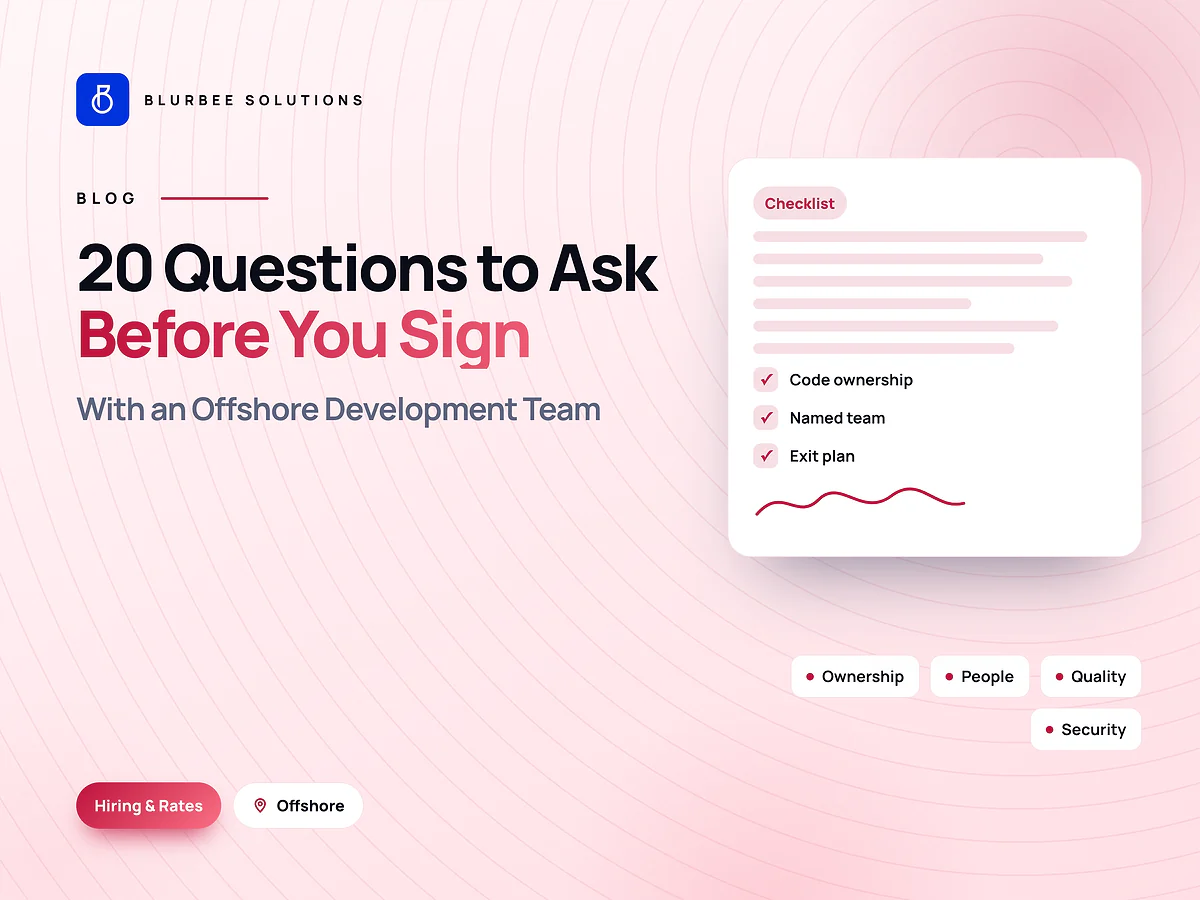
20 Questions to Ask Before You Sign With an Offshore Development Team
The vetting checklist we hand prospective clients: code ownership, testing standards, staff continuity, security, escalation paths and exit terms — with the answers to expect.

We hand this list to prospective clients, including ones evaluating us against other suppliers. A buyer who asks these gets a better engagement — from us and from anyone else — because the questions force both sides to be specific before money is committed.
The uncomfortable ones are the useful ones, so they are all here, with the answer you should expect.
Ownership and contracts
1. Who owns the code, and where does the contract say so?
Expect: you do, on payment, assigned explicitly in writing. Ask to see the clause. Silence, ambiguity, or ownership retained by the vendor with a licence back to you means you are renting your own product.
2. Whose accounts will the code and infrastructure live in?
Expect: yours. Your GitHub organisation, your cloud accounts, your domain registrar, your app store accounts. A vendor who wants to hold these is creating leverage you do not need to give them.
3. What happens to everything if we terminate?
Expect: a defined notice period, and on exit you receive repositories, infrastructure definitions, design files, documentation and credentials with a walkthrough. A vendor reluctant to define this has usually had exits go badly.
4. What are the payment milestones?
Expect: a mobilisation advance of 20-30%, then invoices against delivered work. Full payment up front is not normal and should be refused. Equally, expect to pay something before work starts.
People
5. Who specifically will write the code — by name?
Expect: names, roles and experience. This is the question that prevents the most common disappointment in offshore work, which is senior people pitching and junior people delivering.
6. Can I speak to them before signing?
Expect: yes, a short call. Not to assess them in twenty minutes, but to confirm they exist, know your project, and are the people you are paying for. A vendor who cannot arrange this is telling you something.
7. Who is my delivery lead, and what else are they working on?
Expect: a named person with stated availability. "A dedicated project manager" is not an answer. If nobody is named before signing, nobody is accountable after.
8. What happens if a key person leaves mid-project?
Expect: a specific answer about overlap, documentation and handover — not an assurance that it will not happen. Turnover is normal; being unprepared for it is the problem.
9. What is your annual attrition?
Expect: a number. Any Indian services company that claims near-zero is either very small or not being straight. What matters is whether they can name it and describe how they mitigate the impact.
Quality
10. What QA is included, and where does it appear in the cost breakdown?
Expect: a line item. If testing is not costed, it is not planned, and you will do it after launch. This is the single most common thing quietly missing from a cheap quote.
11. What is your definition of done?
Expect: something specific — code reviewed, tests written and passing, deployed to staging, accessibility checked, documentation updated. A vague answer means the standard will be negotiated retrospectively, under time pressure.
12. How will I see the work — pull requests or deliveries?
Expect: pull requests into your repository, continuously. Bulk deliveries at milestones remove your ability to catch a problem while it is small.
13. What accessibility standard do you build to, and how do you verify it?
Expect: WCAG 2.2 AA, with automated tooling and manual passes for keyboard navigation, focus order and screen reader labelling. Automated-only is not verification.
14. How do you handle performance?
Expect: budgets enforced in the build — Core Web Vitals and bundle size gating the pipeline, not measured after launch and reported.
Working arrangement
15. What are your working hours, and what overlap do I get?
Expect: their actual hours in their timezone, and the resulting overlap window stated honestly. Anyone claiming full coverage of your working day is either lying or planning to burn out their team.
16. How do scope changes get agreed and priced?
Expect: in writing, with an approval step, before work starts. Scope agreed in conversation across a time difference means two teams building different things for a week before anyone notices.
17. What do you need from us, and what happens if we are slow?
Expect: a specific list — written scope, one person who can answer product questions within a business day, system access, priorities that hold within an iteration. And an honest statement that ambiguity costs double across a time difference.
18. What is the escalation path outside working hours?
Expect: a defined trigger, a named person, and a monitored channel. Not "message anyone anytime," which trains everyone to escalate everything.
Security and compliance
19. How are credentials stored, what devices do engineers work on, and who are your subprocessors?
Expect: a managed secret store, company-managed devices with disk encryption, access granted per project and revoked at offboarding, and a named list of every service data passes through. The subprocessor gap is usually error tracking or observability tools capturing request payloads.
For regulated work, add: a data processing agreement, the transfer mechanism for your jurisdiction — the IDTA or UK Addendum for the UK, service-provider terms for California, BAAs for US healthcare — and whether they have completed a client security questionnaire before.
The one that matters most
20. What went wrong on a project like mine, and what did you do about it?
Every real engagement has something. A vendor who cannot name theirs has either not shipped much or is managing you.
The way they describe a failure tells you more than any success story: whether they take responsibility or distribute it, whether they changed anything afterwards, and whether they are capable of telling you something you do not want to hear. That last capacity is what you are actually buying when you buy judgement rather than hands.
Where engagements actually fail
Worth knowing, because it changes which answers you weight.
From post-mortems including our own: absent product decisions on the client side account for the largest share. Scope agreed verbally rather than in writing is next, and it is a shared failure. Then staff substitution, QA missing from the plan, and undefined exit terms.
Note that the largest single cause sits on the buyer's side. Question 17 exists because of it, and a vendor who answers it honestly — telling you what they need and what happens if they do not get it — is more useful than one who says everything will be fine.
How to use the list
One forty-five minute call covers all twenty. Add a written questionnaire for the security items if you are in a regulated sector.
Get the material answers in writing and into the statement of work: IP, QA scope, named staff, exit terms, escalation. Not out of distrust, but because it prevents a disagreement in month four about what was said in month one.
Then verify with a small amount of real work. A two-to-four-week fixed-scope trial project produces evidence that no set of questions can, however good the questions are.
How to use this list
Blurbee analysis of engagement post-mortems, including our own, 2019-2026. Share of failures attributed to each cause.
Why we publish the questions we would rather not be asked
A buyer who asks these gets a better engagement from us, and from anyone else. The questions that are uncomfortable to answer are the ones worth asking, so they are all here with the answer you should expect.
- Fixed-scope first projectTwo to four weeks, priced as a number rather than an estimate, so you have evidence before a longer commitment.
- One delivery lead, namedYou always know who to ask. No account manager relaying questions to a team you never meet.
- Code and IP are yoursAssigned in writing, handed over with repositories, infrastructure definitions and documentation whether or not you continue with us.
- Performance budgets in CICore Web Vitals and bundle size gate the build. Slow does not ship.
- Accessibility to WCAG 2.2 AAReviewed with automated and manual passes, not claimed on a slide.
- Written overlap disciplineStanding calls inside your working window, everything else asynchronous with a decision log.