Software Development in Scotland: Edinburgh, Glasgow and Aberdeen
How Scottish fintech, energy and public-sector suppliers extend engineering capacity, with notes on procurement frameworks, Cyber Essentials Plus and realistic rates.

Scotland's software market divides along lines that have little to do with geography and a lot to do with who the buyer is. Edinburgh fintech applies bank-grade vendor review. Aberdeen energy schedules around physical assets. Public-sector work is decided by framework eligibility before anyone reads a proposal.
Getting these three wrong is the most common way suppliers waste effort here.
Rates
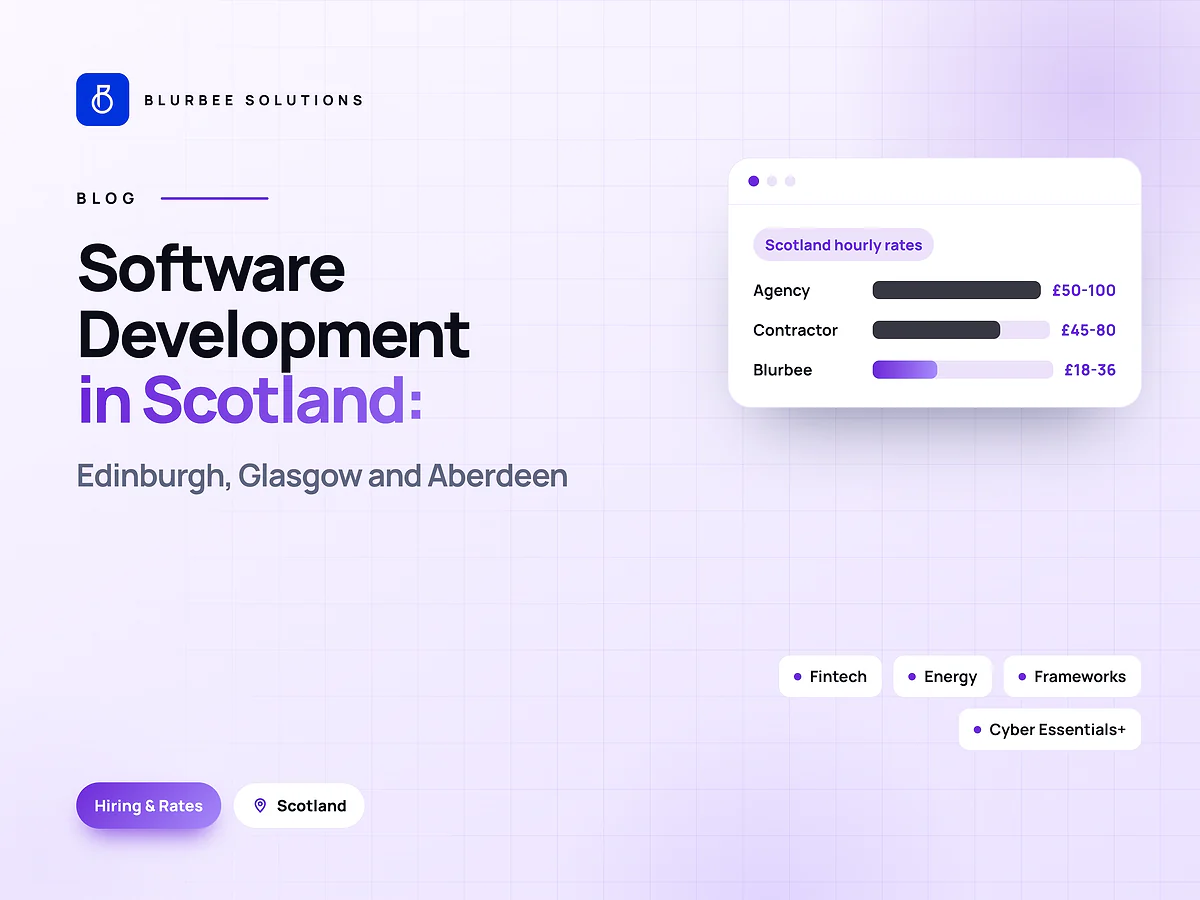
Edinburgh agencies typically quote £60-100 per hour at mid to senior level. Glasgow and Aberdeen studios run £50-80. That sits modestly below London and broadly in line with Manchester or Leeds.
Offshore teams delivering to Scotland, including ours, are £18-36 for a blended team including QA and a delivery lead.
The Scottish senior pool is real but not deep in every specialism. Fintech and energy domain experience is genuinely strong. Large-scale distributed systems and applied machine learning are thinner, and worth verifying specifically rather than assuming the market average applies.
Public sector: eligibility decides it
This is the point most suppliers learn expensively.
Scottish public-sector digital procurement runs largely through frameworks — the Scottish Government's Digital Technology arrangements and related vehicles. If you are not on the relevant framework, or a named subcontractor to someone who is, the pitch does not happen. The quality of your proposal is irrelevant to a competition you cannot enter.
The practical consequence: work out the framework route before writing anything. For most offshore suppliers, that route is delivering under a UK-based prime who holds the framework position and the certifications. That is a normal, well-established arrangement and it is how a great deal of public-sector work actually gets built.
Cyber Essentials Plus
Commonly required for public-sector contracts and for many private suppliers downstream of them.
Cyber Essentials is a self-assessment against five technical controls. Plus adds independent technical verification — an assessor tests the controls rather than accepting the assertion. Scottish Government frameworks frequently layer their own supplier assurance questions on top.
For an offshore supplier, the certification scope is the systems inside the certified boundary. In practice this means the prime-and-delivery-partner structure described above is the workable route for most framework work, and direct supply depends on the specific framework's terms.
Establish which applies in week one. Discovering a certification requirement after a bid is submitted wastes everyone's time.
Edinburgh fintech and asset management
Expect vendor security review before a kickoff date is discussed. A security questionnaire, DPA with subprocessor disclosure, insurance certificates, and evidence of controls rather than assertions.
FCA-regulated firms also apply operational resilience expectations to their suppliers. That means business continuity planning, defined recovery objectives, and — importantly — exit planning as a contract topic. A regulated buyer needs to demonstrate they could move away from you in an orderly way. Suppliers who treat exit terms as an awkward subject fail this test.
Audit trails should be treated as deliverables rather than log files: designed for someone reconstructing what happened months later, retained appropriately, and queryable.
Aberdeen energy: plan around the asset
The scheduling point deserves emphasis because it is where engagements go wrong.
An energy client's deadline is a turnaround window, a drilling programme, or a regulatory filing date. Those do not move. Software delivered two weeks after the window has missed its purpose entirely, however good it is.
The structure that works: plan backwards from the asset date, freeze non-critical change during operational windows, and schedule larger work between them. This is scheduling discipline rather than a technical constraint, and it is what most software suppliers misjudge in this market.
Aberdeen also brings the offshore-operations constraint: satellite connectivity, long disconnections, and severe weather downtime. Any tool used on a platform or a vessel has to be offline-first, with queued writes and explicit conflict rules, tested against genuine link degradation rather than a disabled network toggle.
Glasgow
A broader base — public sector, health, engineering services, a growing product scene. Rates at the lower end of the Scottish range, and a good general engineering pool.
Health-adjacent work here brings NHS Scotland information governance requirements, which are distinct from the rest of the UK and worth reading specifically rather than assuming NHS England guidance transfers.
Contract: Scots law is not English law
The commercial substance is broadly similar, but the legal framework differs in real ways — prescription periods, some contractual remedies, and terminology. Scottish contracts normally specify the courts of Scotland.
Have a Scottish solicitor review rather than assuming an English template transfers cleanly. This is not an expensive step and it avoids a class of problem that only surfaces when something has already gone wrong.
The points to hold are the same as anywhere: IP assignment to you on payment, exit terms defined, your accounts throughout, milestone payments.
Gaelic
Rarely a legal requirement for private business. Public bodies with Gaelic language plans under the Gaelic Language (Scotland) Act 2005 may have commitments, and some public-facing services choose bilingual delivery for reasons of policy rather than obligation.
If it applies, treat it as content architecture in week one — externalised strings, layouts that survive longer text, locale-aware formatting — rather than a translation pass at the end. A retrofit touches nearly every view.
The overlap
IST is 5.5 hours ahead of GMT: 09:00-14:00 GMT of live overlap, the widest window we have with any market. Real-time pairing on a hard problem is genuinely available, which is not true of North American engagements.
We maintain the written discipline regardless — an end-of-day handoff covering what moved, what is blocked and what needs a decision, plus a dated decision log. Those are what make the arrangement robust rather than dependent on people being at their desks.
Start small, especially here
A fixed-scope first project of two to four weeks, one real feature, your repository, milestone payment.
For regulated Scottish buyers there is a specific advantage: your security and procurement processes run against a small engagement before a large one depends on the outcome. The review happens with real evidence rather than a questionnaire, which is easier for your risk function to sign off and faster for everyone.
The Scottish market, in numbers
Composite of published UK rate cards and Blurbee quoted rates converted at prevailing rates, 2026. Indicative bands only.
Why Scottish teams extend with Blurbee
We answer the security questionnaire before it is sent, we understand that framework eligibility decides more than the pitch does, and we plan Aberdeen energy work around the asset rather than our sprint calendar.
- Fixed-scope first projectTwo to four weeks, priced as a number rather than an estimate, so you have evidence before a longer commitment.
- One delivery lead, namedYou always know who to ask. No account manager relaying questions to a team you never meet.
- Code and IP are yoursAssigned in writing, handed over with repositories, infrastructure definitions and documentation whether or not you continue with us.
- Performance budgets in CICore Web Vitals and bundle size gate the build. Slow does not ship.
- Accessibility to WCAG 2.2 AAReviewed with automated and manual passes, not claimed on a slide.
- Written overlap disciplineStanding calls inside your working window, everything else asynchronous with a decision log.