Development Rates Compared: India, USA, UK and Canada in 2026
Honest hourly and day-rate ranges by region and role, what drives the differences, and how to compare total cost of ownership rather than headline price.

Most rate comparisons are written by someone who benefits from the conclusion. This one includes our own bands, the adjustments that make a headline rate misleading, and the situations where paying the highest number is correct.
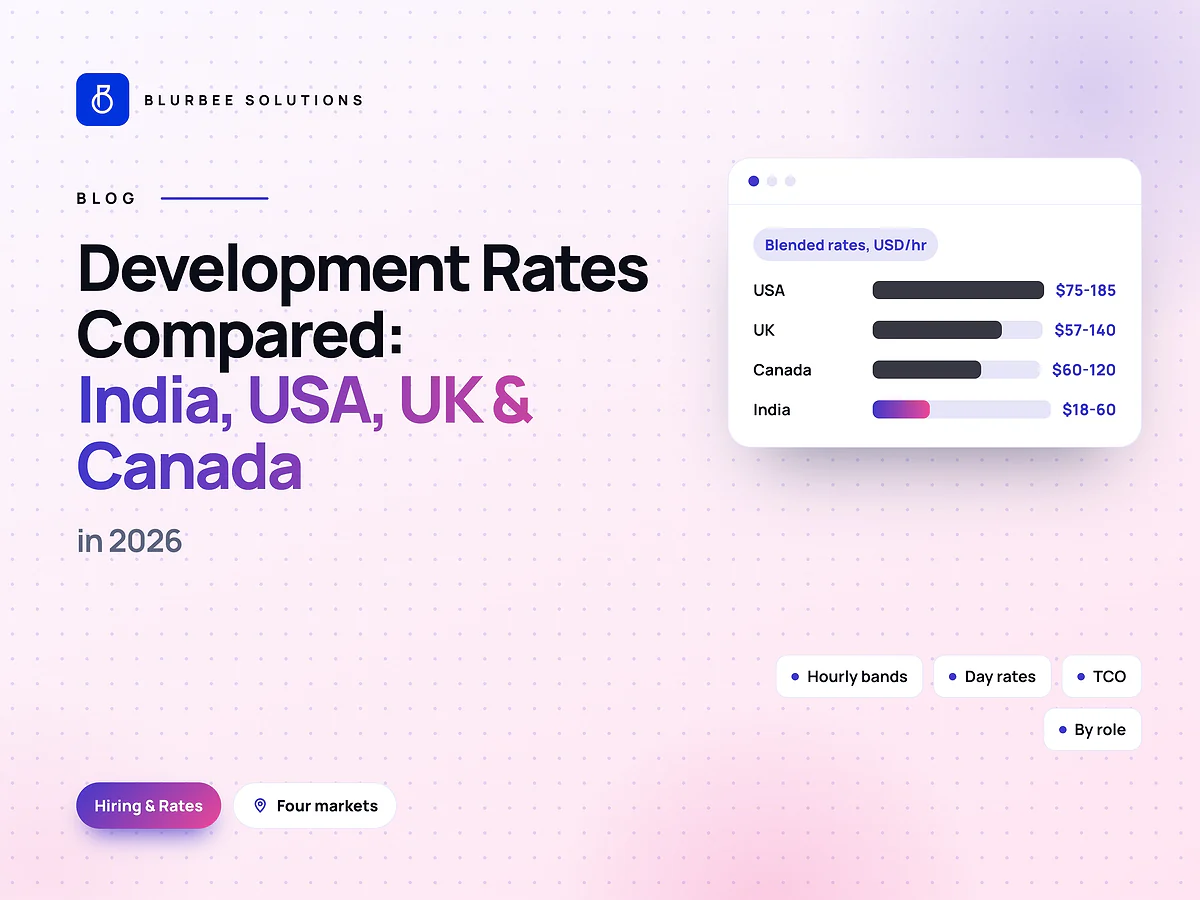
The bands, blended mid-to-senior, in USD
United States: $75-185. Coasts and financial centres at the top; regional studios in the Midwest and Southeast at the lower end. Staffing-firm bill rates for a placed contractor run $55-110, which buys one person rather than a team.
United Kingdom: $57-140. London agencies £75-110 per hour at the top. Regional cities — Manchester, Leeds, Bristol, Birmingham — run £45-65, a genuine 35-45% discount for comparable seniority. Contractors charge £450-650 per day.
Canada: $60-120. Toronto and Vancouver CA$120-165 per hour; regional Ontario, Prairie and Atlantic studios CA$70-140.
United Arab Emirates: $35-110. Dubai and Abu Dhabi price near Western levels; the northern emirates are considerably cheaper.
India: $18-60. Bengaluru and Gurugram at the top of the domestic market; Surat, Ahmedabad and tier-two cities lower. Blended team rates including QA and a delivery lead.
All of these are indicative. Seniority, contract length, scope and negotiation move them materially, and any specific quote should be read against its own assumptions rather than a table.
Why the gap exists
Salary levels and commercial rent, principally. A senior engineer in Surat costs a fraction of one in San Francisco because the cost of living differs by roughly that factor, and office space differs by more.
It is a cost-base difference rather than a quality difference in general web and application engineering. Where it is a capability difference is narrower and worth naming: the deepest pools for large-scale distributed systems and frontier applied machine learning research are genuinely concentrated in a handful of places, and India's are in Bengaluru and Hyderabad rather than distributed across the country. If your project depends on either, verify specifically rather than assuming the market average.
The adjustment nobody puts in the quote
Your own management time.
A well-run distributed engagement consumes four to six hours a week: written briefs, a standing call, reviewing work, answering the decision question in the daily handoff. If your time is worth $150 an hour, that is $2,400-3,600 a month appearing in no quote.
It remains a large saving. But a comparison that ignores it is not a comparison, and the disappointment that follows from ignoring it is predictable.
Total cost of ownership, properly
Four components, only one of which appears in a proposal.
Build cost. The quoted number.
First-year rework. How much of what was built has to be redone because it was misunderstood, under-specified, or built to a standard that did not survive contact with real usage.
Onboarding cost for a developer who did not build it. This is the one that separates cheap from expensive over three years. Ask every candidate how they would bring a new developer up to speed in month six. If the answer involves someone explaining it verbally, documentation does not exist, and every future change carries a tax.
Maintenance. Dependency updates, OS releases, security patches, platform deprecations. Budget 15-20% of build cost annually and mean it.
A cheaper build that generates two months of rework, needs a specialist to maintain, and cannot be handed over is not cheaper. It just moves the cost somewhere the proposal did not mention.
Rates by role, which vary more than you would expect
Across every market, roughly in descending order of premium:
AI and ML commands the highest rate everywhere, and the gap between markets is proportionally narrower here than in any other discipline — genuine scarcity does not respect geography.
Cloud and platform engineering next. Reliability and infrastructure work is priced on the cost of getting it wrong.
Backend and mobile in the middle.
UI/UX design and frontend lower, with more variance based on portfolio quality than on location.
QA lowest, which is precisely why it is the first line item to disappear from a cheap quote. If QA is not costed in a proposal, it is not planned, and you will do it after launch at your own expense.
Comparing a fixed price to an hourly band
Divide the quote by the hours the scope plausibly requires and see where it lands.
A fixed price well below the market band for the stated scope means one of two things: something has been left out of the scope, or margin will be protected later by reducing quality. Both are recoverable if you know which, and neither is if you do not.
Ask for the assumptions the estimate rests on — page count, integration count, who supplies content, what happens if a third-party API is undocumented. A proposal without an assumptions section is a guess with a number attached, and every gap becomes a change request at a rate you did not negotiate.
Contract length and what it should move
A three-month commitment typically prices 10-20% below ad-hoc work in most markets, because it reduces the supplier's bench risk and that saving is legitimately shared.
Beyond about six months, further discount is rare and locking in longer than you can predict demand is a false economy. You end up paying for capacity that waits on your approvals, which is the standard failure mode of a dedicated-team arrangement entered for the wrong reason.
When the highest band is the right answer
Four cases where paying US or UK rates is correct and offshore is not an option worth exploring.
Export-controlled work. ITAR, national-lab-adjacent projects, or anything with US-person staffing requirements. This rules out offshore delivery entirely, and a supplier who does not raise it has not understood the brief.
Genuinely scarce domain expertise. Some knowledge exists in a handful of places. Paying for it is cheaper than funding someone's education on your project.
Organisations that need someone in the room. Some cultures of decision-making do not survive being distributed. That is a legitimate constraint rather than a failing.
Regulated work where local accreditations save more than they cost. A supplier already on a public-sector framework, already holding Cyber Essentials Plus, already through a bank's vendor review — that position has real value, and reproducing it costs more than the rate difference.
The cheapest useful purchase
A two-to-four-week fixed-scope trial project, with any supplier at any rate.
It costs a fraction of a full engagement and produces the only information that actually predicts the outcome: how they estimate, how they write code, how they communicate when something slips, and what handover looks like.
No rate card tells you that. Neither does a reference call, because references are selected.
Blended mid-to-senior bands, converted to USD
Composite of published regional rate cards, 2026, converted to USD at prevailing rates. Indicative bands only — seniority, contract length, scope and negotiation move them materially.
Why we publish our own bands
Most rate comparisons are written by whoever benefits from the conclusion. Ours includes our own numbers, the cases where we are the wrong answer, and the adjustments that make a headline rate misleading.
- Fixed-scope first projectTwo to four weeks, priced as a number rather than an estimate, so you have evidence before a longer commitment.
- One delivery lead, namedYou always know who to ask. No account manager relaying questions to a team you never meet.
- Code and IP are yoursAssigned in writing, handed over with repositories, infrastructure definitions and documentation whether or not you continue with us.
- Performance budgets in CICore Web Vitals and bundle size gate the build. Slow does not ship.
- Accessibility to WCAG 2.2 AAReviewed with automated and manual passes, not claimed on a slide.
- Written overlap disciplineStanding calls inside your working window, everything else asynchronous with a decision log.