Software Development Outsourcing in 2026: How US Companies Do It Well
Onshore, nearshore or offshore; project, team or staff augmentation: a practical guide to outsourcing software development without losing control of quality, IP or budget.

Outsourcing software development used to be mostly about saving money. For many US companies it is now about getting work done at all. Senior engineers are expensive and slow to hire, product roadmaps don't wait, and specialist skills such as AI, cloud and mobile are hard to keep in-house for every project.
Done well, outsourcing gives you capacity and expertise on demand. Done badly, it gives you missed deadlines, code nobody understands, and a contract that makes leaving painful. This guide covers how to do it well.
Why US companies outsource
The US Bureau of Labor Statistics reports a median annual wage of $133,080 for software developers in May 2024, and projects employment to grow 15% from 2024 to 2034, much faster than average (BLS). Strong demand means long hiring cycles and rising costs, especially for senior and specialist roles.
Cost is no longer the only driver. Deloitte's Global Outsourcing Survey 2024 found that access to talent has become the number-one driver of outsourcing decisions (Deloitte). Companies outsource to reach skills they can't hire quickly, and to scale capacity up and down without layoffs.
Onshore, nearshore or offshore?
Onshore (US-based partners) offer the same time zone, culture and legal system, at the highest rates. They suit projects needing frequent in-person work or strict data-residency rules.
Nearshore (Latin America, Canada) offers strong time-zone overlap at moderate rates. Talent pools are growing but are smaller for some specialties.
Offshore (India, Eastern Europe, Southeast Asia) offers the largest talent pools and the lowest rates. The trade-off is less time-zone overlap, which has to be managed deliberately.
Here are the local agency rate bands published across our location pages:
| Market | Typical local agency rate (per hour) |
|---|---|
| United States | $75–$220 |
| United Kingdom | £45–£130 |
| United Arab Emirates | AED 120–420 |
| Canada | CA$60–175 |
| India | ₹800–3,600 |
Blurbee's published rates are $22 to $45 per hour for web development and $30 to $60 for AI and ML work, depending on seniority.
Three engagement models
Project-based outsourcing
The partner delivers a defined outcome, such as a first release, a migration or a new feature set, usually at a fixed price for each phase. It suits clear, bounded work. You manage the outcome, not the people.
Dedicated team
A stable team works only on your product, under your direction or with the partner's delivery lead, at a predictable monthly cost. It suits ongoing products and roadmaps. Our article on dedicated development teams for US companies goes further.
Staff augmentation
Individual engineers join your existing team and processes. It suits companies with strong in-house engineering leadership that need extra hands or a specific skill. You can hire dedicated developers for US teams in 22 roles this way.
The real risks, and how to control them
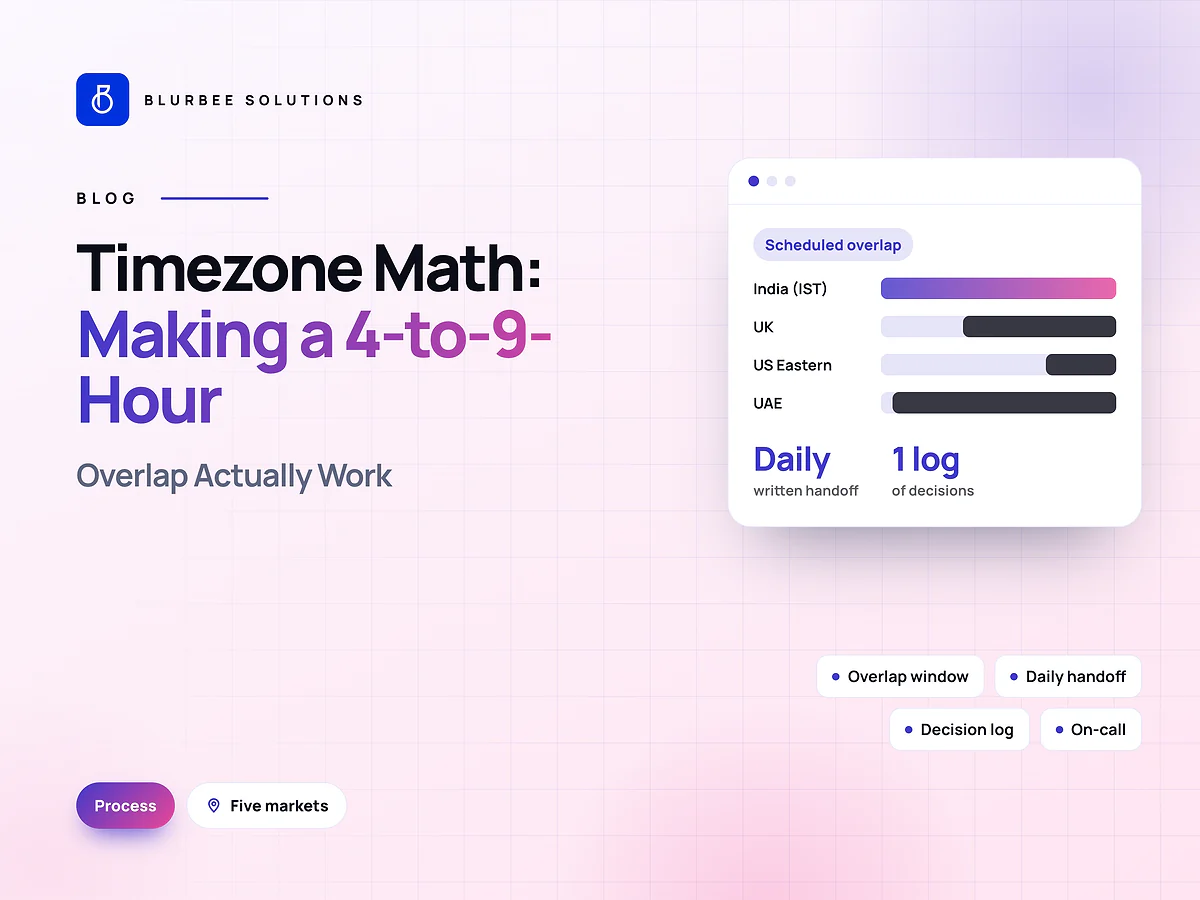
Communication gaps. Requirements get lost between time zones and assumptions. Control it with written specifications, daily written handoffs, a decision log and a regular demo. Our article on time-zone overlap explains how to plan the working day.
Quality problems. Code that works in a demo but breaks in production. Control it with code reviews, automated tests, a clear definition of done and access to the repository from day one so you can see the work as it happens.
IP and ownership. Code held on the vendor's accounts, or unclear assignment of rights. Control it with written IP assignment, repositories and cloud accounts in your name, and an NDA before you share details.
Security. Access to production data and systems by people you don't know. Control it with least-privilege access, separate environments, no real customer data in development, and a security review before launch.
Vendor lock-in. Only the vendor understands the system. Control it with documentation, infrastructure as code, standard technology choices and a clear exit and handover clause.
Hidden costs. Rework, change requests and management overhead. Control it with phased fixed-price work at first, clear change-request terms and weekly visibility of time spent.
How to choose an outsourcing partner
- Look for relevant work. Ask for working software from similar projects and speak to the person who led it.
- Meet the delivery lead, not only sales staff. Ask who will actually write your code.
- Check the process: how requirements are captured, how code is reviewed and tested, how releases happen and how problems are escalated.
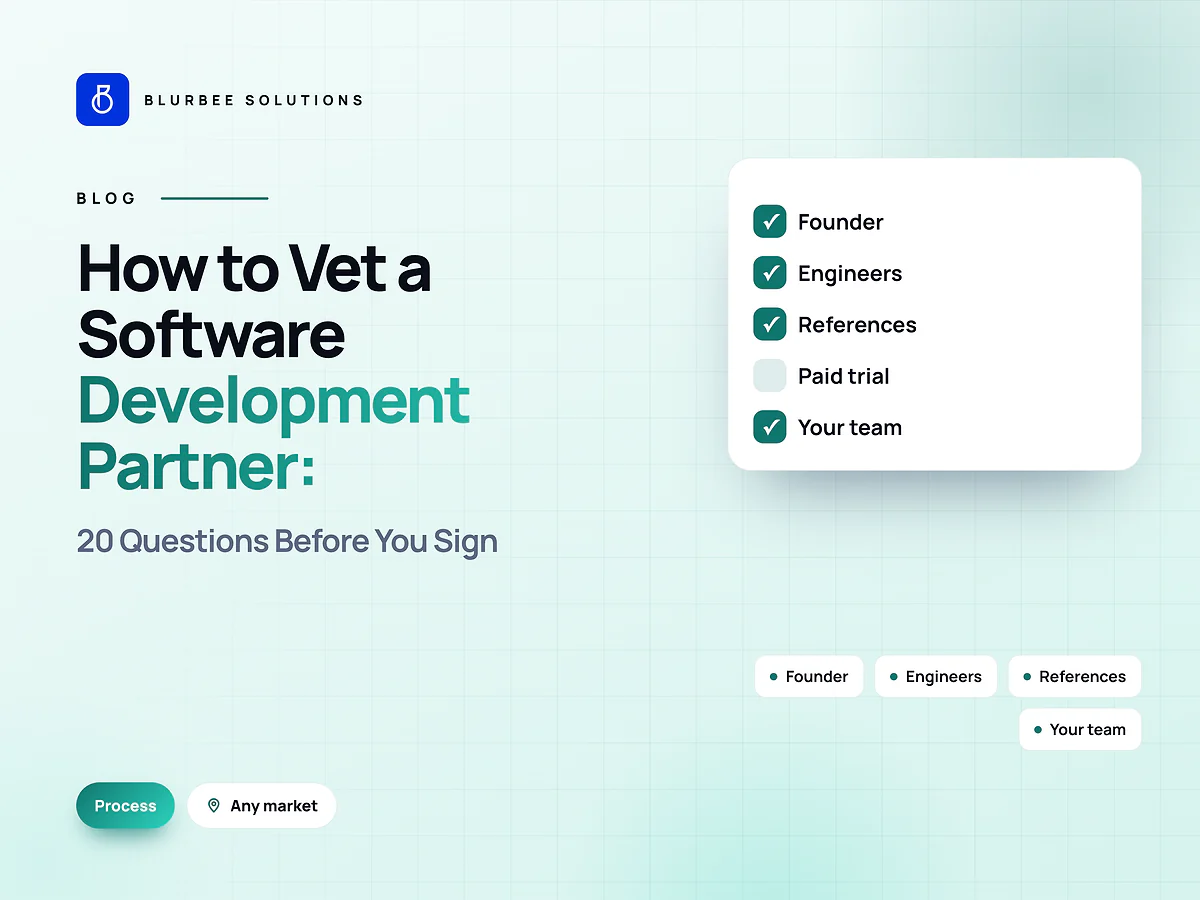
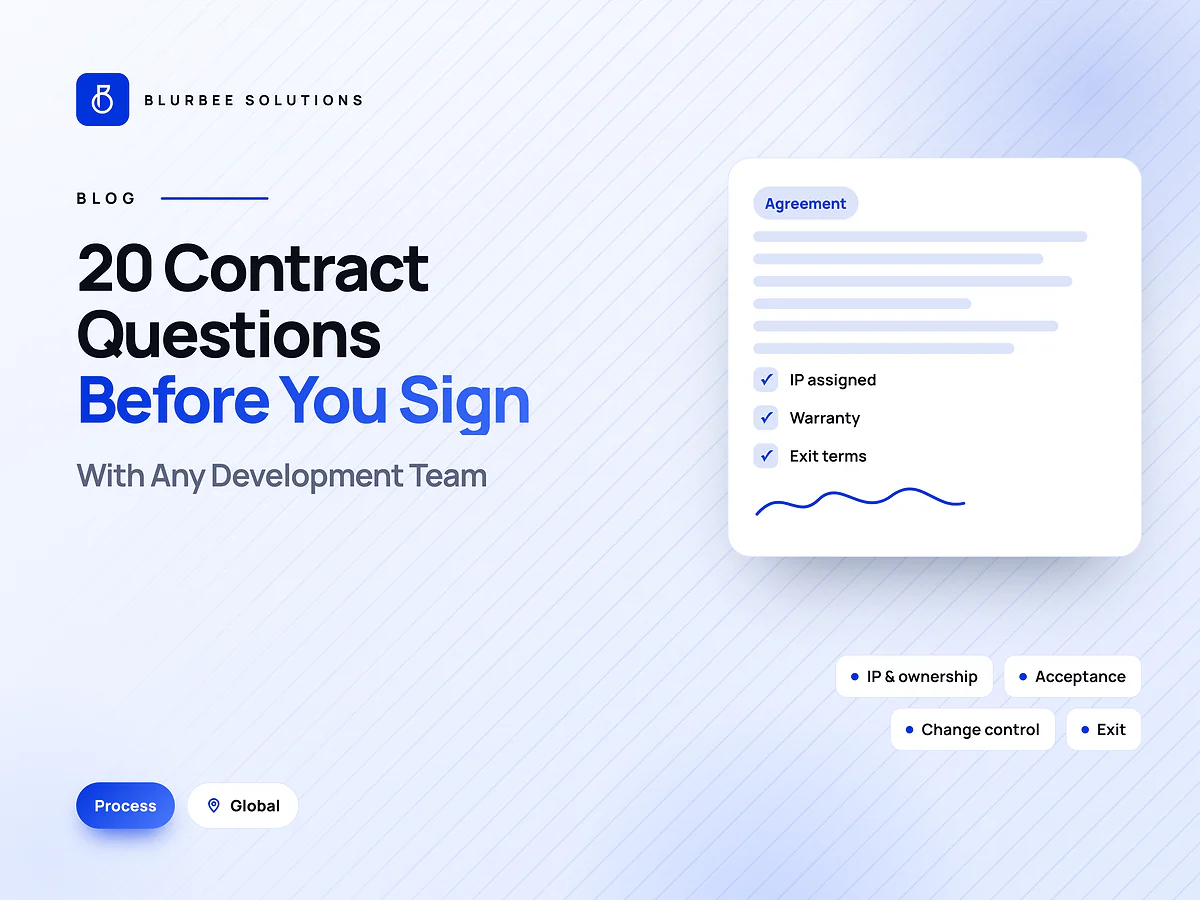
- Read the contract for IP assignment, change requests, staff replacement, exit and handover terms. Our contract questions article lists what to look for.
- Ask for references from clients in your time zone and industry.
- Start small. A paid, fixed-scope first project is the best test of fit.
Our guide to vetting a development partner has a fuller checklist.
Managing an outsourced team day to day
- One owner on your side who can make decisions quickly. Slow decisions cost more than slow developers.
- A shared backlog with priorities you set, visible to both sides.
- A short live overlap every day, used for questions and unblocking, not status reports.
- Written daily handoffs: what moved, what's blocked, what needs a decision.
- A demo every one or two weeks, where you see working software, not slides.
- Metrics you both watch: delivery against plan, defect rates, and time from request to release.
What overlap looks like with an India-based team
With Blurbee, US clients usually get one to three and a half hours of live overlap each working day, more on the East Coast and less on the West Coast. Teams in New York City or Florida typically use their morning for standups and reviews, while California teams lean more on asynchronous handoffs. Work continues while you sleep, so a well-run handoff can shorten delivery.
When not to outsource
- When the core of your competitive advantage is the software itself and you have no internal technical leadership. Keep at least one senior technical owner in-house.
- When requirements change daily and nobody on your side can make decisions.
- When regulation requires that certain data or work stays within US borders.
In these cases, a hybrid model often works: in-house leadership with outsourced capacity.
The first 30 days with a new partner
How the first month goes is the best predictor of how the relationship will go. A good start looks like this:
- Week 1: kickoff and access. Repository, environments, tools and communication channels set up in your name. Roles, decision-makers and escalation paths agreed in writing.
- Week 2: discovery and plan. The partner restates your goals and requirements in their own words, flags risks and proposes a delivery plan with milestones.
- Week 3: first working increment. A small, real piece of functionality in a shared environment, not a slide deck.
- Week 4: review and adjust. You review speed, quality and communication together, and agree what to change.
If you haven't seen working software, code in your repository and a clear plan by the end of the first month, raise it immediately.
Contract essentials checklist
- Scope and deliverables for each phase, with acceptance criteria.
- IP assignment covering code, designs, documentation and anything built for you.
- Confidentiality and data-protection terms, including where data may be stored.
- Staffing: named lead, notice of replacements and a handover period.
- Change requests: how they're estimated, approved and billed.
- Payment terms tied to milestones or delivered work.
- Warranty and support after launch.
- Exit and handover: what you receive and how quickly if you end the relationship.
Signs the relationship is working, or isn't
Healthy signs:
- You see working software regularly, and it matches what you asked for.
- The team asks good questions and challenges unclear requirements.
- Problems are raised early, with options, not hidden until a deadline.
- Code, documentation and infrastructure are in your accounts and up to date.
- Estimates become more accurate over time.
Warning signs:
- Status reports replace demos.
- The same bugs return after being "fixed".
- Key people change without notice.
- You can't get a straight answer about who is doing the work.
- Every change becomes a negotiation.
If warning signs appear, address them directly and early. A good partner will welcome the conversation and propose concrete changes. If nothing improves, your contract's exit and handover terms are what protect you, which is why they matter so much at the start.
Key takeaways
Decide first what you're outsourcing and why: capacity, specialist skills or cost. Choose the location and engagement model that fit your overlap needs and budget, and keep a senior technical owner on your side. Protect yourself with written IP assignment, repositories and accounts in your name, clear change-request terms and an exit clause. Then start small, with a paid, fixed-scope first project, and judge the partner on working software rather than promises.
Outsourcing with Blurbee
Blurbee is a team of 35+ in Surat, India, delivering software for US companies since 2019, with a named delivery lead on every project. We start with a fixed-scope first project, sign an NDA first, and assign code and IP to you in writing. See our web development services and software services across the USA.