NLP Solutions in India: Text Classification, Extraction and Search, Done Right
Practical NLP for Indian businesses: classifying tickets, extracting document fields, multilingual and Hinglish search, DPDP rules and INR budgets.

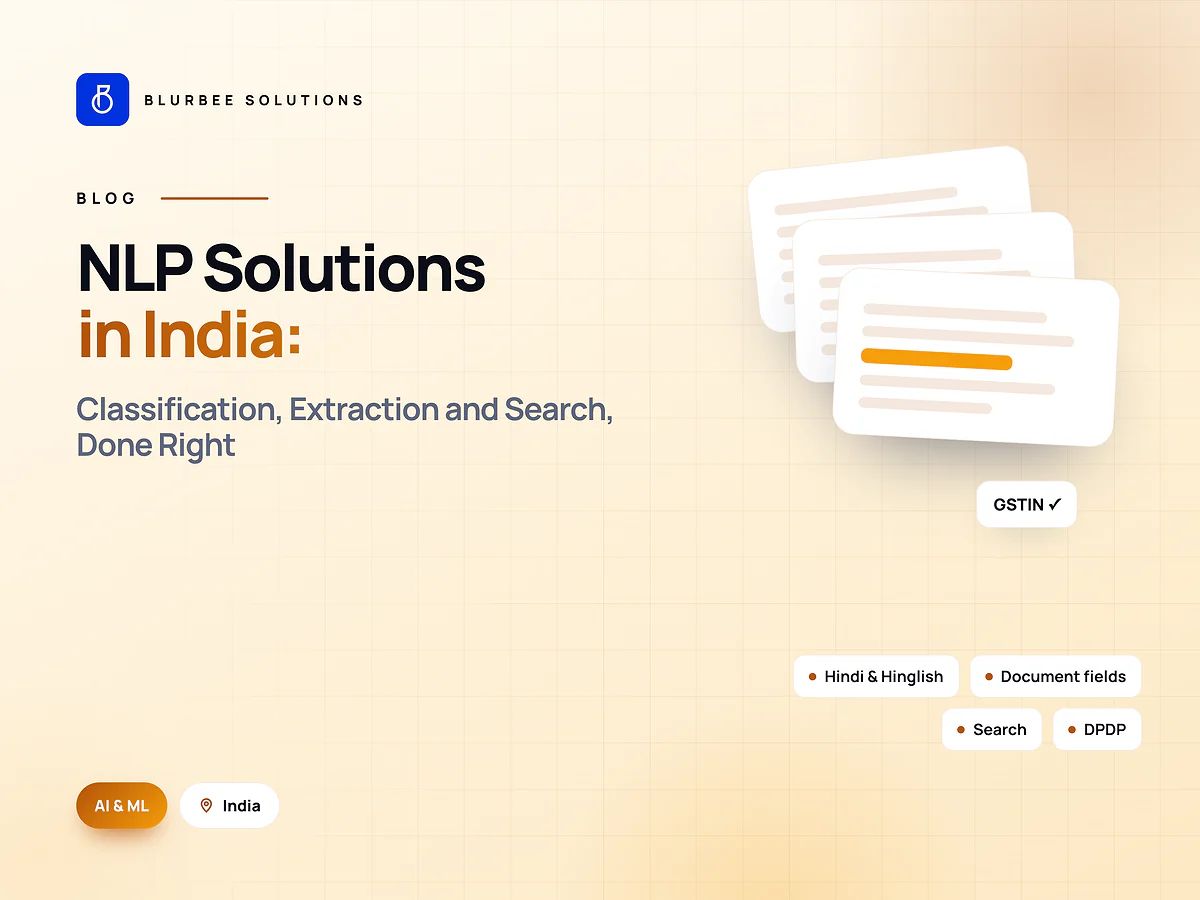
Indian businesses run on text. Customer support tickets in English, Hindi and Hinglish. Invoices, purchase orders and KYC documents. Emails from distributors, WhatsApp messages from customers, contracts, claims, complaints. Much of it is read and routed by hand, which is slow, inconsistent and expensive at scale.
Natural language processing can take on a large share of that work, if it is built carefully. This guide covers the three NLP tasks that deliver most value for fintech, SaaS, manufacturing and enterprise IT teams across India: classification, extraction and search.
Classification: routing text to the right place
Classification assigns a category to each piece of text: complaint or query, billing or technical, urgent or routine, product line, region. Done well, it routes tickets to the right team instantly, prioritises urgent cases and gives managers real data on what customers write about.
Two approaches:
- Large language models work with a few examples and handle messy text well. Good for getting started and for many categories with little labelled data.
- Classic or small fine-tuned models trained on labelled history are cheaper and faster at high volume.
We usually start with an LLM to prove the task and build labelled data, then compare a smaller model on cost and accuracy once volume justifies it. See generative AI vs traditional ML for the trade-off.
Extraction: pulling fields from documents
Extraction pulls structured fields from unstructured text: invoice numbers, GSTINs, amounts and dates from invoices; names, addresses and ID numbers from KYC documents; parties, dates and obligations from contracts.
For scanned documents, extraction is combined with OCR and layout-aware models. Scan quality varies widely in Indian document flows, so we sample OCR output and measure field-level accuracy before automating anything. Validation rules catch impossible values, such as a GSTIN with the wrong format or totals that do not add up.
Search: finding the right answer in any language
Multilingual search lets users find relevant documents whatever language or script they type in. It combines:
- Keyword search for exact terms such as policy numbers, product codes and names.
- Semantic search for meaning, so a question phrased differently still finds the right answer.
For question-answering over documents, search becomes the retrieval layer of a RAG system; see RAG and knowledge base systems in India.
Indian languages and Hinglish
This is where Indian NLP projects most often fail quietly. A model that works well on English tickets can be much weaker on Hindi, Tamil or Bengali, and weaker still on Hinglish written in Latin script, which is how many customers actually type.
What works:
- Measure accuracy separately for each language and script.
- Include transliterated and code-mixed text in the evaluation set.
- Choose models tested on Indic languages. AI4Bharat at IIT Madras releases open Indic models and datasets such as IndicBERT.
- Consider translation as a step, for example through MeitY's Bhashini platform, and test whether it helps or hurts for your task.
Humans in the loop
No NLP system is perfect. The pattern that delivers most value is confidence-based routing: confident predictions are automated, uncertain ones go to a person through a simple review screen. Corrections become new labelled data, so the system improves over time.
DPDP and data handling
Messages and documents usually contain personal data, so the DPDP Act applies. Minimise what is processed, redact identifiers the task does not need, apply retention limits, and know where any external model provider processes data. For sensitive data, self-hosted models in Indian cloud regions are an option.
What it costs
Indicative budgets for a first production release, excluding GST, hosting and model usage:
| Project | Typical budget |
|---|---|
| Ticket or message classification | ₹4-10 lakh |
| Document field extraction | ₹6-15 lakh |
| Multilingual search | ₹8-20 lakh |
| Combined pipeline with review interface | ₹15-30 lakh |
A worked example: support ticket routing
An Indian fintech receives thousands of support messages a day in English, Hindi and Hinglish across email, app chat and WhatsApp.
An evaluation set of a few hundred labelled messages per language shows an LLM classifier performs well in English and noticeably worse on Hinglish. Adding Hinglish examples to the prompt closes part of the gap. As corrected labels accumulate from the review screen, a small fine-tuned model is trained and compared on cost and accuracy.
Confident predictions route automatically; uncertain ones go to a triage agent. Personal identifiers are redacted before any external model call. Within weeks, most messages reach the right team without manual triage, and the team has data on what customers actually write about.
Start with a sample and an evaluation set
The first fixed-scope project takes a sample of your real text, defines the categories or fields you need, builds an evaluation set and measures what accuracy is achievable per language. Two to four weeks, and a clear view of what can be automated before you commit to production.
NLP in India, in numbers
Blurbee quoted ranges, 2026, for a first production release. Excludes GST, hosting and model usage. Indicative bands, not quotations.
Why Indian teams build NLP with Blurbee
We measure accuracy per language and per category, route uncertain cases to people, and choose between classic models and LLMs on cost and quality evidence rather than fashion.
- Fixed-scope first projectTwo to four weeks, priced as a number rather than an estimate, so you have evidence before a longer commitment.
- One delivery lead, namedYou always know who to ask. No account manager relaying questions to a team you never meet.
- Code and IP are yoursAssigned in writing, handed over with repositories, infrastructure definitions and documentation whether or not you continue with us.
- Performance budgets in CICore Web Vitals and bundle size gate the build. Slow does not ship.
- Accessibility to WCAG 2.2 AAReviewed with automated and manual passes, not claimed on a slide.
- Written overlap disciplineStanding calls inside your working window, everything else asynchronous with a decision log.