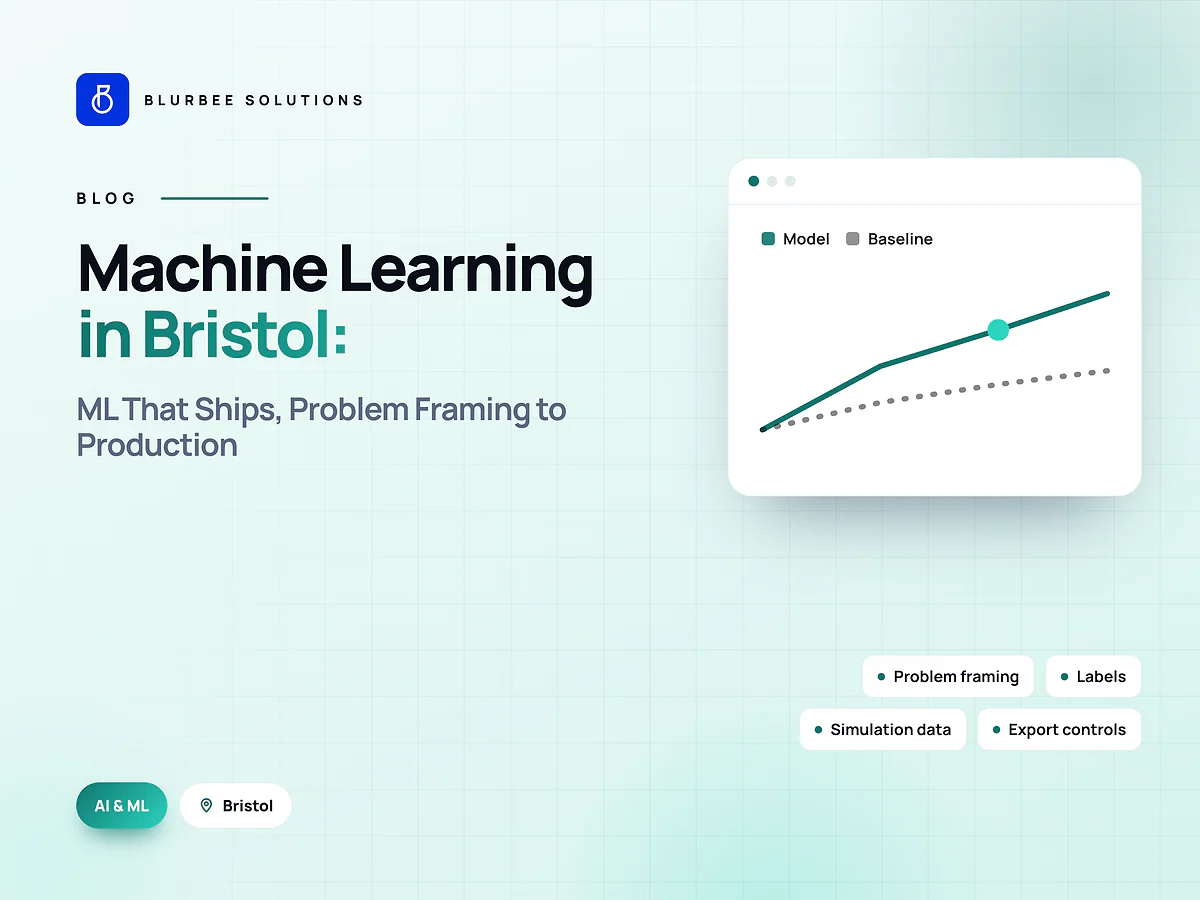
Machine Learning Solutions in Bristol: ML That Ships, From Problem Framing to Production
How Bristol aerospace and creative-tech teams take ML from problem framing to production: labels, simulation data, validation and export controls.

Bristol produces some of the most interesting machine learning problems in the UK. The aerospace cluster around Filton generates enormous volumes of simulation and test data. The creative-tech and robotics scene around Temple Quarter works with images, motion and sensor streams. What these teams often share is a notebook full of promising experiments that never became something people use.
This is how we take ML from problem framing to production.
Stage 1: frame the problem as a decision
Most stalled ML projects fail here, before any modelling. "Use ML on our test data" is an idea, not a problem. Framing turns it into a decision:
- What does the model predict? A fault, a failure time, a defect, a quality score.
- For whom, and when? An engineer during a test campaign, an operator on a line.
- What action follows? Inspect, rerun, flag, adjust.
- What does a wrong answer cost? A missed defect and a false alarm are rarely equal.
Good framing decides the data you need, the metric that matters, and sometimes that ML is not the right tool.
Stage 2: data and labels
Bristol teams often have plenty of data and few reliable labels. Options, roughly in order of cost:
- Use existing outcomes recorded in maintenance, quality or test systems.
- Active learning: label the examples the model is most uncertain about first.
- Weak supervision: derive approximate labels from engineering rules.
- Simulation outputs as labels, with care about the gap to reality.
- Self-supervised pre-training on unlabelled data, then fine-tuning on a small labelled set.
Simulation data is valuable, but models trained only on simulation often disappoint on real equipment. Validate on real measurements wherever possible.
Stage 3: model, starting simple
Start with a simple baseline. For tabular engineering data, gradient-boosted trees are often hard to beat and easier to explain. Deep learning earns its place for images, signals, text and very large datasets. Every run is recorded with its code, data version and settings, so results are reproducible.
Stage 4: validate against real use
Validation must match how the model will be used: later time periods, different equipment, new scenarios. Random splits of historical data often overstate performance because similar examples land on both sides. Break results down by condition and study the errors. For a fuller testing method, see how we test a model before it ships.
Stage 5: deploy and own it
A model is only useful in production: behind an API, in a batch job, or embedded in a tool engineers already use. Production also means monitoring for drift, a retraining process and a named owner. See MLOps from notebook to production.
Export controls and data handling
Some defence and aerospace data falls under UK strategic export controls, which can restrict who may access it, including engineers outside the UK. Check the classification of every dataset before it is shared. Where data cannot leave a UK environment, we can work on derived or synthetic data, or limit our role to the parts of the pipeline that do not touch controlled data. UK GDPR applies wherever personal data is involved.
Rates in Bristol
Bristol agencies typically charge £50-95 per hour for mid to senior engineering. Our blended AI team is £24-47. Framing, data assessment and a baseline model usually take four to six weeks. We share five hours of live overlap with UK working hours.
A worked example: test-rig anomaly detection
A Bristol aerospace supplier runs long test campaigns on components and wants to flag anomalous runs early.
Framing turns this into a decision: should an engineer review this run today? Labels are scarce, but years of test logs exist, and some runs have documented failure investigations. The team starts with an unsupervised anomaly score on sensor features, uses engineer reviews of the highest-scoring runs as labels, and trains a simple classifier as labels accumulate. Validation uses the latest campaign only.
Because some test data is export-controlled, the model is trained inside the supplier's UK environment, and the offshore team works on pipeline code and synthetic data.
Start with framing and a baseline
The first fixed-scope project is a framing workshop, a data and label assessment, and a simple baseline model that shows what is achievable. If the numbers justify it, the path to production follows. For choosing between ML and generative AI, see generative AI vs traditional ML.
ML in Bristol, in numbers
Blurbee's assessment of the main reason stalled ML projects we review never shipped, share of cases. Indicative.
Why Bristol teams ship ML with Blurbee
We frame the problem before we touch a model, validate against conditions the model will really see, and deliver something that runs in production, not a slide with an accuracy number.
- Fixed-scope first projectTwo to four weeks, priced as a number rather than an estimate, so you have evidence before a longer commitment.
- One delivery lead, namedYou always know who to ask. No account manager relaying questions to a team you never meet.
- Code and IP are yoursAssigned in writing, handed over with repositories, infrastructure definitions and documentation whether or not you continue with us.
- Performance budgets in CICore Web Vitals and bundle size gate the build. Slow does not ship.
- Accessibility to WCAG 2.2 AAReviewed with automated and manual passes, not claimed on a slide.
- Written overlap disciplineStanding calls inside your working window, everything else asynchronous with a decision log.