Generative AI vs Traditional ML: Which One Actually Solves Your Problem
A plain-language guide to choosing between generative AI, classic machine learning or simple automation, with examples, costs and a checklist.

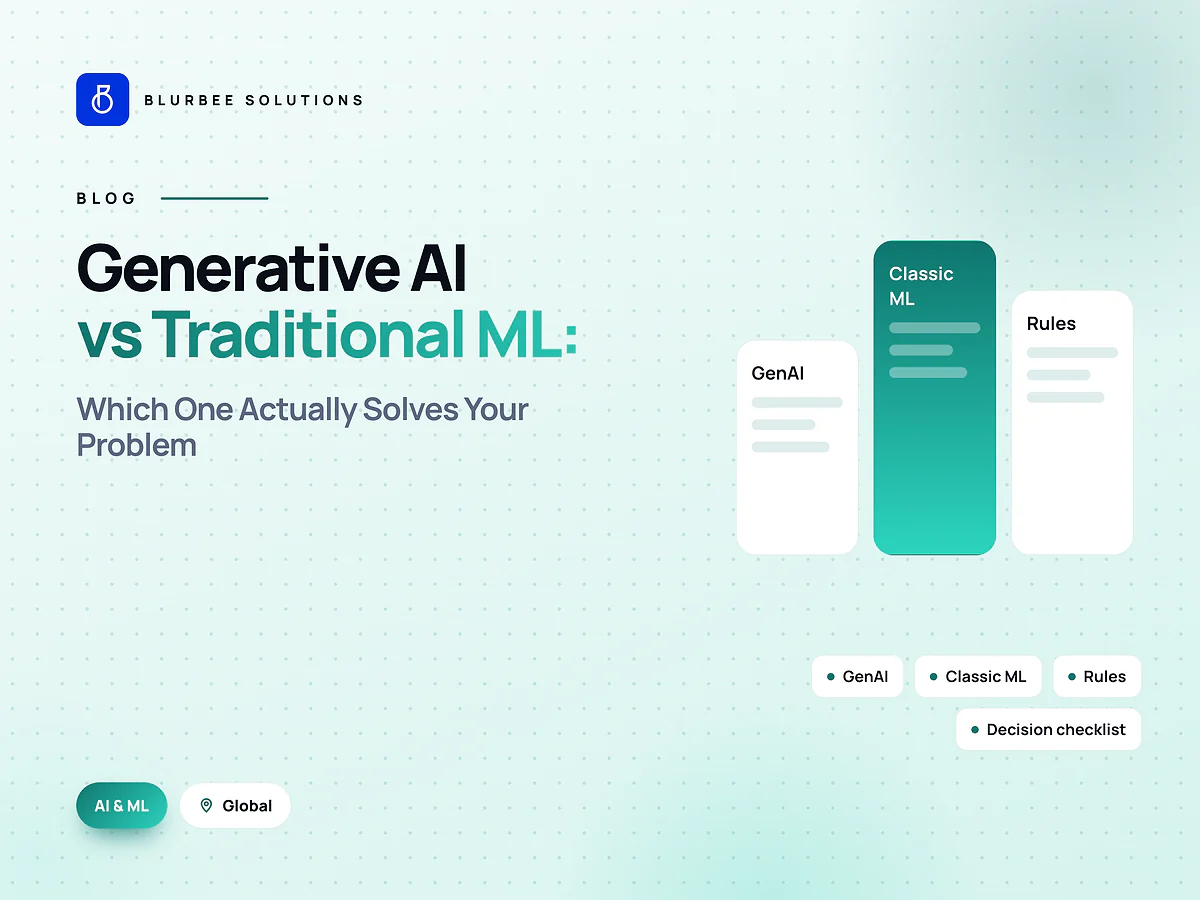
"We want to use AI" is now a common opening line in our first calls. Almost always, what the team means is generative AI, because that is what has been in the news. Sometimes that is exactly right. Often the problem is better solved by a classic machine learning model, and surprisingly often by plain automation with no AI at all.
This guide is a decision tool for choosing between the three before you commit budget.
The three options, in plain language
Generative AI produces new content from instructions: text, summaries, answers, code. Large language models are the familiar example. It works with little or no labelled data, because the model already knows a lot about language.
Traditional machine learning learns from historical examples with known outcomes, then predicts a number or a category for new cases. Demand next week. Will this customer churn? Is this transaction fraud? It needs labelled history, and it is usually very good at the narrow thing it was trained for.
Automation follows rules a person wrote: if the invoice is under this amount and matches the purchase order, approve it. No learning, no surprises.
Start with the problem, not the technology
Ask four questions about the problem.
1. Is the output language or a decision?
If the output is text, such as a draft reply, a summary or an answer, generative AI is the natural fit.
If the output is a number or a category, such as a forecast, score or label, classic ML usually wins, provided you have history.
2. Can the logic be written down?
If an experienced person can state the rule, automate the rule. It will be cheaper, faster, fully predictable and easy to audit. Many "AI" projects are really rule projects that nobody had time to write down.
3. Do you have labelled history?
Classic ML needs past examples with known outcomes: transactions marked as fraud or not, customers who churned or stayed, past demand by week. Without that, generative AI's ability to work from instructions and a few examples is an advantage.
4. What does a wrong answer cost, and who must understand it?
High-stakes decisions about people, such as credit, hiring or insurance, need explainability and human review. Classic models with interpretable features and rule-based systems are easier to explain. Generative AI can be audited through citations and logs, but it should rarely make those decisions on its own.
Typical matches
| Problem | Usual best fit |
|---|---|
| Draft customer replies, summarise tickets | Generative AI |
| Answer questions from policies and manuals | Generative AI with retrieval (RAG) |
| Extract fields from messy emails and documents | Generative AI or document AI |
| Forecast demand, staffing or cash flow | Classic ML |
| Score fraud, churn or credit risk | Classic ML |
| Recommend products from purchase history | Classic ML |
| Approve within thresholds, route by rules | Automation |
Cost behaves differently
Generative AI usually costs money per request, in tokens. That is fine at modest volume and can become significant at scale. Classic ML costs more upfront if labelled data needs preparing, then very little to run. Automation is cheapest of all once built.
At high volume on a narrow task, a classic model or a small fine-tuned model often beats a large general model on both cost and accuracy. For the generative side of that trade-off, see fine-tuning vs prompting vs RAG.
The best systems combine them
Real workflows often use all three:
- Generative AI reads an incoming email or document and extracts structured fields.
- A classic model scores the case for risk or priority.
- Rules handle the clear-cut cases automatically.
- A person reviews the uncertain ones.
Each part does what it is good at, and the expensive parts only run where they add value.
Common mistakes
- Using a language model for a forecast. Language models are not designed for numerical prediction from structured history; classic ML is.
- Training a custom model for a language task that a general model handles well with good prompts.
- Using AI where a rule would do, adding cost and unpredictability for no gain.
- Skipping the evaluation set, so nobody can show which approach actually works better.
Decide with your own data
The reliable way to choose is a short proof of value: build a small evaluation set from real cases, try the simplest viable approach, then the next, and compare accuracy, cost per decision, latency and explainability. Two to four weeks is usually enough for the numbers to make the choice obvious.
We build generative AI, classic machine learning and automation for teams across India, the United States, the United Kingdom, the UAE and Canada. For classic ML delivered end to end, see ML that ships, from problem framing to production; for production GenAI, see from GPT wrapper to production-grade GenAI.
A worked example: one problem, three answers
An insurance claims team wants to "use AI on claims".
- Reading claim emails and documents to pull out policy number, incident date and claimed amount: generative AI or document AI, because the input is messy language.
- Scoring which claims are likely fraudulent: classic ML, trained on years of claims with known outcomes.
- Fast-tracking small claims under a threshold with no flags: a rule.
Built together, the system extracts the data, scores the risk, automates the obvious cases and sends the rest to a handler with everything in one place. Built as "an AI chatbot for claims", it would have done none of these well.
A one-page checklist
Before committing budget, write down:
- The decision or output the system must produce.
- Whether a rule could produce it.
- What data exists, and whether outcomes are labelled.
- The cost of a wrong answer, and who must be able to explain it.
- Expected volume, which drives running cost.
- How success will be measured, in a number.
If you can fill that in, the right approach is usually clear before any code is written.
Choosing an approach, in numbers
Blurbee's assessment of the usual best-fit approach, scored out of 10 for fit. Opinion based on our engagements; your data decides.
Why teams choose their AI approach with Blurbee
We build all three: generative AI, classic machine learning and rule-based automation. That means we can recommend the cheapest one that solves your problem, and prove it with your data.
- Fixed-scope first projectTwo to four weeks, priced as a number rather than an estimate, so you have evidence before a longer commitment.
- One delivery lead, namedYou always know who to ask. No account manager relaying questions to a team you never meet.
- Code and IP are yoursAssigned in writing, handed over with repositories, infrastructure definitions and documentation whether or not you continue with us.
- Performance budgets in CICore Web Vitals and bundle size gate the build. Slow does not ship.
- Accessibility to WCAG 2.2 AAReviewed with automated and manual passes, not claimed on a slide.
- Written overlap disciplineStanding calls inside your working window, everything else asynchronous with a decision log.