Generative AI Solutions in India: From GPT Wrapper to Production-Grade GenAI
What separates a GPT wrapper from production GenAI in India: evaluation sets, DPDP-ready data handling, Indic languages, run costs and INR budgets.

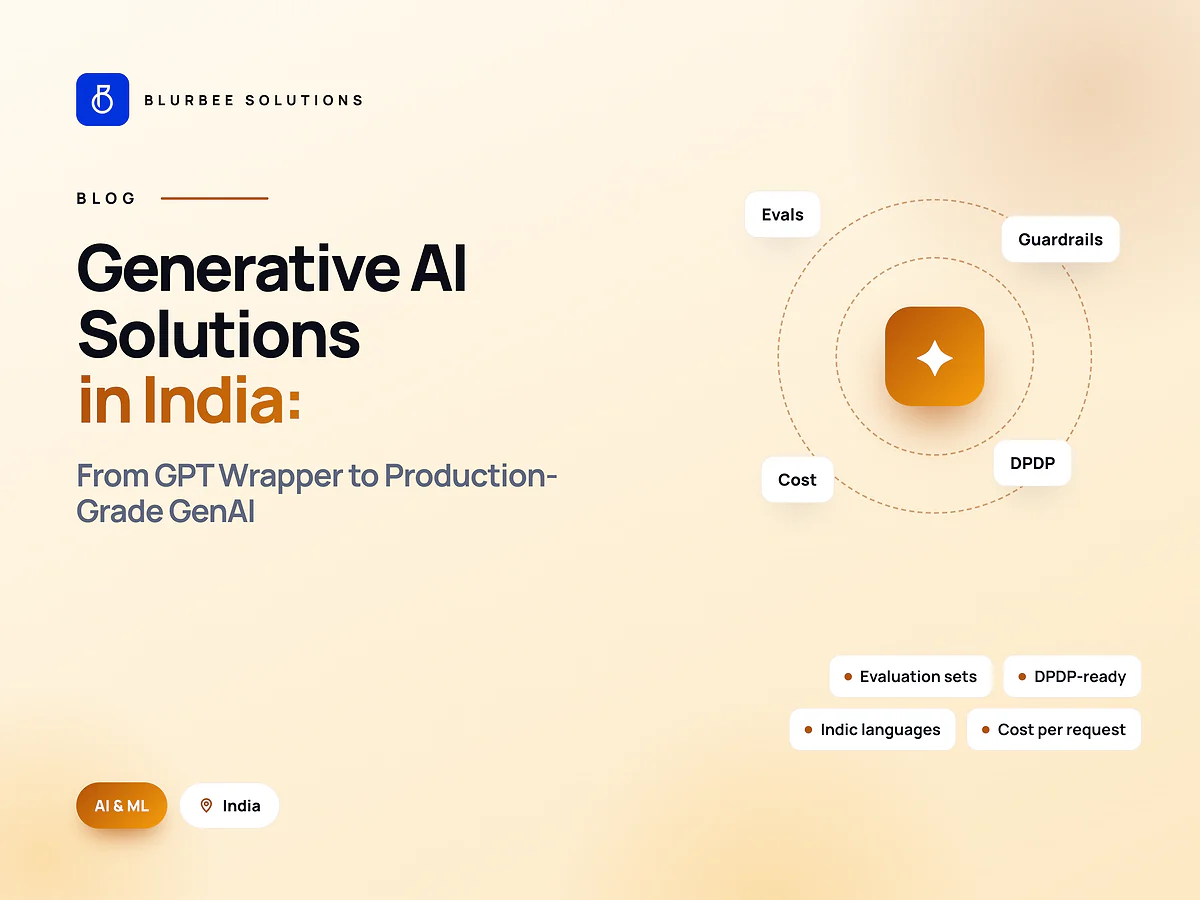
Most generative AI projects in India start the same way. Someone builds a demo in an afternoon, it impresses the leadership team, and six months later it is still a demo. The gap between the two is not a better model. It is everything around the model: data, evaluation, guardrails, cost control and compliance.
This is what that gap contains, and how to budget for crossing it.
What a "GPT wrapper" actually is
A wrapper takes user input, sends it to a hosted large language model, and displays the reply. There is nothing wrong with that as a starting point. It is the fastest way to find out whether a task suits a language model at all.
The problem is treating it as the finished product. A wrapper has no knowledge of your business beyond what fits in the prompt. It has no way to tell you whether today's answers are better or worse than yesterday's. It will happily answer questions it should refuse, and it logs everything a customer types, including their phone number and account details, to a provider you may not have a processing agreement with.
The five things production GenAI adds
Across the GenAI work we deliver, the model call is usually under 15% of the effort. The rest is:
- Grounding. Retrieval over your own documents, product data or tickets, so answers reflect your business rather than the public internet.
- Evaluation. A fixed set of real inputs with accepted answers, scored automatically on every change.
- Guardrails and review. Refusal rules, output checks, and a human-in-the-loop path for anything consequential.
- Cost and latency control. Caching, model routing and per-request budgets.
- Compliant logging. What is stored, for how long, where, and who can see it.
Skip any of these and the project stalls at the same point: someone asks "how do we know it's right?" and nobody has a number.
Build the evaluation set before the prompts
This is the single most useful habit in GenAI delivery. Before tuning anything, collect 50 to 200 real inputs from the workflow you are automating, and write down the answer a competent employee would accept for each.
Then every decision becomes measurable. Is the cheaper model good enough? Run the set. Did the new prompt fix billing questions but break refunds? Run the set. Is it ready to launch? Agree the threshold in advance, then run the set.
Teams that skip this end up arguing from anecdotes, usually the one bad answer a senior stakeholder saw on a Tuesday.
The DPDP Act covers prompts and logs too
The Digital Personal Data Protection Act, 2023 applies wherever personal data is processed, and GenAI systems process a lot of it without anyone deciding to. Customers type account numbers into chat boxes. Retrieved support tickets contain names and addresses. Conversation logs are kept "for debugging" with no retention limit.
Practical controls we build in:
- Redaction before the model call for identifiers the task does not need.
- A processor agreement with every model provider that sees personal data, and a record of where that provider processes it.
- Retention limits on conversation logs, enforced by the system rather than a policy document.
- Clear notice at the point of use that an AI system is involved and what happens to the input.
None of this is exotic. It is simply easier to design in during week one than to retrofit after a customer asks where their data went.
Decide language scope in week one
India's Eighth Schedule lists 22 languages, and your users will type in several of them, often in Latin script and mixed with English. The leading models handle Hindi and the major Indic languages reasonably well, but quality varies noticeably by language and drops on code-mixed input.
So language scope is a scoping decision, not a feature to add later. Pick the languages you will support, put real examples of each, including transliterated Hinglish, into the evaluation set, and measure them separately. A system that scores well overall but fails on Tamil queries is a system that fails a specific set of customers.
Cost per request is an architecture decision
A demo that costs a few rupees per conversation can become a serious monthly bill at production volume. We model cost per request during the proof of value, using real prompt and response lengths, and set a budget alert before launch.
The levers that matter most:
- Model routing. Send simple classification steps to a small, cheap model and reserve the expensive one for the steps that need it.
- Caching of repeated context and common answers.
- Shorter prompts. Long system prompts are paid for on every request.
- Batching for anything that does not need a real-time response.
Together these routinely halve run costs without a measurable drop in evaluation scores.
Hosted models, open weights, or both
We decide per task. Hosted frontier models from OpenAI, Anthropic and Google are usually strongest for complex reasoning and let you iterate fastest. Open-weights models hosted in your own cloud suit high-volume narrow tasks, and cases where data may not leave your environment.
Either way, the model sits behind an abstraction so it can be swapped when the evaluation set shows a cheaper or local option is good enough. Locking a product to one provider's API shape is an avoidable cost.
What it costs in India
Our indicative bands, excluding GST and model usage:
| Project | Typical budget |
|---|---|
| Proof of value with evaluation set | ₹4-8 lakh |
| Internal assistant over documents | ₹8-20 lakh |
| Customer-facing assistant with guardrails | ₹15-35 lakh |
| Agentic workflow writing to other systems | ₹20-45 lakh |
Add 18% GST if you are billed within India, and budget model usage separately, based on the cost-per-request figure from the proof of value.
Start with one workflow and an evaluation set
The first fixed-scope project we recommend is narrow on purpose: one workflow, one evaluation set, one working pipeline, and a cost-per-request figure. Two to four weeks.
At the end you know whether the task suits GenAI, what "good enough" looks like as a number, and what it will cost to run. That is enough to make the production decision on evidence rather than on the demo.
Generative AI in India, in numbers
Blurbee quoted ranges, 2026. Excludes GST and model or API usage, which is billed at cost. Indicative bands, not quotations.
Why Indian teams build GenAI with Blurbee
We build the evaluation set before we tune a single prompt, treat prompts and logs as personal data under the DPDP Act, and quote cost per request alongside the build price, so the business case survives contact with real traffic.
- Fixed-scope first projectTwo to four weeks, priced as a number rather than an estimate, so you have evidence before a longer commitment.
- One delivery lead, namedYou always know who to ask. No account manager relaying questions to a team you never meet.
- Code and IP are yoursAssigned in writing, handed over with repositories, infrastructure definitions and documentation whether or not you continue with us.
- Performance budgets in CICore Web Vitals and bundle size gate the build. Slow does not ship.
- Accessibility to WCAG 2.2 AAReviewed with automated and manual passes, not claimed on a slide.
- Written overlap disciplineStanding calls inside your working window, everything else asynchronous with a decision log.