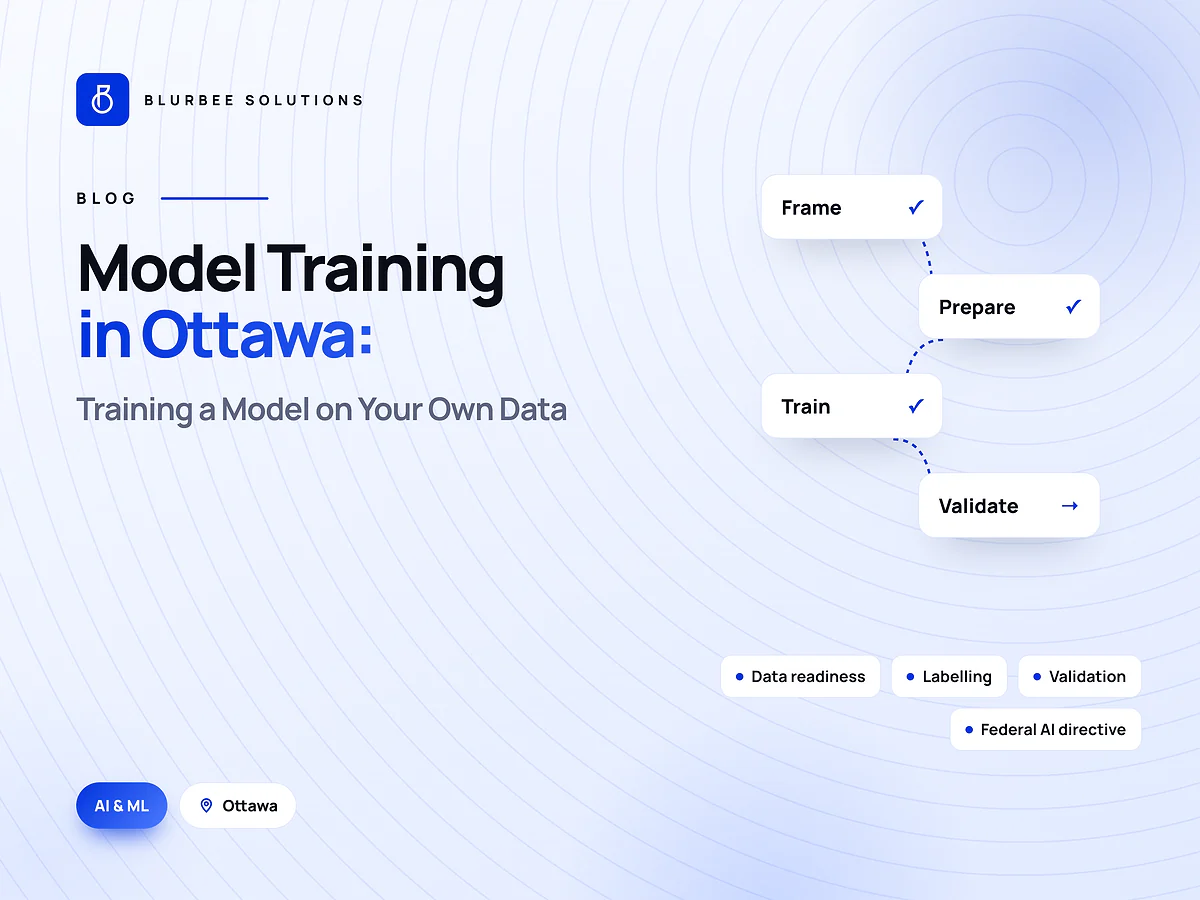
Model Training in Ottawa: Training a Model on Your Own Data, Start to Finish
Training a model on your own data for Ottawa govtech and telecom teams: data readiness, labelling, validation, the federal AI directive and CAD costs.

Ottawa's Kanata tech park and the government departments downtown have something in common: a lot of valuable data and strict rules about what can be done with it. Telecom firms hold years of network events. Government programmes hold case histories. Defence suppliers hold test data. Training a model on that data can answer questions no general AI model can, but only if the project is set up properly from the start.
This is what training a model on your own data involves, start to finish.
First, check you need to train at all
Training a custom model is the right choice when the task is specific to your data and no general model does it well:
- Predicting outcomes from your operational history, such as call volumes, equipment failures or case durations.
- Classifying your own documents, tickets or network events into your categories.
- Detecting anomalies in your systems' behaviour.
For general language tasks, such as summarising, drafting or answering questions from documents, prompting or fine-tuning an existing model is usually faster and cheaper. See generative AI vs traditional ML for the decision.
Step 1: define the decision and the metric
What decision will the model support, who acts on it, and what does a wrong answer cost? That determines the metric. Missing a network fault and raising a false alarm have very different costs, so "accuracy" alone is rarely the right measure. We agree the acceptance bar before any training.
Step 2: data access and readiness
In Ottawa this step often takes longest, for good reasons: security screening, data-sharing agreements and data-location rules. Federal contracts may require Contract Security Program screening for anyone with access. We can work entirely inside your environment so data never leaves it.
Then the readiness check: how much data exists, how complete it is, whether outcomes are recorded, and whether the past still resembles the present.
Step 3: preparation and labelling
Real data is messy: missing values, inconsistent formats, duplicates, and labels whose meaning changed over the years. Preparing it is the largest part of the work and the largest source of value. If labels are needed, we design labelling guidelines, measure agreement between labellers and audit samples, because inconsistent labels teach inconsistent behaviour.
Step 4: train, tune and compare
We start with simple, well-understood models as a baseline, then try more complex ones only if they beat it meaningfully. Every run is recorded with its code, data version and settings so it can be reproduced. For structured data, gradient-boosted trees are often hard to beat; deep learning earns its place for images, audio, text and very large datasets.
Step 5: validate honestly
Test on data the model has never seen, ideally from a later time period than the training data, to mimic real use. Break results down by important groups and conditions. Study the errors, not just the score. For how we test models before they ship, see AI model evaluation in Toronto.
Step 6: package and document
A model is only useful when it can be deployed, monitored and retrained. We deliver the model, the training pipeline, versioned data references, an evaluation report and documentation. For keeping it healthy afterwards, see MLOps from notebook to production.
Government rules on automated decisions
Federal institutions using automated decision systems follow the Treasury Board Directive on Automated Decision-Making, in effect since 2019. It requires an Algorithmic Impact Assessment, transparency to affected people, quality assurance including testing for unintended bias, and human involvement proportionate to the impact level. Good documentation from training makes the assessment far easier.
There is no federal AI statute in force; the proposed Artificial Intelligence and Data Act lapsed when Parliament was prorogued in January 2025. Privacy law, including PIPEDA and the Privacy Act for government data, still applies.
Rates in Ottawa
Ottawa agencies typically charge CA$85-165 per hour for mid to senior work. Our blended AI team is CA$41-82. A data-readiness assessment and first training run is usually four to eight weeks. We keep 3.5 hours of live overlap with Eastern time.
A worked example: predicting network faults
An Ottawa telecom team wants to predict equipment faults a day ahead from network event logs.
Framing sets the decision: which sites to inspect tomorrow, with a limited crew. The metric becomes precision in the top twenty predictions per day, not overall accuracy. Data preparation reveals that event codes changed after a firmware update two years ago, so older data needs mapping. Validation uses the most recent three months, never seen in training. The baseline model is a gradient-boosted tree; a more complex model is only adopted if it beats it clearly on that top-twenty metric.
The result is a ranked daily list for the crew, an evaluation report, and a pipeline that can be retrained when firmware changes again.
Start with a readiness assessment
The first fixed-scope project assesses your data against the decision you want to support, trains a baseline model, and reports honestly on what accuracy is achievable. Then you decide whether to invest further.
Model training in Ottawa, in numbers
Blurbee delivery practice, indicative split for a first custom model. Data work dominates.
Why Ottawa teams train models with Blurbee
We check data readiness before promising accuracy, document every training run so it can be reproduced and audited, and design for the screening and data-location rules federal work brings.
- Fixed-scope first projectTwo to four weeks, priced as a number rather than an estimate, so you have evidence before a longer commitment.
- One delivery lead, namedYou always know who to ask. No account manager relaying questions to a team you never meet.
- Code and IP are yoursAssigned in writing, handed over with repositories, infrastructure definitions and documentation whether or not you continue with us.
- Performance budgets in CICore Web Vitals and bundle size gate the build. Slow does not ship.
- Accessibility to WCAG 2.2 AAReviewed with automated and manual passes, not claimed on a slide.
- Written overlap disciplineStanding calls inside your working window, everything else asynchronous with a decision log.