RAG and Knowledge Base Systems in India: Retrieval-Augmented Generation Without the Hype
How to build a RAG knowledge base that answers correctly: hybrid search, reranking, permissions, Indic and scanned documents, evaluation and INR budgets.

Retrieval-augmented generation has become the default answer to "how do we make AI answer from our own documents?" It is the right pattern. It is also the one most often built badly, because the demo works on ten hand-picked documents and fails quietly on ten thousand real ones.
This is RAG without the hype: what goes wrong, what to build instead, and how to know it is working. For the wider picture of production GenAI, see our generative AI guide for India.
How RAG works, briefly
A RAG system does two things. First it retrieves: it searches your documents for passages relevant to a question. Then it generates: a language model writes an answer using those passages, ideally citing them.
The model can only be as good as the passages it is given. That is the most important sentence in this article.
Most failures are retrieval failures
When a RAG system gives a wrong answer, the instinct is to change the prompt or the model. Usually the real cause is that the right passage was never retrieved. Common reasons:
- Poor chunking. Documents split mid-sentence or mid-table, or chunks so large the relevant line is diluted.
- Pure vector search. Semantic search is weak on exact terms such as product codes, clause numbers, names and abbreviations, and business documents are full of them.
- No metadata filters. Answering a 2026 policy question from a 2021 document because nothing filtered by date or version.
- Unreadable sources. Scanned PDFs indexed as empty pages, and tables flattened into nonsense.
- Stale index. Deleted or superseded documents still being retrieved.
So we measure retrieval separately. For each question in the evaluation set, did the correct passage appear in the top few results? If not, no prompt will save the answer.
What good retrieval looks like
Structure-aware chunking. Split by headings, sections and clauses, keep tables intact, and attach the document title and section path to each chunk so it makes sense on its own.
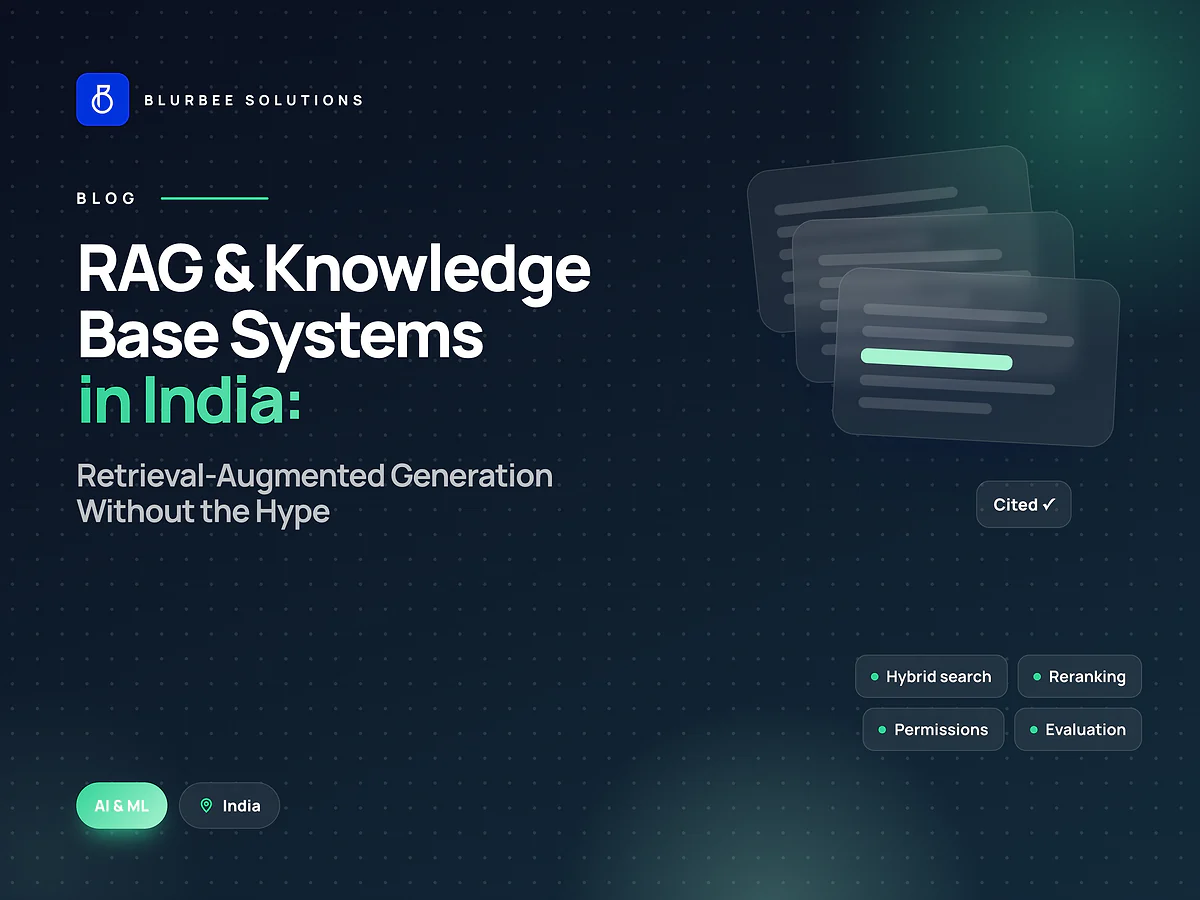
Hybrid search. Combine keyword search, which is strong on exact terms, with vector search, which is strong on meaning, and merge the results. For business documents this almost always beats either alone.
Reranking. Retrieve a wider set, then use a reranking model to order it by true relevance before passing the best few to the language model.
Metadata filters. Document type, department, product, version, date and language, all filterable at query time.
Refusal when retrieval is weak. If nothing relevant is found, the system should say so rather than improvise.
Permissions belong inside the search
In enterprise knowledge bases, not everyone can see everything. HR policies, board papers, customer contracts and pricing are restricted.
Permissions must be enforced during retrieval. Each chunk carries access metadata from its source system, and search only returns chunks the user is allowed to see. Filtering the answer after the model has read a restricted passage is too late, because the information may already have shaped the response.
Scanned documents and Indian languages
Indian organisations hold a lot of knowledge in scanned PDFs, forms and mixed-language documents.
Scanned documents need OCR with quality checks, and tables and forms need layout-aware extraction. We sample OCR output and measure error rates before indexing, rather than trusting it blindly.
Indic languages need embedding models tested on those languages, since performance varies widely. Options include indexing in the original language, translating queries, or both. MeitY's Bhashini platform is worth evaluating for translation. Whatever the approach, the evaluation set must include real questions in each supported language, including transliterated Hinglish.
Evaluate in two layers
We ship every RAG system with an evaluation set of 50 to 200 real questions and accepted answers, scored on every change:
- Retrieval: whether the correct passage is in the top results, measured as recall at k.
- Generation: whether the answer is faithful to the retrieved passages, whether it answers the question, and whether the citations are correct.
Two layers tell you where to look when something breaks. One combined score does not.
Keeping it current
A knowledge base is only as good as its freshness. We sync from source systems such as SharePoint, Google Drive, Confluence, ticketing tools and databases, re-index changed documents, remove deleted ones, and store the version and date with every chunk. Answers cite the document and its date, so users can judge whether it is current.
Which vector database
Often the one you already run. PostgreSQL with pgvector handles many business-scale knowledge bases comfortably and keeps operations simple. Dedicated vector databases earn their place at larger scale. The choice matters much less than chunking, hybrid search and evaluation.
DPDP Act and the index
If documents contain personal data, the index is another copy of it. Under the Digital Personal Data Protection Act, 2023, retention limits, access controls and deletion obligations apply to the index as well. Exclude personal data the use case does not need, and make sure deleting a source record removes its chunks.
What it costs
Indicative budgets for a first production release, excluding 18% GST, hosting and model usage:
| Project | Typical budget |
|---|---|
| Internal document Q&A | ₹6-12 lakh |
| Customer support knowledge base | ₹10-20 lakh |
| Multilingual with scanned documents | ₹14-28 lakh |
| Permission-aware enterprise search | ₹18-40 lakh |
Start with fifty questions
The first fixed-scope project uses a sample of your documents and fifty real questions. We build the retrieval pipeline, measure it, and deliver an evaluation report showing how often the right passage is found and how often the answer is correct. Two to four weeks, fixed price in INR, and a number to decide on.
RAG in India, in numbers
Blurbee quoted ranges, 2026, for a first production release. Excludes GST, hosting and model usage. Indicative bands, not quotations.
Why Indian teams build RAG with Blurbee
We measure retrieval before generation, enforce document permissions inside the search, and ship an evaluation set with every system, so you know how often it is right, not just that it sounds right.
- Fixed-scope first projectTwo to four weeks, priced as a number rather than an estimate, so you have evidence before a longer commitment.
- One delivery lead, namedYou always know who to ask. No account manager relaying questions to a team you never meet.
- Code and IP are yoursAssigned in writing, handed over with repositories, infrastructure definitions and documentation whether or not you continue with us.
- Performance budgets in CICore Web Vitals and bundle size gate the build. Slow does not ship.
- Accessibility to WCAG 2.2 AAReviewed with automated and manual passes, not claimed on a slide.
- Written overlap disciplineStanding calls inside your working window, everything else asynchronous with a decision log.