App Development in Boston: API and Backend Choices That Make or Break an App
The backend and API decisions behind a Boston biotech or edtech app: REST vs GraphQL, offline sync, auth, HIPAA, 201 CMR 17 and USD costs.

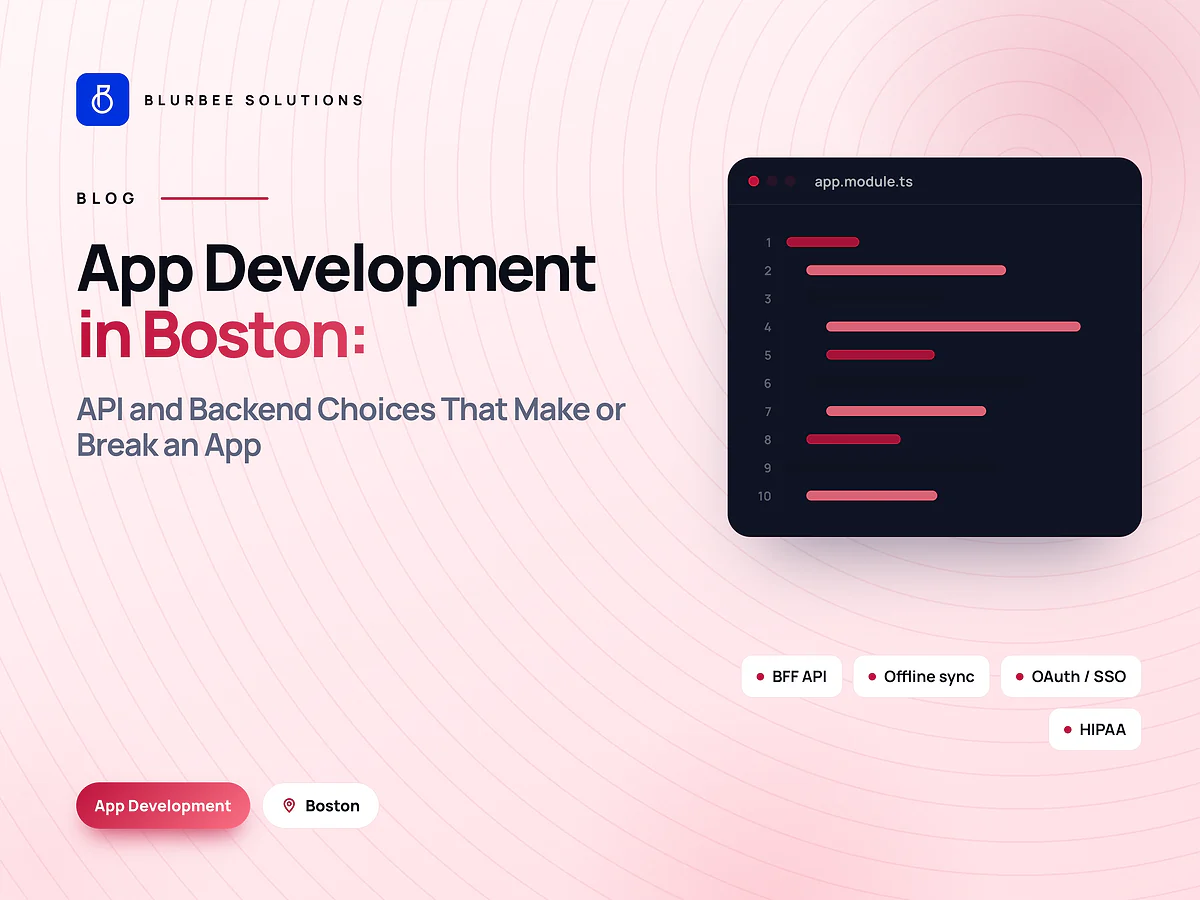
Boston and Cambridge produce a particular kind of mobile app. Biotech companies around Kendall Square want apps for clinical teams, patients or lab staff. Universities and edtech firms want apps for students and researchers. The interfaces get the attention, but the decisions that make or break these apps are underneath: how the API is shaped, how data stays secure, and what happens when the network drops in a lab basement.
This guide covers the backend and API choices that matter most for a Boston mobile app.
Design the API around screens, not tables
The most common cause of slow, fragile apps is a chatty API: a screen that needs eight requests to render, each waiting on a mobile network. Start from the key screens, list the data each needs, and shape the API so most screens need one or two calls.
A backend-for-frontend is often the cleanest way to do that: a thin layer that combines data from internal services and research systems into one response per screen.
REST or GraphQL
Both work for mobile.
- REST is simpler to cache, secure, rate-limit and operate, and every engineer knows it.
- GraphQL helps when screens pull from many sources and over-fetching is costly, at the price of more complex caching and security rules.
For most first releases, REST with a backend-for-frontend is the pragmatic choice. GraphQL earns its place in data-rich apps with many different screen needs.
Version the API from day one
Users do not update apps immediately, so several versions run at once for months. Version the API, keep older versions working, and set a policy for minimum supported app versions with a graceful upgrade prompt. Breaking an old version silently breaks the app for everyone who has not updated.
Offline and unreliable networks
Labs, hospital corridors, field sites and lecture halls all lose signal. Decide early:
- What is cached on the device and for how long.
- How offline changes are queued and synced.
- How conflicts are resolved when two people edit the same record.
- What the user sees while offline and syncing.
Retrofitting offline support after launch usually means rewriting the data layer.
Authentication and permissions
Use proven standards: OAuth 2.0 with OpenID Connect, short-lived access tokens with refresh, and institutional single sign-on where universities or hospitals require it. Permissions are enforced on the server for every request, never trusted from the app. No passwords or long-lived secrets stored in the app.
Sensitive data: HIPAA and Massachusetts rules
HIPAA. If the app handles protected health information for a covered entity, or you act as their business associate, you need a business associate agreement, encryption in transit and at rest, access controls, audit logs and breach procedures. The quiet failures are sensitive data leaking into application logs, crash reports, analytics events or push notification text.
201 CMR 17.00. Massachusetts requires anyone holding residents' personal information to maintain a written information security programme with specific safeguards, including encryption of personal data over public networks and on portable devices.
Research data. Studies often come with institutional review and data use agreements that limit where data can be stored and who can see it. The backend must enforce those limits.
Observability
Track latency and error rates per endpoint and per app version, with request IDs linking app crashes to backend logs. It is the fastest way to tell whether a problem is the app, the network or the backend.
Rates in Boston
Boston agencies typically charge $110-200 per hour for mid to senior engineering. Our blended app team is $24-48. A first release with app, backend-for-frontend and core integrations usually takes ten to eighteen weeks. We keep 3.5 hours of live overlap with Eastern time.
Questions to settle before building screens
- Which systems hold the data, and who owns each integration?
- Which data is sensitive, and where may it be stored, cached and logged?
- Which screens must work offline, and what happens on conflict?
- How do users sign in, and does an institution require SSO?
- How many app versions will we support, and for how long?
- What does each screen need in one call?
Answering these in a short design week saves months of rework after launch.
Start with the API contract
The first fixed-scope project maps key screens to their data and source systems, designs the API contract and auth model, and builds one screen end to end on it. For what follows launch, see a post-launch app roadmap; for backend scaling, see backend architecture that survives 10x growth.
App backends in Boston, in numbers
Blurbee's assessment of backend issues found in mobile apps we inherit, share of cases. Indicative.
Why Boston teams build app backends with Blurbee
We design the API around the screens and the data rules, not the other way round, so the app stays fast, works offline where it must, and passes a security review.
- Fixed-scope first projectTwo to four weeks, priced as a number rather than an estimate, so you have evidence before a longer commitment.
- One delivery lead, namedYou always know who to ask. No account manager relaying questions to a team you never meet.
- Code and IP are yoursAssigned in writing, handed over with repositories, infrastructure definitions and documentation whether or not you continue with us.
- Performance budgets in CICore Web Vitals and bundle size gate the build. Slow does not ship.
- Accessibility to WCAG 2.2 AAReviewed with automated and manual passes, not claimed on a slide.
- Written overlap disciplineStanding calls inside your working window, everything else asynchronous with a decision log.