App and Software Development in Manchester, Birmingham, Leeds and Bristol
A guide for companies across England's regional tech cities: day rates, contractor notice periods, team-extension models and what each city's market actually looks like.

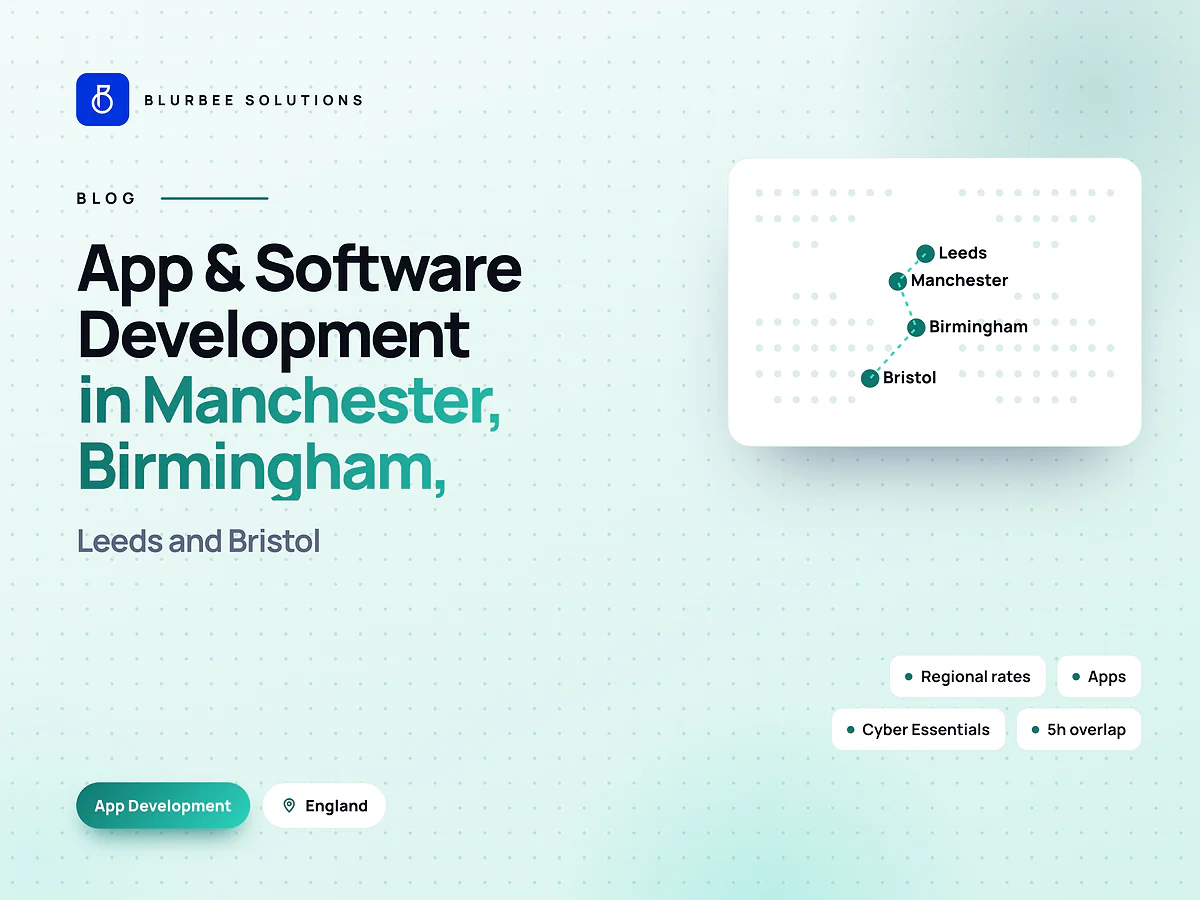
England's regional tech cities have absorbed a large share of what used to be London work, for the straightforward reason that the same engineer costs 35-45% less in Manchester than in Shoreditch. If you are already in one of those cities, the interesting question is different: how do you add capacity when the local market has the same shortage London does, just at a lower price?
The four routes, costed properly
Permanent hire. £6,000-9,000 per month for a mid-to-senior engineer, plus recruitment cost, plus a four-to-twelve-week notice period. The right answer for long-term core capability. The problem is timing — a hire made today starts next quarter, and senior engineers in these cities have several offers.
Day-rate contractor. £450-650 per day, so £9,000-13,000 per month. Fast to start and easy to stop. What you do not get is continuity: when the contract ends the context leaves with them, and you are rarely buying more than one skill.
Regional agency. £45-65 per hour, roughly £7,000-10,000 per month per engineer. You get a team and accountability. You pay for coordination, and you should verify the seniors who pitched are the ones delivering.
Offshore extension. Around £3,000-6,000 per month per full-time equivalent, including QA and a delivery lead, with five hours of daily overlap and no notice period.
The honest adjustment on the last: four to six hours a week of your own time for written direction and review. If your engineering leadership is already stretched, count that properly rather than discovering it in month two.
The five cities are not interchangeable
The rates are similar. The available specialisms are not, and that matters more than price for anything non-generic.
Manchester has the deepest general engineering pool outside London and a genuine product scene. Most likely of the four to have candidates with real distributed-systems and platform experience. Also the most competitive, so hiring timelines are longest.
Leeds skews toward financial services and health technology. That brings compliance expectations into briefs early — vendor security review, DPAs, audit trails — and teams here are used to it. If your work is in either sector, that familiarity is worth something.
Birmingham is strongest in industrial, logistics and public sector. Integration-heavy work against systems older than the web, and public-sector procurement processes with their own eligibility and accreditation requirements.
Bristol has real depth in aerospace, semiconductors and creative technology. Also the most likely to carry export-control considerations on defence-adjacent work, which rules out offshore delivery entirely and is worth establishing on the first call.
IR35 changed the shape of the market
Worth stating plainly because it is frequently misunderstood in this context.
IR35 concerns the employment status of UK-based individuals working through intermediaries, and the reforms shifted determination responsibility to the engaging business. That made day-rate contractor engagement more administratively costly and pushed a lot of demand toward agencies and outcome-based service contracts.
An offshore company delivering a service under a contract for services sits outside that regime entirely. This is not a loophole — it is simply a different kind of arrangement — but it is one reason team extension has grown relative to individual contracting since the reforms.
Which roles extend, and which do not
Extend well: backend and API work, frontend build against agreed designs, QA and test automation, mobile builds, platform and DevOps. These have clear inputs, verifiable outputs, and do not depend on spontaneous conversation to progress.
Keep in-house: product management, without exception. Whoever decides what gets built and in what order needs to be present where priorities are actually set, and much of that happens informally in your building. An offshore product manager is a message relay with a job title.
Also keep anything whose real function is unblocking by finding the right person. Distance breaks that role.
Mixed: design. Visual and interaction design extends fine against a clear brief. Discovery research with your customers does not, unless your customers are reachable from where the team sits.
Onboarding determines the ramp, not distance
The most common reason an extended engineer takes six weeks to become useful is not the time difference. It is that your onboarding has always depended on someone explaining things at a desk, and nobody noticed because there was always someone at the desk.
Three fixes, all of which have value regardless of whether you ever extend:
A README that works from a clean checkout on a machine that has never seen the project. Test it on someone new — it is almost never true the first time.
An architecture note explaining why things are as they are. Not what the code does, which the code says, but which decisions were deliberate and which are accidents nobody has cleaned up. This is the single highest-value document for reducing questions, and very few teams have it.
A first task that is small, real and ships in week one. Not a tutorial project. Something that reaches production while the stakes are low, exercising the whole pipeline.
With those, two to four weeks to productive. Without them, six to eight, and the cause will be misattributed to the arrangement.
The overlap, and how we use it
IST is 5.5 hours ahead of GMT: 09:00-14:00 GMT of live overlap. The widest window we have with any market.
That is generous enough for real-time pairing on a hard problem, which is not true of any North American geography. We still maintain the written discipline — a handoff at the end of each India day covering what moved, what is blocked and what needs a decision, plus a decision log with dates and reasoning — because those make the arrangement robust rather than dependent on people happening to be available.
British Summer Time narrows the window slightly. We move the standing call rather than pretending otherwise.
Keeping judgement in the relationship
An extended team that only executes is a team whose judgement you are paying for and not receiving.
Ask, in the first call, what we would change about your plan. A team with no opinion has either not read the brief or does not intend to raise problems. Then share the reasoning behind priorities rather than just the priorities — a team that understands why makes better decisions in the hundred small cases you never hear about.
The test after a month: did they tell you something you did not want to hear? If not, either everything is genuinely fine or the relationship has quietly become order-taking.
Start with one engineer for a month
One person, one bounded piece of real work, in your repository, reviewed by your team.
You learn how they estimate, how they write code, whether they raise problems early or absorb them silently, and what happens when something slips. If it goes badly it cost you a month. If it goes well you have someone who already understands your codebase and a basis for scaling that is evidence rather than optimism.
Regional UK rates and the extension arithmetic
Composite of UK market rates and Blurbee quoted rates converted at prevailing rates, 2026. Monthly figures assume a full-time equivalent.
Why regional English tech teams extend with Blurbee
Five hours of daily overlap, a blended team rate below a single regional contractor's day rate, and no notice period. We extend teams rather than replace them, and we tell you which roles should stay with you.
- Fixed-scope first projectTwo to four weeks, priced as a number rather than an estimate, so you have evidence before a longer commitment.
- One delivery lead, namedYou always know who to ask. No account manager relaying questions to a team you never meet.
- Code and IP are yoursAssigned in writing, handed over with repositories, infrastructure definitions and documentation whether or not you continue with us.
- Performance budgets in CICore Web Vitals and bundle size gate the build. Slow does not ship.
- Accessibility to WCAG 2.2 AAReviewed with automated and manual passes, not claimed on a slide.
- Written overlap disciplineStanding calls inside your working window, everything else asynchronous with a decision log.