App Development in India: Native vs Cross-Platform in 2026
How India's devices and networks decide native vs cross-platform: Android-first users, budget phones, UPI flows, Indic scripts, DPDP and INR budgets.

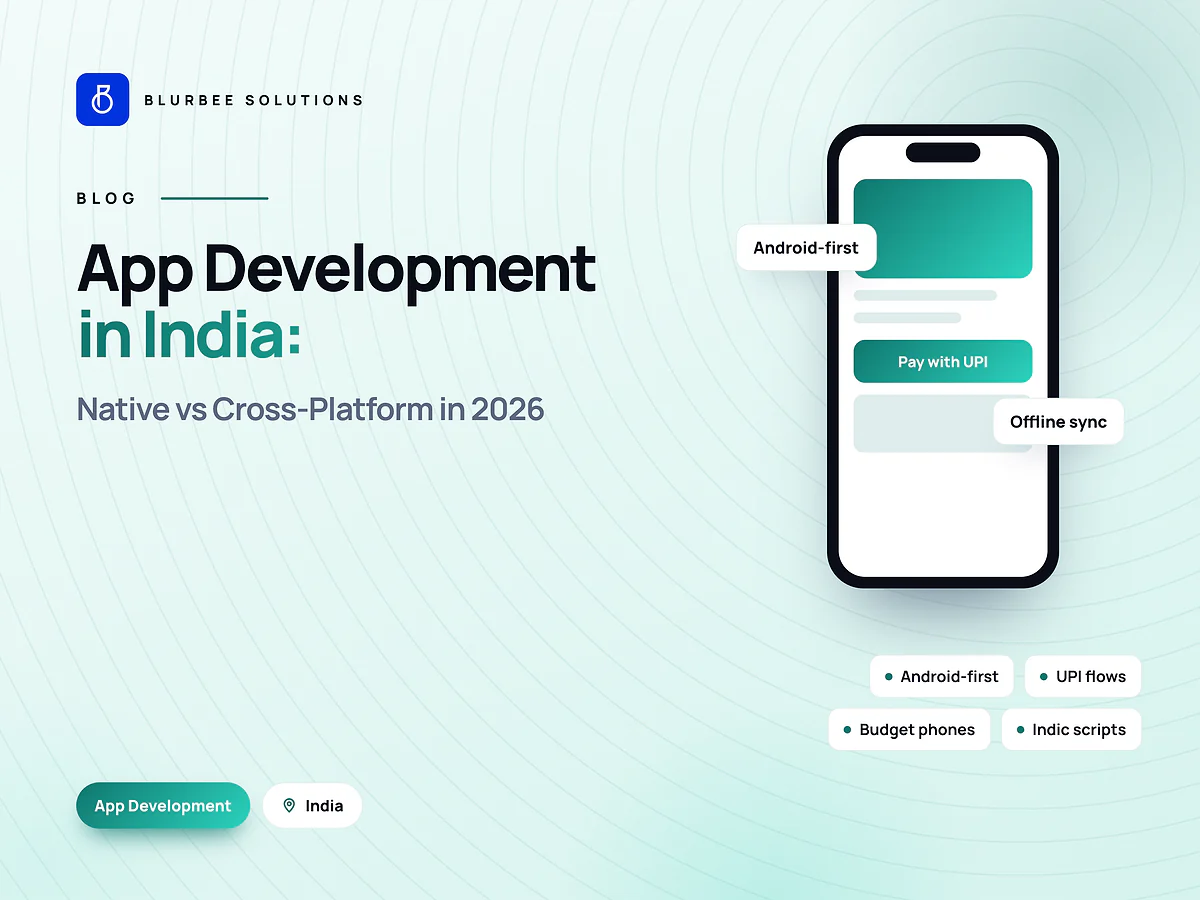
The native-versus-cross-platform debate is usually framed as a technical question. In India it is mostly a question about your users: which phones they carry, how good their connection is, how they pay, and what language they read. Answer those first and the platform choice usually becomes obvious.
For a city-specific take on the same question, see our Delhi NCR guide. This one looks at the whole country.
Start with the device reality
India is overwhelmingly Android. StatCounter puts Android at well over 90% of mobile operating system usage in the country. The phones are extremely varied, from current flagships to entry-level devices with limited memory and storage, often a few years old.
That changes the brief in three ways:
- Android-first is the default, and often Android-only for the first release.
- Performance must be proven on entry-level hardware, not on the device in a designer's pocket.
- App size matters. Users with limited storage delete large apps, and some never install them.
Cross-platform is the right default for most
For most commerce, fintech, service and content apps, Flutter or React Native is the sensible starting point. One codebase reaches Android and iOS, features ship on both at once, and performance is more than adequate for forms, lists, payments and content.
Flutter draws its own interface, so it looks and behaves the same across thousands of Android device variants. That consistency is valuable in India, and it performs well on mid-range phones.
React Native suits teams with React web experience and lets you share business logic with a web app.
We choose based on your team, your product and your hiring plans, and write the reasoning down so it survives the next change of CTO.
When native is worth it
Native Kotlin on Android and Swift on iOS earns its extra cost when the app:
- depends on device hardware, such as camera processing, Bluetooth peripherals or sensors;
- does substantial background work, like location tracking or long-running sync;
- needs complex, high-frame-rate animation or custom rendering;
- must run well on the lowest-end devices, where every megabyte and millisecond counts.
A common and sensible pattern is cross-platform for the app, with native modules for the one or two features that need them.
Budgets for size, startup and memory
Whatever the platform, we set budgets and check them in CI: download size, cold-start time, and memory on a named entry-level reference device. A build that exceeds the budget fails.
We test on real devices from the bottom of your user base, not emulators. We also design for intermittent connectivity from the start: local caching, optimistic updates, retry with backoff, and clear offline states. A user in a lift or a train should not lose a half-completed form.
UPI is a flow, not a button
UPI handled over 18 billion transactions a month through 2025, according to NPCI. For most Indian apps, it is the payment method.
Integrate through a licensed payment gateway that supports UPI intent and collect flows. Then handle every outcome: success, failure, the user backing out of their UPI app, and pending. Pending is common, so the server must confirm payment status with the gateway before fulfilling an order, never trusting the app's return alone. Most payment bugs we fix in Indian apps are unhandled pending states.
Indian languages and scripts
If your users extend beyond metro English-speaking audiences, language support is a build requirement, not a later translation pass:
- Externalised strings from the first screen.
- Layouts that tolerate longer text, since many Indic translations run longer than English.
- Correct font rendering for Devanagari, Tamil, Bengali and other scripts, tested on real devices because Android font support varies.
- Transliterated input: many users type Hindi in Latin script, so search and forms should handle it.
DPDP consent inside the app
The Digital Personal Data Protection Act, 2023 applies to personal data your app collects. In practice:
- Collect only what each feature needs.
- Show a clear notice and obtain consent in plain language, in the user's language where you support it.
- Let users withdraw consent and request deletion from inside the app.
- Audit third-party SDKs. Analytics and advertising SDKs are the most common source of data collection nobody intended.
Measure stability from day one
In India's fragmented Android market, crashes and freezes on devices you never tested are a fact of life. What matters is seeing them quickly. We instrument every app with crash and ANR reporting, plus funnel analytics on the core flows, before the first release.
Google Play's Android vitals flags apps with a user-perceived crash rate above 1.09% or an ANR rate above 0.47%, and apps over those thresholds can see reduced visibility in the store. We track both from the first internal build, broken down by device model and Android version, so problems on popular budget phones are caught before they reach reviews.
What it costs
Indicative budgets for a first production release, excluding 18% GST, store fees and hosting:
| Approach | Typical budget |
|---|---|
| Cross-platform MVP | ₹6-15 lakh |
| Cross-platform with offline sync and UPI | ₹10-24 lakh |
| Native Android only | ₹8-20 lakh |
| Native Android and iOS | ₹14-35 lakh |
Most first releases take eight to eighteen weeks.
Start with one core flow
Our recommended first project is a single core flow, such as onboarding, a first purchase with UPI, or a booking, built end to end on your chosen platform, tested on entry-level devices, and measured against size and startup budgets. Two to four weeks, fixed scope, fixed price in INR. It settles the platform question with evidence rather than opinion.
Building apps for India, in numbers
Blurbee quoted ranges, 2026, for a first production release. Excludes GST at 18%, store fees and backend hosting. Indicative bands, not quotations.
Why Indian product teams build apps with Blurbee
We test on the phones your customers actually carry, not the flagship on a designer's desk, set app-size and startup budgets in CI, and write the platform decision down before any code is written.
- Fixed-scope first projectTwo to four weeks, priced as a number rather than an estimate, so you have evidence before a longer commitment.
- One delivery lead, namedYou always know who to ask. No account manager relaying questions to a team you never meet.
- Code and IP are yoursAssigned in writing, handed over with repositories, infrastructure definitions and documentation whether or not you continue with us.
- Performance budgets in CICore Web Vitals and bundle size gate the build. Slow does not ship.
- Accessibility to WCAG 2.2 AAReviewed with automated and manual passes, not claimed on a slide.
- Written overlap disciplineStanding calls inside your working window, everything else asynchronous with a decision log.