AI Agents and Agentic Workflows in Birmingham: What an Agentic Workflow Can (and Can't) Do Yet
What AI agents can safely do for Midlands manufacturers and logistics firms today, where they still fail, how to integrate with ERP and MES, and UK GDPR duties.

Agentic AI is being sold to Midlands manufacturers and logistics firms as a way to run whole processes on autopilot. Some of that is real. Most of it is a demo that works on a clean dataset and stops working the first time it meets a twenty-year-old ERP, a supplier who replies in a PDF, or a production change made by phone.
This is an honest map of what agents can do in Birmingham operations today, what they can't yet, and how to build the first one safely.
What an agent is, in operational terms
An agent is a language model given a goal and a set of tools, such as "look up this order", "find the matching invoice" or "draft a reply", and allowed to decide which to use in what order. Unlike a fixed script, it can handle variation. Unlike a person, it can also be confidently wrong at speed.
That trade-off decides everything. Agents are useful where tasks vary but results can be checked, and dangerous where a wrong action is expensive and hard to undo.
What works in Midlands operations today
Across manufacturing and logistics, the tasks we see working reliably share three traits: high volume, a small set of tools, and a result someone can check quickly.
Supplier and customer email triage. Classifying inbound messages, pulling the order or delivery they refer to, and drafting a reply for approval.
Purchase order matching. Matching invoices and delivery notes against purchase orders and flagging mismatches for a person.
Delivery exception chasing. Spotting late or short deliveries, drafting chasers, and logging responses.
Cross-system summaries. "What is the status of this customer's open orders?" answered from ERP, warehouse and transport systems in one place.
What still fails
Autonomous production scheduling. Changing schedules involves capacity, materials, labour and customer priorities that live partly in systems and partly in people's heads. A wrong change ripples through the plant.
Open-ended processes across many systems. Every additional step and system multiplies the chance of an error.
Negotiation and commitments. Agreeing prices, dates or terms with suppliers on the company's behalf.
The pattern is consistent: the longer the chain and the costlier the mistake, the more a human needs to be in it.
Integration is most of the work
Birmingham briefs rarely start from a blank page. They start from ERP, MES, warehouse and transport systems, supplier portals and EDI feeds. Agents reach these through tools, and tool design matters more than prompt design:
- Narrow tools. "Get purchase order by number" rather than "query the database".
- Validated inputs with error messages the model can act on.
- Read-only by default. Writing to the ERP is a separate, approved step.
- Full logging of every call and result.
For older systems without APIs, we usually read from a reporting database or existing file exports, or build a small integration service. Screen automation is a last resort.
Safety rules we apply to every agent
- Least privilege: only the tools and data the task needs.
- Human approval for anything irreversible, financial or customer-facing.
- Limits on steps, time and spend.
- Untrusted input stays untrusted: supplier emails and PDFs cannot grant new permissions or change instructions.
- An evaluation set of real tasks, run on every change.
UK GDPR and supply-chain security
Where agents process personal data, such as contact details in supplier emails, UK GDPR applies. Article 22 restricts solely automated decisions with legal or similarly significant effects on individuals, so anything deciding about people needs meaningful human involvement.
Automotive suppliers often face OEM information-security assessments, commonly TISAX-style. These cover where data goes, so the choice of model provider and hosting region has to fit them. Public-sector work in the West Midlands usually requires Cyber Essentials.
Rates in Birmingham
Birmingham agencies typically charge £50-95 per hour, well below London. Our blended AI team is £24-47. A narrow agent with a few tools, a human checkpoint and an evaluation set is a two-to-four-week proof of value, then several weeks to production. We keep five hours of live overlap with UK working hours.
A worked example: purchase order matching
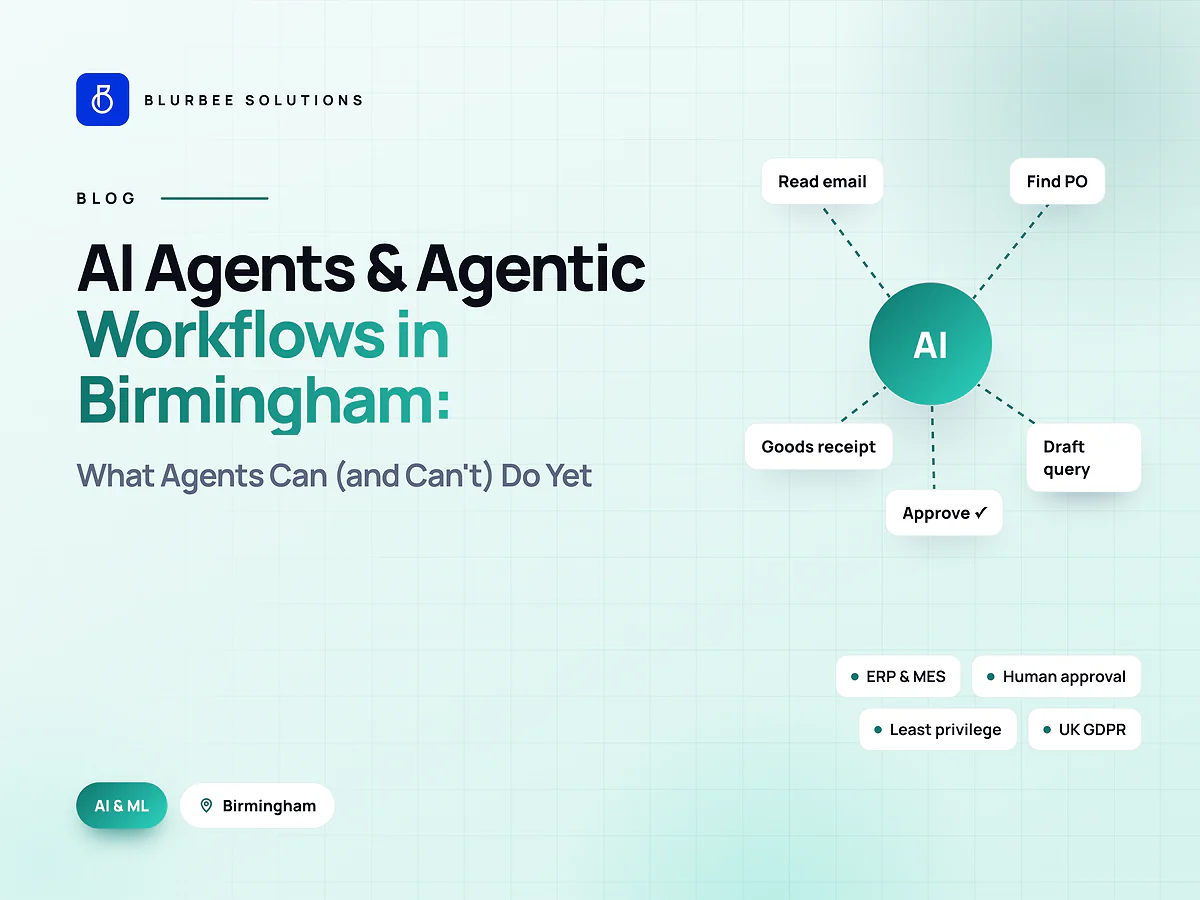
A Midlands manufacturer receives several hundred supplier invoices a week by email. Today a clerk opens each one, finds the purchase order in the ERP, checks quantities and prices against the delivery note, and either approves it or emails the supplier.
A narrow agent handles the same flow with four read-only tools: read the email and attachment, look up the purchase order, look up the goods receipt, and draft a query email. It produces a proposed match with the evidence attached. Clean matches go to a one-click approval queue; mismatches go to the clerk with the discrepancy highlighted and a drafted supplier query.
Nothing is posted to the ERP without a person approving it. The clerk's time shifts from searching to deciding, and every action is logged for audit. That is the kind of result that funds the next workflow.
Start with email triage
The first fixed-scope project we recommend is supplier or customer email triage with drafted replies that a person approves. High volume, easy to check, low risk. It shows how agents behave in your environment before anything touches the ERP.
For the wider picture, see agentic workflows in 2026 and AI automation that targets the whole workflow.
AI agents in the Midlands, in numbers
Blurbee's assessment of production readiness for manufacturing and logistics tasks, scored out of 10. Opinion based on our engagements.
Why Midlands operations teams build agents with Blurbee
We start from the ERP, MES and supplier portals you already run, give agents only the permissions a task needs, and put a person at every irreversible step. Five hours of overlap with UK time keeps reviews live.
- Fixed-scope first projectTwo to four weeks, priced as a number rather than an estimate, so you have evidence before a longer commitment.
- One delivery lead, namedYou always know who to ask. No account manager relaying questions to a team you never meet.
- Code and IP are yoursAssigned in writing, handed over with repositories, infrastructure definitions and documentation whether or not you continue with us.
- Performance budgets in CICore Web Vitals and bundle size gate the build. Slow does not ship.
- Accessibility to WCAG 2.2 AAReviewed with automated and manual passes, not claimed on a slide.
- Written overlap disciplineStanding calls inside your working window, everything else asynchronous with a decision log.