AI Automation in Vancouver: Automating the Workflow, Not Just the One Task
Why Vancouver gaming, VFX and clean-tech teams gain more by automating whole workflows than single tasks, plus BC PIPA, overlap and CAD rates.

Most AI automation projects start by picking a task. Summarise these reports. Tag these assets. Draft these replies. The task gets automated, the demo looks good, and three months later the team is barely faster, because the task was never the bottleneck. The waiting, hand-offs and rework around it were.
Vancouver's studios and clean-tech firms get far more from automating the workflow than the task. This is how we approach it.
Task automation versus workflow automation
A workflow is the whole chain: work arrives, someone triages it, someone else does it, a third person reviews it, it goes back for changes, and eventually it ships. Each step has waiting time before it.
Automating one step inside that chain often moves the queue rather than shortening it. If AI tags assets in seconds but they then wait two days for a supervisor to approve the tags, the artist is no faster.
Workflow automation starts by mapping the chain, measuring where time actually goes, and removing or merging steps before automating what remains.
Map it before you model it
The first week is spent watching the workflow, not writing prompts. For each step we record:
- What arrives, and in what form.
- Who acts on it, and what decision they make.
- How long it waits before anyone touches it.
- How often it goes back for rework, and why.
Usually a few surprises appear: steps that exist only because of an old tool, approvals nobody reads, information re-typed from one system into another. Removing those needs no AI at all, and it is often the biggest win.
Where AI fits in Vancouver workflows
Game studios. Triaging bug reports and player feedback into the right team with duplicates merged. Generating first-pass metadata for build and asset tracking. Summarising playtest sessions into structured findings. Searching internal design documentation.
VFX and animation. Tagging and describing assets for the asset manager, checking shot deliveries against technical specifications, and routing notes from review sessions to the right artists with context attached. Studios in Yaletown and Gastown judge tools by artist hours saved, so that is what we measure.
Clean tech. Extracting data from permits, engineering reports and grant applications, drafting routine compliance documentation from structured data, and reconciling project data across systems.
Keep people where mistakes are expensive
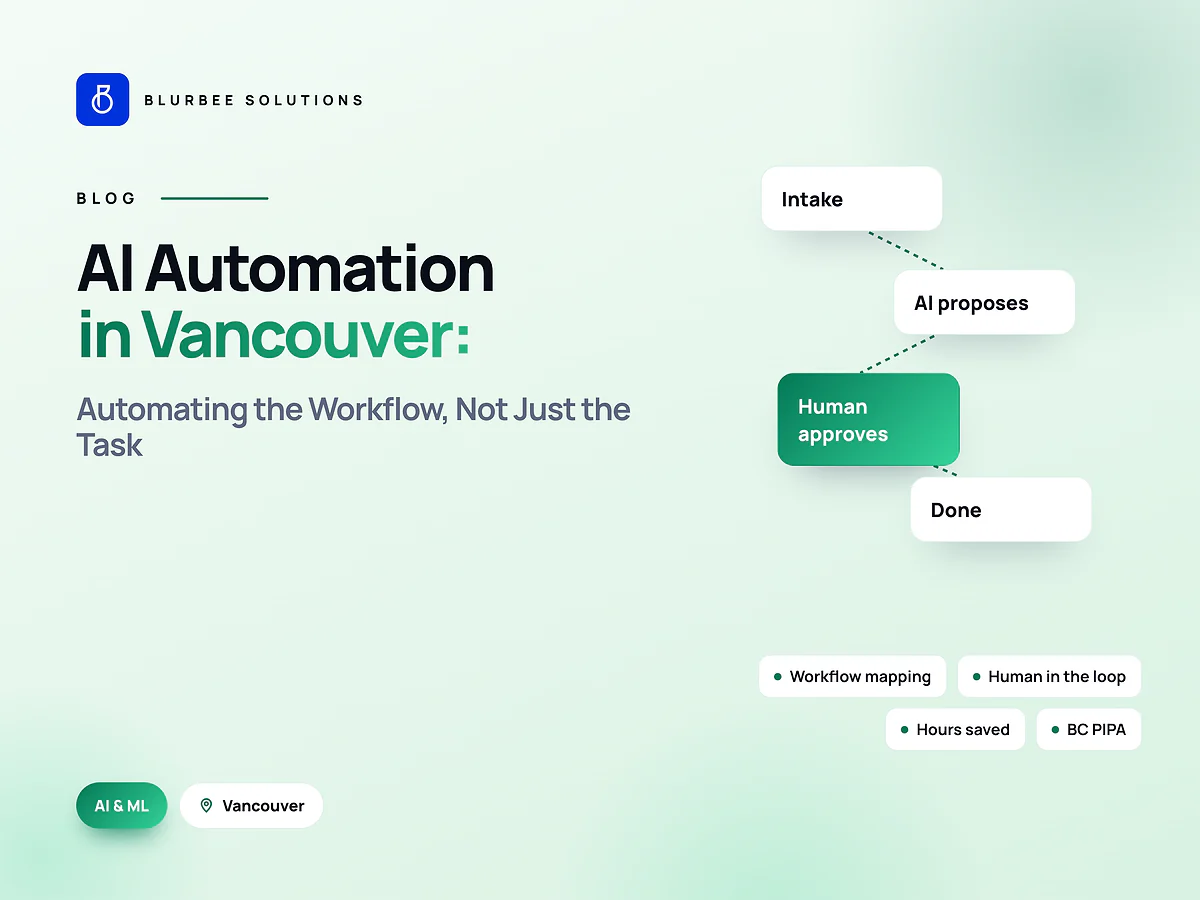
The system proposes; a person approves wherever an error is costly, hard to reverse or affects a customer or artist directly. The review screen matters as much as the automation. If approving a suggestion takes longer than doing the work manually, nobody will use it.
As confidence builds, measured by how often people override the system, approval thresholds can loosen. That decision is made with data, not enthusiasm.
Integrate with existing tools
Studios and engineering firms already run production tracking, asset management, issue trackers and document systems. We integrate automation into those through their APIs, so people see suggestions where they already work. A new standalone tool is one more tab nobody opens.
Measure hours, not tasks
We measure a baseline before building anything, then again after launch:
- Hours saved per week, per team.
- End-to-end cycle time from work arriving to work done.
- Rework rate.
- Override rate: how often people reject or correct the system.
"Tasks automated" is a vanity metric. Time returned to the team is the one that justifies the next phase.
BC PIPA and Canadian AI rules
Private-sector organisations in British Columbia fall under BC PIPA rather than federal PIPEDA for activity inside the province. For automation, that means personal information is collected with consent for reasonable purposes, protected with appropriate safeguards, and handled responsibly by service providers, including any AI model provider that processes it.
There is currently no federal AI statute in force in Canada. The proposed Artificial Intelligence and Data Act lapsed with Bill C-27 when Parliament was prorogued in January 2025. Privacy law still applies, and procurement and sector rules may add more, so we design for transparency, logging and human oversight regardless.
Working across Pacific time
Vancouver has the tightest overlap of any Canadian city we serve: about one hour with Pacific time, plus an early-evening IST slot. Automation work suits this well because most of it is asynchronous. A daily written handoff, recorded demos of each change and a decision log keep things moving, and the overlap is reserved for decisions.
A worked example: playtest feedback
Take a common game-studio workflow. After each playtest, hundreds of written responses and session notes arrive. A producer reads them, tags them by feature and severity, removes duplicates, and files issues for the right team. It takes most of two days, and by then the build has moved on.
Automating only the summarising step produces a nice summary that still waits for the producer. Automating the workflow looks different:
- Responses arrive in one place automatically from the survey and session tools.
- The system clusters them by feature, flags duplicates and proposes a severity with the quotes that justify it.
- The producer reviews clusters, not individual responses, and approves, merges or rejects in one screen.
- Approved clusters become issues in the tracker, assigned to the right team with evidence attached.
The producer still makes every judgement call. Two days becomes a couple of hours, and the feedback reaches the team while the build is still current. That is the kind of result that funds the next workflow.
Rates in Vancouver
Vancouver AI consultancies typically charge CA$140-170 per hour, agencies CA$90-140 and contractors CA$85-130. Our blended team is CA$41-82. Automating the first stage of a workflow usually takes four to eight weeks, including measurement and a review step.
Start with one workflow
The first fixed-scope project maps one workflow end to end, measures it, removes the steps that should not exist, and automates the stage that wastes the most time, with a human in the loop. Two to four weeks, fixed price in CAD, and a before-and-after number in hours.
AI automation in Vancouver, in numbers
Composite of published Vancouver consultancy and agency rate cards, contractor rates and Blurbee quoted rates converted at prevailing rates, 2026.
Why Vancouver teams automate with Blurbee
We map the whole workflow before touching a model, put people at the decision points that matter, and measure hours saved rather than tasks automated. The work runs asynchronously around a Pacific-time overlap, with written handoffs every day.
- Fixed-scope first projectTwo to four weeks, priced as a number rather than an estimate, so you have evidence before a longer commitment.
- One delivery lead, namedYou always know who to ask. No account manager relaying questions to a team you never meet.
- Code and IP are yoursAssigned in writing, handed over with repositories, infrastructure definitions and documentation whether or not you continue with us.
- Performance budgets in CICore Web Vitals and bundle size gate the build. Slow does not ship.
- Accessibility to WCAG 2.2 AAReviewed with automated and manual passes, not claimed on a slide.
- Written overlap disciplineStanding calls inside your working window, everything else asynchronous with a decision log.