Agentic Workflows in 2026: What's Real, What's Still a Demo
Which AI agent workflows work in production in 2026, which are still demos, and the tools, permissions and human checkpoints that separate them.

Every few weeks a new demo shows an AI agent booking travel, running a sales process or managing a codebase on its own. Some of that is real. A lot of it is a carefully chosen path through a problem that falls apart on the second try. In 2026 the useful question is not whether agents work. It is which ones work, under what conditions.
What an agent actually is
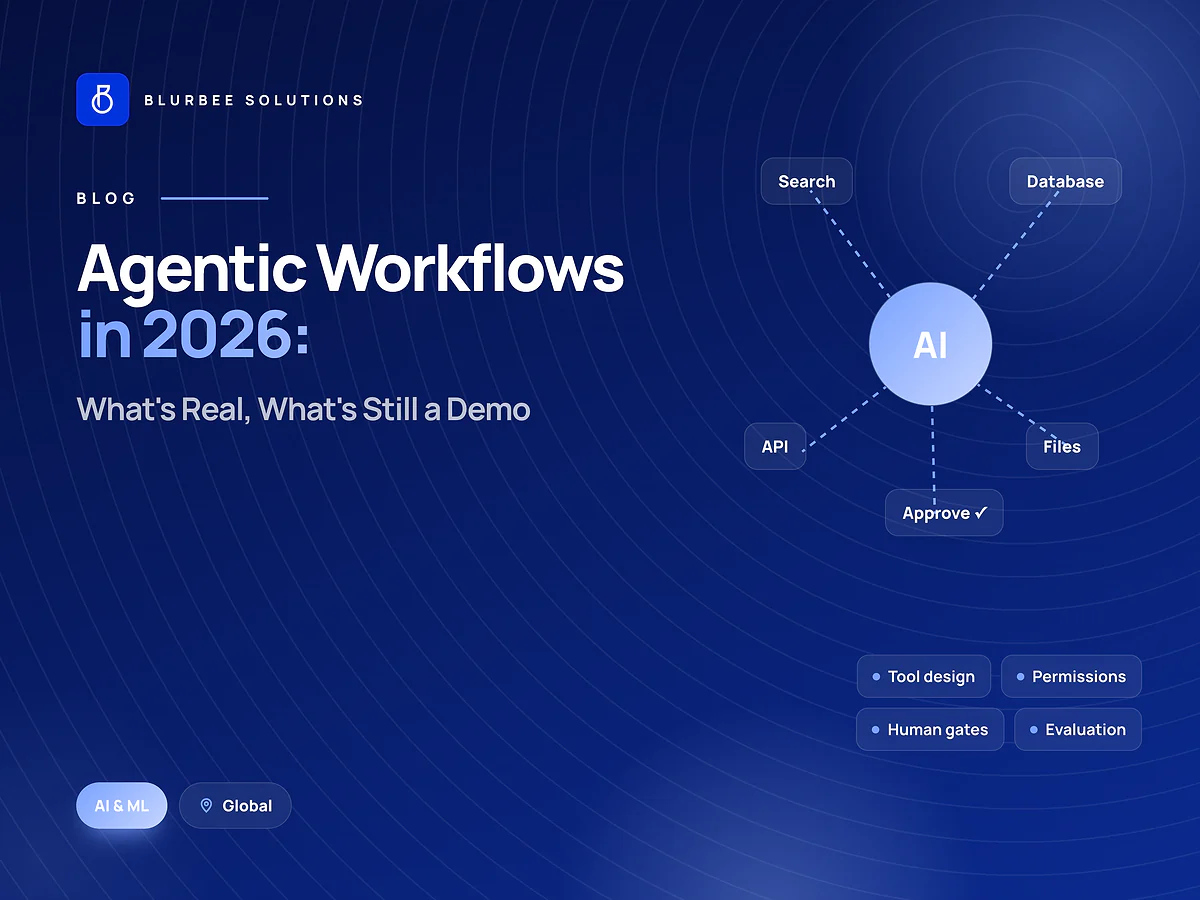
An agentic workflow gives a language model a goal and a set of tools, such as search, file access, a database query or an API call, and lets it decide which to use. The model plans, acts, reads the result and continues until it finishes or stops.
That flexibility is the point and the problem. A fixed script does the same thing every time. An agent can handle variation, and it can also go wrong in ways a script never would.
Why long chains fail
Reliability compounds. If an agent gets each step right most of the time, a task with many steps gets all of them right far less often. Agents also drift away from the goal, repeat actions, misread tool output, or confidently finish a task they did not complete.
This is the single most important fact about agents in production: shorter chains with better tools beat longer chains with smarter prompts.
What is real in 2026
Use cases we see working reliably share four traits: narrow scope, a small set of well-designed tools, a result someone can check, and a human at the points that matter.
Research and summarising with citations. Gathering information across documents or sources and producing a cited summary. Errors are visible because the citations can be checked.
Support triage and drafting. Classifying tickets, pulling account context and drafting a reply for an agent to approve.
Coding assistance within a repository. Making changes, running tests and proposing a pull request for human review.
Structured back-office tasks. Extracting data from documents into a system, with review of anything uncertain.
What is still mostly a demo
Fully autonomous processes across many systems. End-to-end procurement, finance operations or customer onboarding with no human checkpoints. The chains are long, the systems are many, and a wrong action is expensive.
Open-ended goals. "Grow our pipeline" or "manage our social media" give an agent too little structure to be reliable or measurable.
Agents with dozens of tools. The more tools, the more often the model picks the wrong one. Most production agents we build need three to seven.
Tools matter more than prompts
The quality of an agent depends heavily on the tools it is given:
- Narrow and specific. "Get order status by order ID" beats "query the database".
- Clear descriptions of what each tool does and when to use it.
- Validated inputs, rejecting bad calls with useful error messages the model can act on.
- Useful outputs, concise and structured, not raw dumps.
- Safe by default: read-only unless writing is essential.
The Model Context Protocol, introduced in November 2024, gives a common way to connect models to tools and data, which makes integrations reusable. It does not decide which tools an agent should have, what they may do, or how to check the result. That is still design work.
Permissions and human checkpoints
Every agent we ship follows the same rules:
- Least privilege. The agent can do only what the task requires.
- Human approval for anything irreversible, financial, or customer-facing.
- Limits on steps, time and spend per task.
- Full logging of every action, input and result.
- Untrusted content stays untrusted. Emails, web pages and documents an agent reads can contain instructions designed to hijack it. That content never grants new permissions.
Evaluate agents like software
An agent needs an evaluation set of realistic tasks with expected outcomes. Score each run on whether the task was completed correctly, how many steps it took, whether it used appropriate tools, and whether it did anything it should not have. Run the set on every change to prompts, tools or models.
Without this, you are relying on demos, and demos are chosen to succeed.
Workflow first, agent second
Many problems sold as agents are better solved as reliable pipelines with a model at one or two steps. If the steps are known, build a fixed workflow and use the model only for the judgement calls, such as classifying, extracting or drafting. Use an agent only where the path genuinely varies from case to case.
This is less exciting and far more dependable. It is also cheaper to run and easier to debug.
A checklist before you build an agent
Answer these honestly before committing:
- Does the path genuinely vary by case? If not, build a fixed workflow.
- Can success be checked? If nobody can tell whether the agent did the job, you cannot evaluate or improve it.
- What is the worst action it could take? Design permissions and approvals around that.
- How many tools does it really need? Aim for the smallest set that completes the task.
- Who reviews its work, and how long does review take? A slow review step erases the gain.
- What happens when it fails? Define the fallback: a person, a retry, or a safe stop.
If you cannot answer all six, the project is not ready for an agent yet. That is useful to know before spending money.
Start narrow
Our recommended first project is one narrow task: a few tools, clear permissions, a human checkpoint and an evaluation set. Two to four weeks to a working, measured proof of value, then expand only where the evaluation numbers justify it. For the related question of how to engineer prompts reliably, see prompt engineering as a system.
We build AI agents for teams across India, the United States, the United Kingdom, the UAE and Canada; see AI and ML services.
AI agents, in numbers
Blurbee's assessment of production readiness, scored out of 10. Opinion based on our engagements and client pilots, not a survey.
Why teams build AI agents with Blurbee
We build narrow agents with explicit permissions, logged actions and human checkpoints, evaluated before launch. It is less exciting than a demo, and it is what survives contact with real users.
- Fixed-scope first projectTwo to four weeks, priced as a number rather than an estimate, so you have evidence before a longer commitment.
- One delivery lead, namedYou always know who to ask. No account manager relaying questions to a team you never meet.
- Code and IP are yoursAssigned in writing, handed over with repositories, infrastructure definitions and documentation whether or not you continue with us.
- Performance budgets in CICore Web Vitals and bundle size gate the build. Slow does not ship.
- Accessibility to WCAG 2.2 AAReviewed with automated and manual passes, not claimed on a slide.
- Written overlap disciplineStanding calls inside your working window, everything else asynchronous with a decision log.