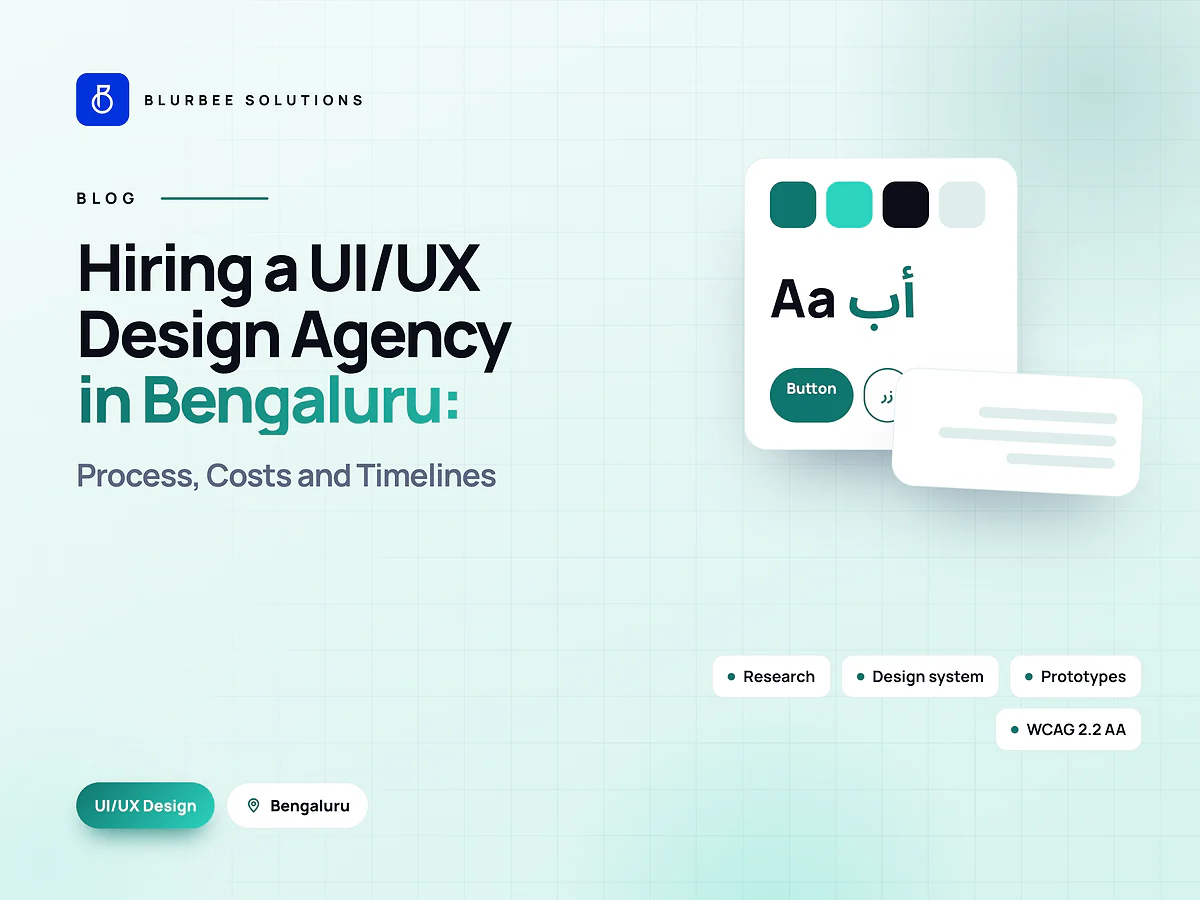
Hiring a UI/UX Design Agency in Bengaluru: Process, Costs and Timelines
What a UI/UX engagement in Bengaluru involves end to end: discovery, wireframes, design systems, handoff, and what each phase costs and takes in weeks.

Bengaluru is the only Indian city where a design brief regularly arrives with a design system attached. That single fact should change how you buy design here, because most agency proposals are written for a different situation — a client with no system, no internal platform team and no strong opinion about tokens. If that is not you, a lot of what you will be sold is redundant.
This is what a UI/UX engagement actually involves, phase by phase, with the durations and costs each one carries.
What you are actually buying
"UI/UX design" covers at least four distinct products, and conflating them is the most common reason engagements go wrong.
Research answers what users are trying to do and where they fail. It produces evidence: interview findings, task-completion data, a prioritised problem list.
Interaction and information architecture answers how the product should be organised and what happens when. It produces flows, wireframes and specifications.
Visual design answers what it looks like. It produces high-fidelity screens.
Design systems answer how the team will keep it consistent as it grows. It produces components, tokens and documentation.
You can buy any of these separately. Most Bengaluru product teams with an existing product need the first and the fourth, and buy the second and third out of habit. Being clear about which you are commissioning changes both the price and what you get.
Phase one: discovery, one to two weeks
Discovery is where the engagement is either set up to succeed or quietly doomed. Done properly it produces three things: a written statement of the business outcomes the design must move, an audit of what exists, and a decision about who has authority to approve direction.
That third item matters more than it sounds. The single most common cause of overrun on a design project is not scope, it is a review cycle with four stakeholders who each have veto and none of whom has ownership. A good agency will ask, in the first week, who signs off. If they do not ask, you should tell them.
For a live product, discovery should include real data: analytics on the flows in question, session recordings, and the support tickets your team already has. That last source is consistently the most valuable and the least used. Support tickets are a free record of exactly where your interface fails, written by users, in their own words.
If you want user research rather than stakeholder interviews, budget an extra one to two weeks and expect five to eight interviews per user segment. Fewer than five and you are collecting anecdotes.
Phase two: architecture and wireframes, two weeks
This is where the structure is settled: navigation, page inventory, what each screen must accomplish, and the flows between them. Working in low fidelity here is not a cost-saving measure, it is a speed measure. Structural problems are cheap to fix in a wireframe and expensive to fix in a designed screen, because by then the argument is about visual detail rather than the underlying model.
Expect wireframes plus a clickable prototype for the two or three flows that carry the most business risk. If a proposal promises high-fidelity screens in week two, the structural thinking has been skipped.
Phase three: visual design, three weeks
High-fidelity screens, states and responsive behaviour. Three weeks is typical for a single platform with a moderate screen count. Two things extend it: an undefined brand, which turns every screen into a branding discussion, and an unbounded number of edge-case states.
Insist that empty, loading, error and permission-denied states are designed for the main flows. They are where most of the real user experience happens and where they are most often left to the engineer to improvise.
Phase four: the design system, two weeks
For a team with more than three engineers building UI, this is the phase that pays for itself. A design system is not a Figma page of components; it is tokens (colour, type, spacing, radius, motion), components built from those tokens, documented usage rules, and — if we are also implementing — a Storybook build the engineers work against.
The reason to do it during the engagement rather than after is that the components get built once, from the real screens, rather than reverse-engineered from a finished design under time pressure.
In Bengaluru specifically, this is often not a build but an extension: you have a system, and the work is adding components to it without breaking its conventions. That is a different skill from designing a system, and worth confirming a team has done before.
Phase five: handoff and QA, one week
Handoff fails silently. The Figma file gets delivered, the engineers build something adjacent to it, and nobody notices until QA. Avoiding that costs about a week and involves: published Figma components with tokens, written interaction specs for anything not visually obvious, a walkthrough call with the engineers who will build it, and a design QA pass against the built product before release.
The walkthrough is the highest-value hour in the whole engagement. An engineer asking "what happens if this list is empty and the user has no permission" in week nine is much cheaper than the same question in production.
What it costs
Bengaluru studios quote roughly ₹1,000–2,600 per hour, senior product designers at the top of that band. As project shapes: a focused UX audit is ₹75,000–2 lakh. A full product design engagement from discovery through handoff is ₹4–15 lakh. A design system on its own is ₹3–8 lakh depending on component count and whether implementation is included.
The cheapest useful purchase, if you have a live product, is the audit. It is one to two weeks, produces a prioritised problem list with evidence, and frequently establishes that the problem is three screens rather than the entire product — which saves you the cost of the engagement you were about to commission.
How to evaluate a Bengaluru design agency
Ask to see the working files, not the case study. A polished case study proves someone can write a case study. The Figma file shows whether components are published or copy-pasted, whether tokens exist, whether states were designed or improvised, and whether the file could be handed to another designer.
Ask what they would remove from your product. Every mature product has features nobody uses that cost every user attention. A designer who only adds is not thinking about the experience, they are thinking about the deliverable.
Ask how they would measure whether the redesign worked. If the answer does not include a number that existed before the project started, there is no way to know.
Ask who does the work. Bengaluru's design market is competitive enough that senior designers pitch and juniors execute. This is fine if disclosed and priced accordingly, and a problem if discovered in week four.
Where projects actually go wrong
In our experience, in this order: no single approver, so review cycles never converge; content arriving late, so designs are made against placeholder text and break when real copy lands; edge-case states left undesigned; and a handoff with no engineering conversation.
None of these is a design skill problem. All of them are project setup problems, and all of them are fixable in the first week for free.
Design and product context, in numbers
Blurbee delivery data across 2019–2026 engagements. Distribution varies with research depth and number of platforms.
Why Bengaluru product teams work with Blurbee
Bengaluru is the one Indian market where clients routinely arrive with an existing design system and an internal platform team. We are built for that: capacity extension with tokens and Storybook discipline, not a rebrand nobody asked for.
- Fixed-scope first projectTwo to four weeks, priced as a number rather than an estimate, so you have evidence before a longer commitment.
- One delivery lead, namedYou always know who to ask. No account manager relaying questions to a team you never meet.
- Code and IP are yoursAssigned in writing, handed over with repositories, infrastructure definitions and documentation whether or not you continue with us.
- Performance budgets in CICore Web Vitals and bundle size gate the build. Slow does not ship.
- Accessibility to WCAG 2.2 AAReviewed with automated and manual passes, not claimed on a slide.
- Written overlap disciplineStanding calls inside your working window, everything else asynchronous with a decision log.