UI/UX Design in Dubai: Process, Costs and Timelines
A design-system and usability pass for Dubai products: bilingual RTL design, user testing, what each phase costs in AED, VAT and free-zone contracting.

Most Dubai products we are asked to look at don't need a redesign. They need fixing. The core flows work, the brand is fine, but a checkout loses people at the same step every week, the Arabic version was mirrored at the end, and every new screen looks slightly different from the last because there is no shared design system.
A design-system and usability pass fixes that without starting over. This is what it involves, how long it takes and what it costs.
Redesign versus usability pass
A full redesign replaces everything. It takes months before anyone benefits, throws away what already works, and often introduces new problems that take another cycle to find.
A usability pass targets the flows that cost you money or support time, ships improvements within weeks, and leaves behind a design system that makes every future change cheaper. For teams in DIFC and Business Bay with a live product and revenue riding on it, that is nearly always the better investment.
Phase 1: audit and usability testing
We start with evidence. Analytics show where users drop off. Support tickets show what confuses them. Then we watch real users try to complete key tasks, remotely and in both languages.
Five to eight participants per user group is usually enough to surface the major problems. We recruit from your own customers where possible. Dubai's audience is unusually mixed, with Arabic-first Emiratis, Arabic-speaking expatriates, and English-first residents from dozens of countries, so a generic testing panel can mislead.
The output is a prioritised list: each problem, the evidence for it, the proposed fix and the effort involved.
Phase 2: flows and information architecture
Most usability problems are structural, not visual. Navigation labels that make sense to the product team but not to customers. Forms that ask for information in the wrong order. Checkout steps that could be merged. We fix the structure before touching the visual layer.
Phase 3: UI in both directions
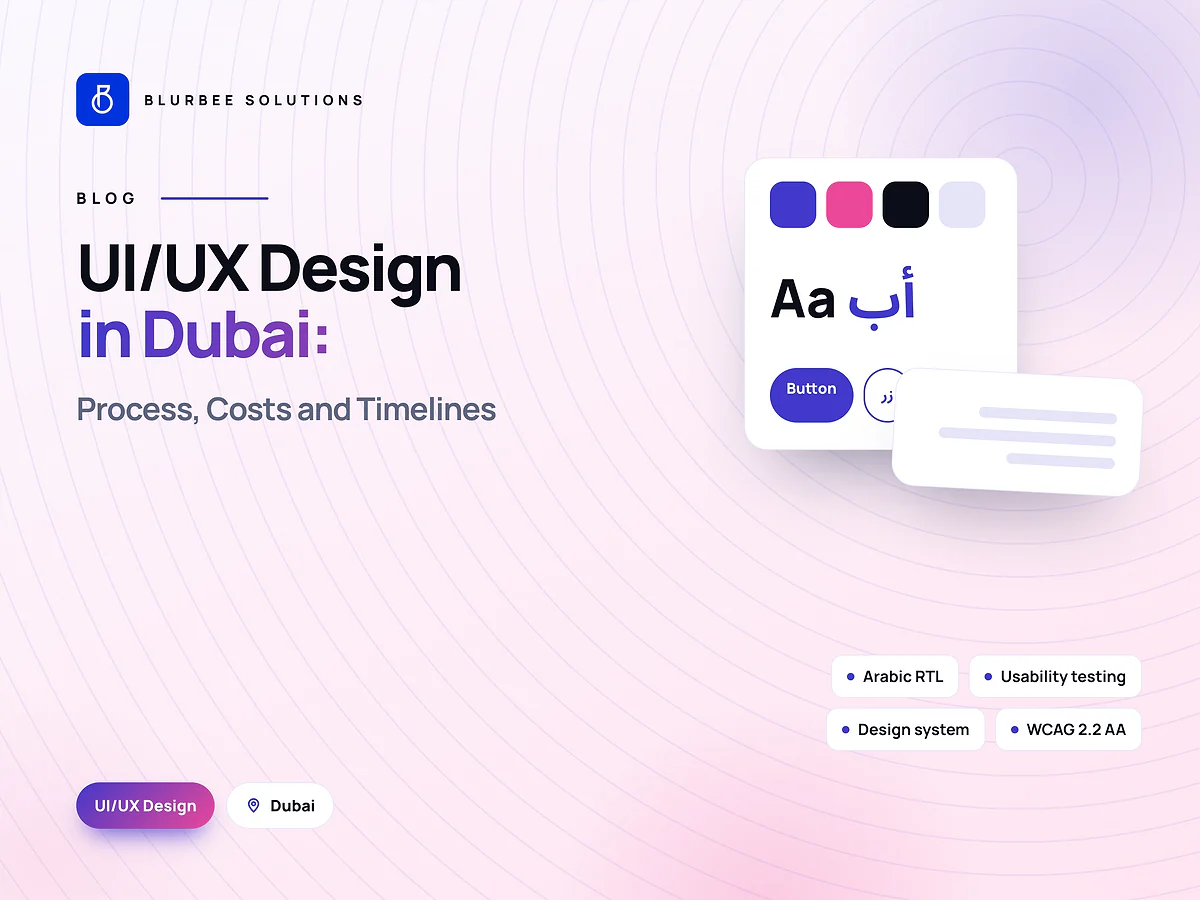
Arabic and English are designed together from the first wireframe. That means:
- Direction-aware layouts built on logical properties, start and end rather than left and right.
- Icon decisions: arrows and progress indicators flip, while direction-neutral icons such as search do not.
- Text-length tolerance, since Arabic can be shorter or longer than English and fixed-width elements break.
- A typeface with proper Arabic support, with correct shaping and diacritics, not a Latin font with a fallback.
- Numerals and dates chosen deliberately for your audience.
A design mirrored at the end fails on all of these, and Arabic-first users notice immediately.
Phase 4: component library and tokens
This is what makes the work last. We consolidate the interface into a Figma component library with variants for every state: default, hover, focus, error, disabled, loading and empty. Design tokens capture colour, typography, spacing, radius and direction, and map directly onto your front-end code.
After this, a new screen is assembled from existing parts rather than designed from scratch, and it matches everything else automatically.
Phase 5: handoff and build support
Design intent is most often lost between Figma and the browser. Our handoff includes annotated flows, error and empty states, accessibility notes, and a walkthrough with your engineers. We then stay available during the build, answering questions the same day, which the full working-day overlap makes easy.
Accessibility in both languages
We design and test to WCAG 2.2 AA: contrast, visible focus, target sizes, labels for screen readers, and error messages that tell people how to fix the problem. It applies to both languages, and bidirectional content needs its own screen-reader testing.
What Dubai usability audits usually find
Some problems show up in almost every product we audit here:
- Forms that fight local data. Phone fields that reject the +971 format, Emirates ID fields without masking or validation, and address forms designed for postcodes the UAE does not use.
- Mixed-direction strings that break in Arabic: prices, dates, order numbers and English brand names inside Arabic sentences, with punctuation on the wrong side.
- Checkout steps built for another market. Missing cash-on-delivery, wallet or instalment options that a large share of users expect.
- Language switches that lose context, returning users to the home page instead of the same screen in the other language.
- Arabic that was machine-translated, which Arabic-first users notice immediately and read as carelessness.
Each is small to fix and expensive to leave in place.
Costs and timelines
Dubai agencies typically charge AED 180-400 per hour for mid to senior design work. Our blended design team is AED 73-154.
Indicative timelines for a mid-sized product:
| Phase | Duration |
|---|---|
| Audit and usability testing | 1-2 weeks |
| Flows and information architecture | 1-2 weeks |
| UI in Arabic and English | 2-3 weeks |
| Component library and tokens | 2-3 weeks |
| Handoff and build support | 1 week |
Phases overlap, so a full pass typically runs six to ten weeks. VAT at 5% applies to most services in the UAE.
Free-zone contracting
If your company sits in a free zone such as DIFC, the contracting and data-protection rules follow that zone. DIFC has its own data protection law, separate from the federal PDPL. Share your registration early and we structure the agreement and any data handling around it.
Working your hours
IST is only 1.5 hours ahead of Gulf Standard Time, so we share a full working day. Design reviews happen live rather than overnight, and a question raised at 11am Dubai time gets answered at 11am Dubai time.
Start with a two-week audit
The first fixed-scope project is a usability audit of your three most important flows in both languages, ending with a prioritised list of fixes and effort estimates. It is useful on its own, even if your team implements everything after that.
Designing for Dubai, in numbers
Blurbee delivery practice, 2026. Weeks for a mid-sized web or app product; phases overlap in practice.
Why Dubai teams design with Blurbee
We design both directions from the first wireframe, test with real users in each language, and hand over a design system engineers can build from without guessing. And we share your whole working day, so reviews happen live, not overnight.
- Fixed-scope first projectTwo to four weeks, priced as a number rather than an estimate, so you have evidence before a longer commitment.
- One delivery lead, namedYou always know who to ask. No account manager relaying questions to a team you never meet.
- Code and IP are yoursAssigned in writing, handed over with repositories, infrastructure definitions and documentation whether or not you continue with us.
- Performance budgets in CICore Web Vitals and bundle size gate the build. Slow does not ship.
- Accessibility to WCAG 2.2 AAReviewed with automated and manual passes, not claimed on a slide.
- Written overlap disciplineStanding calls inside your working window, everything else asynchronous with a decision log.