UI/UX Design in India: Design Systems That Survive a Rebrand
How Indian product teams build design systems that outlive a rebrand: layered tokens, themeable components, Indic typography, governance and INR costs.

Indian product companies rebrand more often than they expect: a funding round, a new market, a merger, a refreshed logo that "only changes the colours". Then the engineering estimate arrives, and it turns out the old brand blue is hard-coded in four hundred places across web and mobile, half the buttons are slightly different, and dark mode was never really finished.
A design system built the right way makes the next rebrand a configuration change rather than a project. This is how.
Why systems break during a rebrand
Most design systems start as a component library: buttons, inputs, cards. That is useful, but if brand values are written directly into those components, and into screens that bypass them, a rebrand means editing every one. Some get missed, variants multiply, and the system drifts.
The fix is to separate brand decisions from component structure.
Layered design tokens
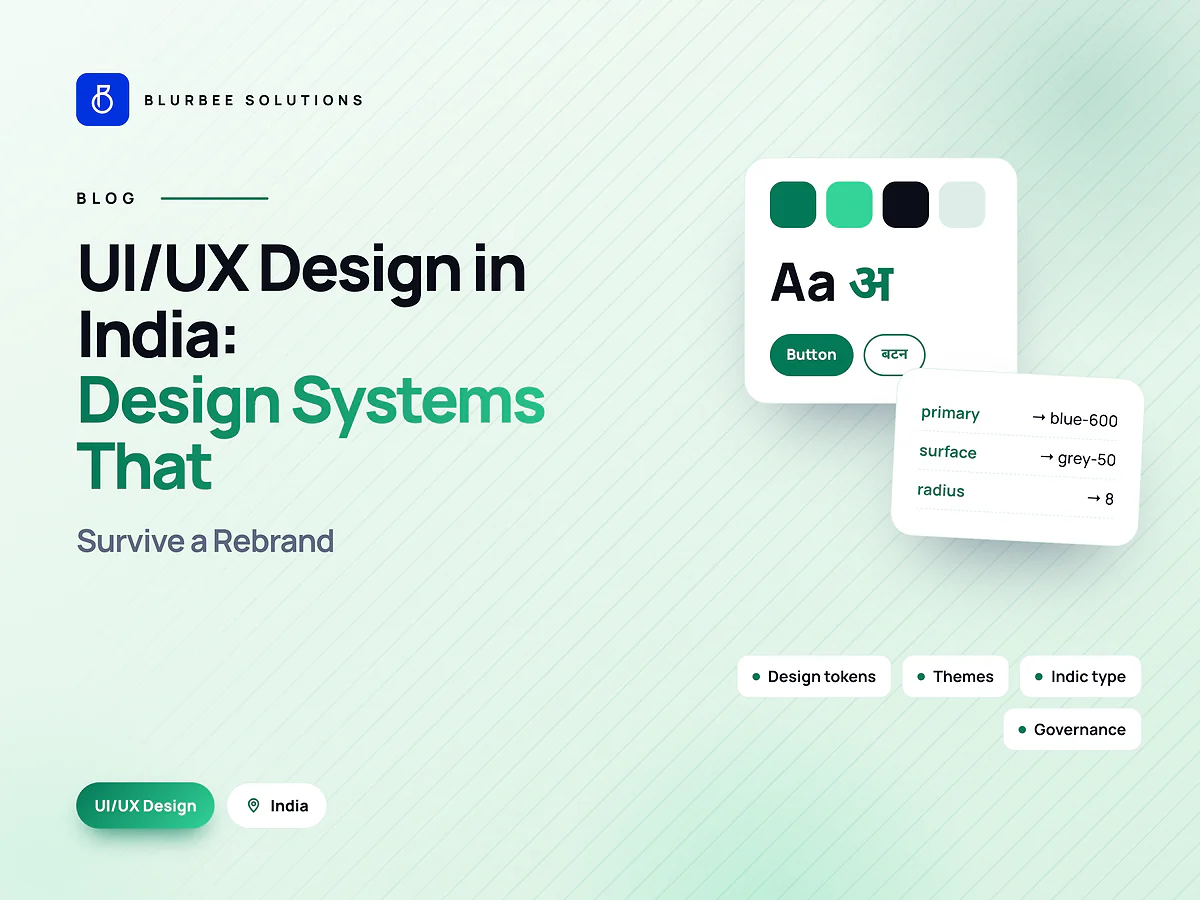
Design tokens are named values for design decisions, stored once and used everywhere. The structure that survives a rebrand has three layers:
Primitive tokens hold raw values: blue-600, grey-100, radius-8, a specific font family.
Semantic tokens give them meaning: color-action-primary, color-text-error, surface-raised.
Component tokens map meaning to parts: button-primary-background, input-border-focus.
Components only ever use semantic or component tokens. A rebrand mostly changes the primitive layer and a few semantic mappings. Every screen updates automatically.
Themes from the same structure
The same layering supports multiple themes: a main brand, a sub-brand, a white-label client, dark mode. The semantic and component layers stay shared; only the primitive values swap. For Indian SaaS companies serving enterprise clients with their own branding, this turns white-labelling from a fork into a setting.
Indic typography
If your product serves users in Indian languages, typography tokens must cover each script:
- Fonts that render Devanagari, Tamil, Bengali, Telugu and others correctly, including conjuncts.
- Line heights suited to taller glyphs and diacritics.
- Size scales tested per script, since the same point size reads differently.
- Components tested with longer translated text, so labels do not overflow buttons.
Keep design and code in sync
A design system lives in two places, design files and code, and they drift unless synchronised:
- Store tokens in a shared format, such as the W3C Design Tokens Community Group format, as the single source.
- Generate CSS variables, Android and iOS resources from tokens automatically.
- Publish components with usage documentation.
- Run visual regression tests so unintended changes are caught in CI.
Accessibility through the rebrand
New palettes must still meet WCAG contrast requirements: at least 4.5:1 for normal text. Checking contrast at the token level, between each text token and the surfaces it sits on, catches problems before they reach a single screen.
Governance
Systems fragment without ownership. A small named team owns the system, with a simple process: propose a change, review it against existing components, release it with a version number and changelog. Product teams consume releases rather than building local variants.
What it costs
A token and theming foundation for an existing component library typically costs ₹4-12 lakh with us, depending on component count and platforms, excluding 18% GST. A full design system from scratch costs more, and is often not needed if the existing components are reasonable.
A worked example: a two-week rebrand
An Indian fintech with a token-based system rebrands after a funding round: new primary colour, new typeface, slightly rounder corners.
The design team updates the primitive tokens and a handful of semantic mappings, checks contrast for every text and surface pair, and publishes a new token release. Engineering updates the token package on web, Android and iOS. Visual regression tests show every changed component for review. Two weeks later the new brand is live across the product.
The same company's previous rebrand, before the system existed, took a quarter and left old colours scattered across screens for a year.
Start with an audit
The first fixed-scope project audits your current components and styles: variant counts, hard-coded values, accessibility gaps and the target token structure. Two weeks, with a priced plan for the foundation. For finding UX problems in the flows themselves, see the design audit we run in week one.
Design systems, in numbers
Blurbee's indicative comparison of relative rebrand effort for a mid-sized product, scored out of 10 where 10 is most effort.
Why Indian teams build design systems with Blurbee
We separate brand decisions from component structure with layered tokens, so colour, type and shape can change without touching every screen, and we keep design and code in sync.
- Fixed-scope first projectTwo to four weeks, priced as a number rather than an estimate, so you have evidence before a longer commitment.
- One delivery lead, namedYou always know who to ask. No account manager relaying questions to a team you never meet.
- Code and IP are yoursAssigned in writing, handed over with repositories, infrastructure definitions and documentation whether or not you continue with us.
- Performance budgets in CICore Web Vitals and bundle size gate the build. Slow does not ship.
- Accessibility to WCAG 2.2 AAReviewed with automated and manual passes, not claimed on a slide.
- Written overlap disciplineStanding calls inside your working window, everything else asynchronous with a decision log.