Technology Services for the Prairies and Canada's Territories
How businesses in Manitoba, Saskatchewan, Yukon, NWT and Nunavut build reliable digital services with small local hiring pools, satellite links and remote-first delivery.

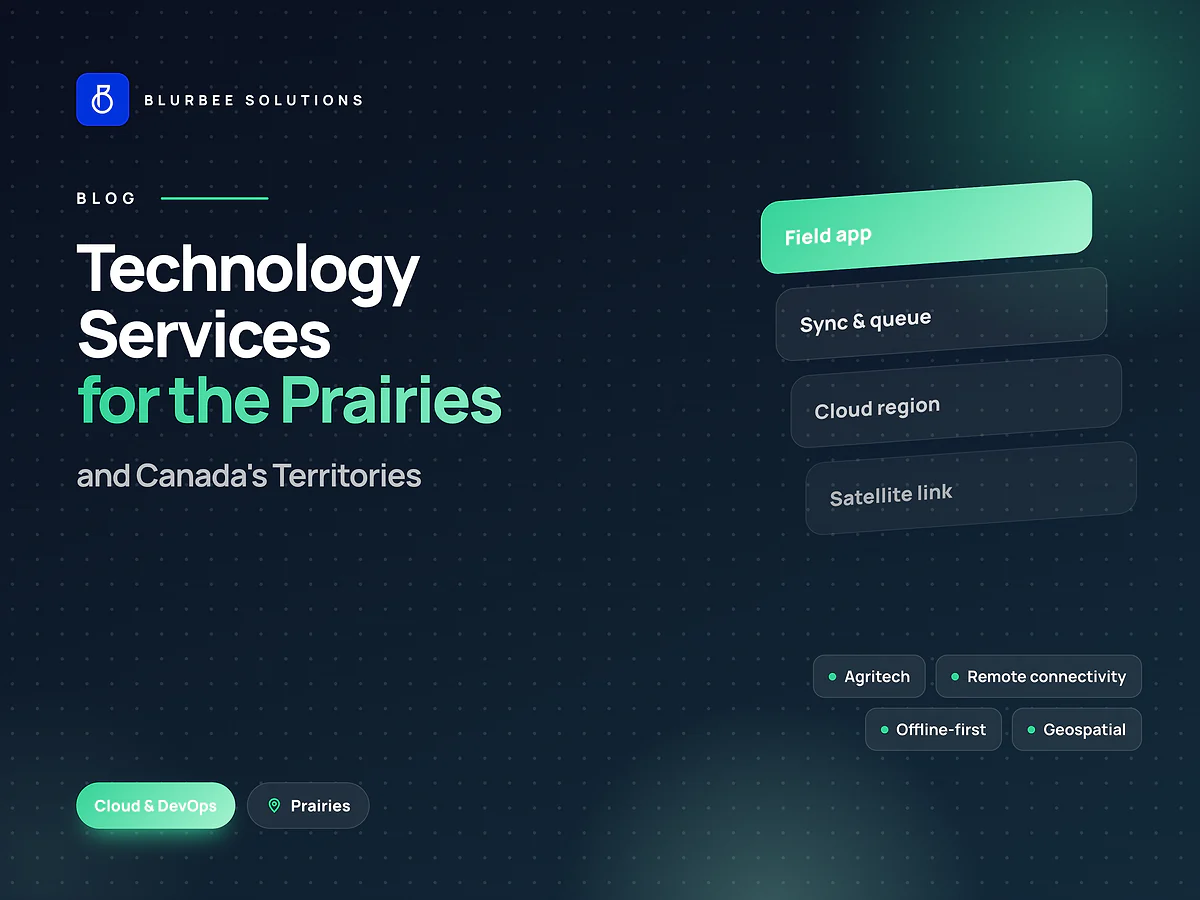
Two constraints define software in the Prairies and the territories, and neither is budget. The local senior engineering pool is small enough that hiring is often not an available option at any price. And a meaningful share of your users are on connections that a demo on office fibre tells you nothing about.
Everything useful here follows from taking both seriously.
The connection is a design input, not an afterthought
The single most common failure in this region is software that works in the office and does not work where it is used.
Design against a payload budget tied to the worst connection you must support. On rural LTE, keep views under roughly 1MB. On fixed wireless, under 500KB with aggressive caching. On a satellite link, under about 200KB and offline-first as a matter of course.
Those numbers are not precise thresholds so much as forcing functions. A budget in the build pipeline that fails the check is the only thing that reliably keeps payloads down over a year of feature work.
Test against degradation, not absence
Turning wifi off is not a test. It produces clean, immediate errors, which is the easy case.
A real satellite link produces 700-millisecond round trips, intermittent packet loss, and requests that eventually succeed after a long wait. Applications that handle a disabled network gracefully very often hang indefinitely under those conditions, because nothing ever definitively fails.
Test with a proxy that injects latency and loss. Set explicit timeouts on every request. Make sure a pending state is visible and cancellable rather than an indefinite spinner. And decide what the application does when a write has been queued for six hours, because in the North it will be.
Offline-first, decided before the data model
Four decisions, all taken in week one:
Local storage is the source of truth, with the server as the eventual reconciler. Writes queue and survive an application restart, a dead battery and a week without signal. Sync status is visible to the user, because silently showing stale data is worse than showing nothing. And there are explicit rules for what happens when two devices modified the same record, because in field operations they will.
Retrofitting this is close to a rewrite. If any of your users work outside reliable coverage, that is not a detail to raise in month three.
Geospatial at Prairie scale
Saskatchewan agritech and resource operations work at field-and-satellite scale, and the characteristic mistake is sending raw geometry to a browser on a rural connection.
The approach that works: server-side tiling and generalisation, so the client receives only what it can actually draw at the current zoom. Spatial indexing in PostGIS or equivalent. Pre-computed aggregates for the views people open most, rather than computing them per request.
This is unglamorous data engineering, and it is where the value sits on these projects. The map component itself is a commodity.
Sector notes
Winnipeg transport and aerospace. Fleet and freight software with unusually long data-retention requirements, driven by regulatory and insurance obligations. Design the archival strategy early; retention rules discovered in year two are expensive to satisfy retrospectively.
Saskatchewan agriculture and mining. Seasonal deadlines that do not move, and geospatial data volumes that make the query layer the hard part. Plan backwards from the season, freeze during it.
Northwest Territories and Nunavut public services. Remote-community connectivity as the primary constraint, plus accessibility and plain-language requirements that are enforced rather than aspirational.
Yukon government work. Accessibility and plain language for a widely dispersed population, with WCAG conformance evidence commonly required as a deliverable rather than a claim.
Language: Inuktitut is architecture, not translation
Nunavut services frequently need Inuktitut support, and it involves more than a translated string file.
Syllabics rendering with a font covering the full Unicode range. Layouts that survive longer strings without breaking. Input method support so users can actually type. Correct sorting and search behaviour. And the same externalised-string discipline any bilingual build requires — no text hardcoded in components, including in error messages, emails and generated documents.
Decide it in week one. A retrofit touches nearly every view.
Accessibility as a contractual deliverable
Territorial public-sector work treats accessibility as a requirement with evidence attached, not a best practice. That means WCAG 2.2 AA with both automated tooling and manual passes — keyboard navigation, focus order, contrast, screen reader labelling, motion preferences — delivered as a findings list with severity.
There is a practical overlap worth noting: much of what makes a page accessible also makes it lighter and faster. Semantic markup, real link text, correct heading hierarchy and forms that work without JavaScript all reduce payload and improve behaviour on poor connections. The two requirements pull in the same direction here.
Privacy
PIPEDA governs commercial personal-data handling across all five jurisdictions — none has a substantially similar private-sector provincial or territorial act. Health information is covered by separate statutes in Manitoba and Saskatchewan.
Territorial public bodies operate under their own access and privacy legislation, which in practice usually carries a Canadian data residency expectation. If that applies, we host in a Canadian cloud region; all three major providers have them. Establish it before architecture.
Write for the person who cannot call you
This matters more here than anywhere else we work, because the local support pool is genuinely thin.
Runbooks written for someone who has never spoken to us. Infrastructure as code in your repository. Documented recovery procedures for the failures that are actually likely — a satellite outage during a sync, a queued write conflict, a certificate expiry.
We hand over assuming the next person to touch the system will not have us available. That is a reasonable assumption in a region where the nearest alternative developer may be two thousand kilometres away, and it changes what documentation has to cover.
The overlap
Central time gives 2.5 hours of live overlap, 09:00-11:30 CT. One standing call inside the window, then asynchronous work with a written handoff at the end of each India day: what moved, what is blocked, what needs a decision.
For this region the model suits well, because the people who know why a field means what it means are frequently in the field, not at a desk. A written question they can answer between tasks often works better than a call neither party had time to take.
What shapes a Prairie and Northern project
Blurbee delivery practice. Budgets reflect what a page or sync payload must fit within to remain usable.
Why Prairie and Northern organisations work with Blurbee
We design for the connection you actually have, not the one a demo assumes. Offline-first architecture, tested against real latency and packet loss, and a delivery model that does not require anyone local to be available at 4pm.
- Fixed-scope first projectTwo to four weeks, priced as a number rather than an estimate, so you have evidence before a longer commitment.
- One delivery lead, namedYou always know who to ask. No account manager relaying questions to a team you never meet.
- Code and IP are yoursAssigned in writing, handed over with repositories, infrastructure definitions and documentation whether or not you continue with us.
- Performance budgets in CICore Web Vitals and bundle size gate the build. Slow does not ship.
- Accessibility to WCAG 2.2 AAReviewed with automated and manual passes, not claimed on a slide.
- Written overlap disciplineStanding calls inside your working window, everything else asynchronous with a decision log.