Cloud and DevOps in Manchester: CI/CD Setups That Cut Release Time
A CI/CD overhaul for Manchester media and retail-tech teams: DORA metrics, UK cloud regions, Cyber Essentials, regional rates and timelines.

Manchester's digital sector has grown up fast. Media and production teams around MediaCityUK in Salford, and retail and e-commerce tech in the Northern Quarter and across the city, ship software every day, but many of them still release it the way they did five years ago: a long-lived branch, a manual checklist, a Thursday afternoon deploy and a nervous Friday.
A good CI/CD pipeline changes that. This is how we approach an overhaul, what it costs in Manchester, and what to expect.
Measure first: the four DORA metrics
Before changing anything, we measure the four delivery metrics from the DORA research programme:
- Deployment frequency: how often you release to production.
- Lead time for changes: time from commit to running in production.
- Change failure rate: the share of deployments that cause a problem.
- Time to restore service: how long recovery takes when something breaks.
Together they show speed and stability. A team that deploys often but breaks things constantly is not doing well; neither is a team that never breaks anything because it barely deploys. The baseline also tells us where to start, and makes it obvious later whether a change helped.
Where pipelines usually lose time
Across the pipelines we review, the same handful of problems account for most of the delay:
- Serial test suites. A 40-minute suite that could run in 8 minutes in parallel.
- No caching. Dependencies and container layers rebuilt from scratch on every run.
- Long-lived branches that make every merge a small integration project.
- Manual deployment steps that need a specific person to be available.
- Flaky tests that fail randomly, so people rerun pipelines until they pass and stop trusting them.
- Environment drift, where staging does not resemble production, so testing there proves little.
We fix them in order of time lost, one at a time, and measure after each.
What a good pipeline looks like
The target state for most Manchester product teams:
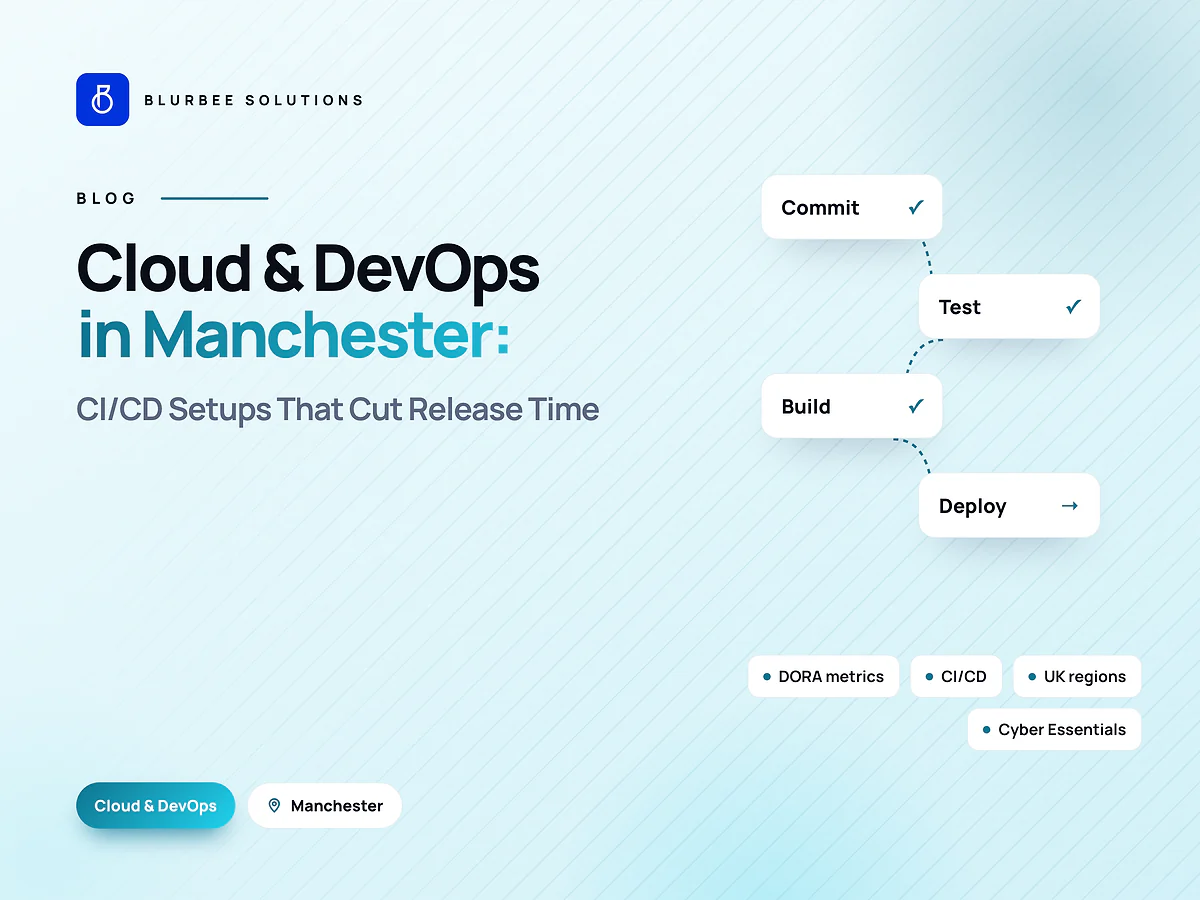
- Trunk-based development with short-lived branches merged at least daily.
- Fast feedback: lint, unit tests and build in under ten minutes, run in parallel with aggressive caching.
- Automated deployment to staging on every merge, and to production on approval or automatically.
- Feature flags that separate deploying code from releasing features, so unfinished work can ship safely switched off.
- Automated rollback, or a one-command rollback, tested regularly.
- Infrastructure as code, so environments are reproducible and staging matches production.
It rarely needs a new CI platform. GitHub Actions, GitLab CI and Azure DevOps are all capable, and the gains come from design, not tool choice.
Media and retail specifics
Media teams at MediaCityUK often run publishing platforms and video workflows with hard deadlines set by broadcast schedules. Feature flags and safe, reversible deployments matter more than raw frequency. Being able to ship a fix during a live event without risk is the real win.
Retail and e-commerce teams live by peak periods. We set up change freezes as code, load testing in the pipeline before peak, and performance budgets that fail a build when page speed regresses.
UK regions and data
UK GDPR does not require UK hosting, but many public-sector, NHS-adjacent and enterprise contracts do. AWS London (eu-west-2), Azure UK South and Google Cloud London (europe-west2) all keep data in the UK. We confirm requirements before choosing regions, and design pipelines so deployment artefacts and logs respect the same boundaries.
Cyber Essentials Plus
Greater Manchester public-sector bodies and NHS-related work commonly require Cyber Essentials Plus from suppliers. A good pipeline supports it directly: automated patching of base images, dependency vulnerability scanning, secrets management, least-privilege access for deployment roles and an audit trail of what was deployed and by whom.
Cost control comes with it
Pipeline work usually reveals cloud waste: oversized instances, idle environments left running, unused storage and expensive data transfer. We tag resources by team and product, rightsize, schedule non-production environments to shut down out of hours, and apply committed-use pricing where usage is steady.
Rates in Manchester
Manchester's day rates are well below London's, so the local market is genuinely competitive. Consultancies typically charge £70-95 per hour, DevOps contractors roughly £60-87 when day rates are converted, and agencies £50-75. Our blended team is £21-41.
A pipeline overhaul for a single product usually takes four to eight weeks. We share five hours of overlap with UK working hours, and incident escalation is agreed in writing.
A typical engagement, week by week
Week 1: measure. Read access to the repository, pipeline and cloud account. We collect the four DORA metrics from your history, time every pipeline stage, list flaky tests, and map how a change reaches production, including the manual steps.
Week 2: fix the biggest bottleneck. Usually test parallelism and caching, sometimes a manual approval that can be automated safely. We measure again and share the before-and-after numbers.
Weeks 3-4: make deployment boring. Automated deploy to staging on every merge, infrastructure as code for the environments, a tested rollback, and feature flags for anything risky.
Weeks 5-8: embed the habits. Short-lived branches, a quarantine process for flaky tests, dashboards for the DORA metrics, runbooks for the common incidents, and a handover session with your team.
Start with one repository
The first fixed-scope project covers one repository and its pipeline: measure the four DORA metrics, fix the slowest stage, and deliver a costed plan for the rest. Two to four weeks, fixed price in GBP, and a before-and-after number you can show the rest of the business.
Delivery performance, in numbers
Composite of published Manchester consultancy and agency rate cards, contractor day rates divided by 7.5 hours, and Blurbee quoted rates converted at prevailing rates, 2026.
Why Manchester teams modernise delivery with Blurbee
We measure before we change anything, fix the pipeline one bottleneck at a time, and leave every piece of infrastructure as code in your accounts. Five hours of overlap with UK time means incidents and reviews happen while your team is online.
- Fixed-scope first projectTwo to four weeks, priced as a number rather than an estimate, so you have evidence before a longer commitment.
- One delivery lead, namedYou always know who to ask. No account manager relaying questions to a team you never meet.
- Code and IP are yoursAssigned in writing, handed over with repositories, infrastructure definitions and documentation whether or not you continue with us.
- Performance budgets in CICore Web Vitals and bundle size gate the build. Slow does not ship.
- Accessibility to WCAG 2.2 AAReviewed with automated and manual passes, not claimed on a slide.
- Written overlap disciplineStanding calls inside your working window, everything else asynchronous with a decision log.