Cloud and DevOps Consulting in Chennai: CI/CD Setups That Cut Release Time
How Chennai engineering teams cut release cycles from weeks to hours: pipeline design, environment strategy, monitoring and rollback discipline that actually holds.

Most Chennai engineering teams we meet do not have a tooling problem. They have a queue problem. Code sits merged for three days waiting for a QA environment nobody can provision without a ticket, then waits again for a release window that happens once a week, then goes out at 11pm on a Friday because that is when it is safest to break things.
Faster releases are not primarily about installing a CI server. They are about removing the queues.
Measure four things before changing anything
The DORA research programme identified four metrics that reliably describe delivery performance, and they are the right baseline because they are hard to game: deployment frequency, lead time from commit to production, change failure rate, and time to restore service.
Measure all four for two weeks before touching the pipeline. Almost every team is surprised by at least one. The usual surprise is lead time: engineers estimate hours and the data says days, because the clock does not stop while code waits for a human.
The second reason to measure first is political. A pipeline project with no baseline is a matter of opinion at review time. A pipeline project that moved lead time from 62 hours to 5 is a fact.
Fix environment provisioning first
On most engagements this single change produces the largest improvement, and it is rarely where teams expect to start.
If getting a test environment requires a request to another team, your delivery speed is capped by that team's queue regardless of how good your tests are. The fix is infrastructure as code — Terraform, or the equivalent for your platform — with an environment that any engineer can create from a branch and destroy when the pull request merges.
Two conditions make this work. Environments must be genuinely disposable, which means no manual configuration and no snowflake state anyone is afraid to lose. And they must be cheap, which means they scale to zero or shut down overnight, or the cloud bill will kill the practice within a quarter.
Design the pipeline as a series of gates, not a single job
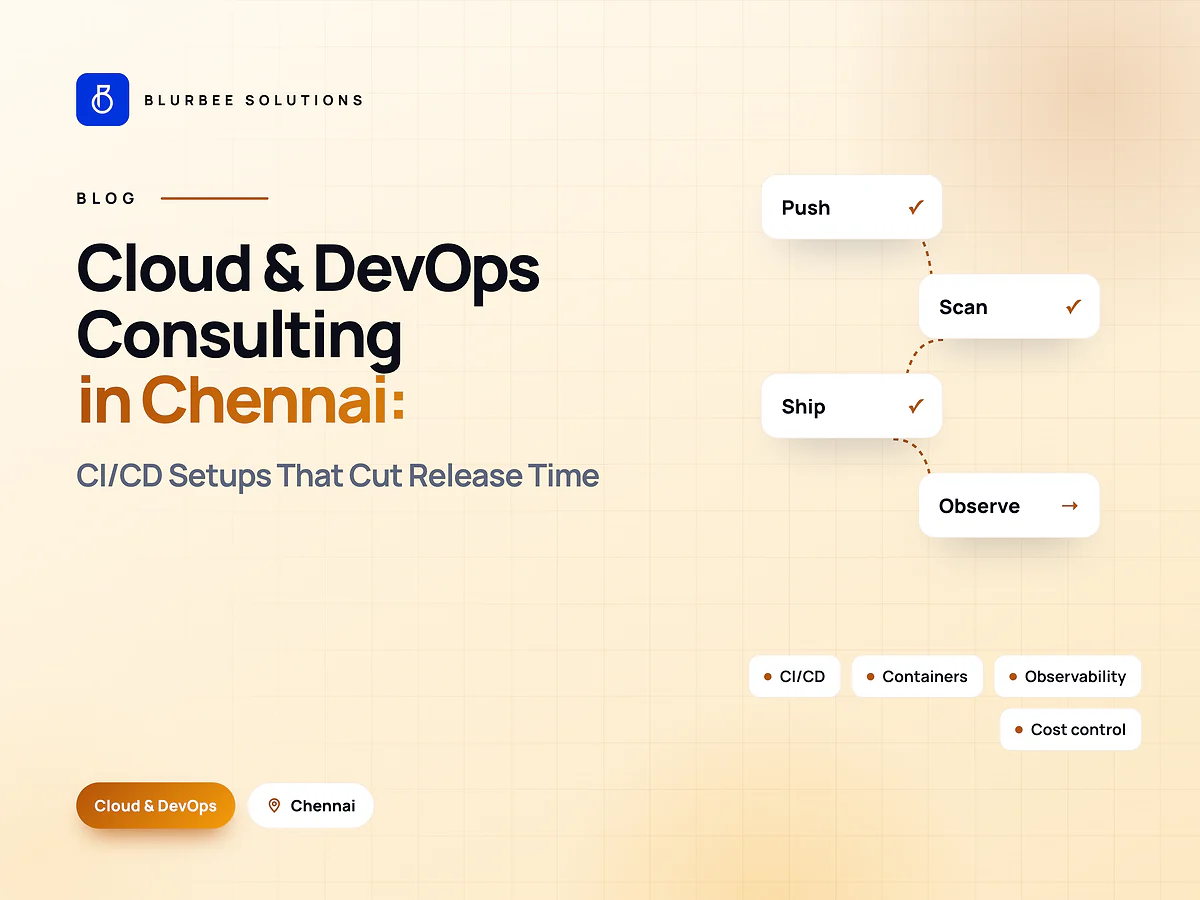
A pipeline that runs everything on every commit is slow, and a slow pipeline gets bypassed. Stage it by cost and confidence:
On every commit: lint, type check, unit tests. Target under five minutes. This is the gate developers wait for, so it has a latency budget like any user-facing thing.
On every pull request: integration tests, a preview environment, and any budget checks that matter — bundle size, Core Web Vitals, accessibility violations. Fail the build on regression rather than reporting it. A warning nobody blocks on is a warning nobody reads.
On merge to main: build once, produce an immutable artefact, deploy to staging automatically, run smoke tests.
On release: promote the same artefact that passed staging. Never rebuild for production. The artefact you tested must be the artefact you ship, or your staging environment is theatre.
Make rollback boring
The reason teams release weekly is fear, and the cure for fear is a rollback path someone has actually used.
That means the previous version stays deployable, database migrations are backwards-compatible for one version so rolling back code does not require rolling back schema, and rollback is one command or one button rather than a procedure someone has to remember under pressure.
Test it. Roll back a real deploy in a quiet hour and time it. A rollback path that has never been exercised is a hypothesis.
Feature flags belong in the same conversation. Separating deploy from release — shipping code dark and turning it on for a fraction of traffic — means a bad feature does not require a deploy to undo. It also means deploys become uninteresting, which is the goal.
Chennai specifics: healthcare and multi-site operations
Chennai's hospital networks and manufacturing groups run multi-site operations, and that changes the reliability conversation in two ways.
First, identity and role management is an architectural concern from the start rather than a feature. A system used across eight facilities with different staff roles and different local practices needs role management that a site administrator can operate without a developer.
Second, network reliability at the site is not the same as network reliability in the data centre. Systems used in wards, on shop floors and at remote facilities need to degrade rather than fail: local caching, queued writes, and an interface that tells the user what is stale rather than silently showing old data.
For anything touching patient data, the Digital Personal Data Protection Act, 2023 applies to sensitive personal data handling, and hospitals billing US payers inherit HIPAA business-associate obligations as well. Both affect logging design directly — you cannot debug what you are not allowed to store.
Observability: the four things worth having on day one
Uptime checks from outside your own network, so an outage is not invisible because your monitoring shares the failure. Error tracking with stack traces and release attribution. Latency and error rate per endpoint, so degradation is visible before it becomes downtime. And alerts routed to a named human with an agreed expectation about response.
Add distributed tracing when you have enough services that a slow request's cause is genuinely ambiguous. Before that, it is an expensive way to feel modern.
Alert discipline matters more than alert coverage. An alert that fires without requiring action trains people to ignore alerts, and a team that ignores alerts is worse off than a team with none, because it has the illusion of coverage.
What it costs
A pipeline and infrastructure audit is ₹1-3 lakh over one to two weeks and is the right first purchase — it tells you which of these changes will pay back fastest in your specific situation. A full setup covering IaC, CI/CD, environments and monitoring is ₹5-18 lakh over three to ten weeks. Reliability retainers run ₹40,000-1.5 lakh per month.
Cloud cost review deserves separate mention because the return is measurable: a first pass typically finds 20-40% savings from rightsizing, orphaned resources, storage class and retention fixes, and committed-use discounts on baseline load. That work has a clear end and pays for itself.
What good looks like at the end
A new engineer clones the repository, runs one command, and has a working local environment. They open a pull request and get a preview URL automatically. Their change reaches production the same day, behind a flag. If it misbehaves, they turn the flag off without deploying anything. If the deploy itself was bad, they roll back in under two minutes and nobody has to wake anyone.
None of that is exotic. It is mostly the removal of queues and the replacement of remembered procedures with executable ones.
The four numbers that describe a delivery pipeline
Blurbee delivery data across Cloud & DevOps engagements, 2019-2026. Hours from merged commit to production for a representative mid-size client.
Why Chennai engineering teams bring us their pipelines
We treat deployment as a product with users, and those users are your engineers. The measure is not how sophisticated the pipeline looks but whether a junior developer can ship on their first week and roll it back in ninety seconds.
- Fixed-scope first projectTwo to four weeks, priced as a number rather than an estimate, so you have evidence before a longer commitment.
- One delivery lead, namedYou always know who to ask. No account manager relaying questions to a team you never meet.
- Code and IP are yoursAssigned in writing, handed over with repositories, infrastructure definitions and documentation whether or not you continue with us.
- Performance budgets in CICore Web Vitals and bundle size gate the build. Slow does not ship.
- Accessibility to WCAG 2.2 AAReviewed with automated and manual passes, not claimed on a slide.
- Written overlap disciplineStanding calls inside your working window, everything else asynchronous with a decision log.