Nearshore vs Offshore Software Development: How US Companies Should Choose in 2026
Latin America, India, Eastern Europe or a US partner? A practical comparison of time zones, cost, talent and risk, and how to make whichever you choose work.

Once a US company decides to work with an external development team, the next question is where. Onshore partners share your time zone and legal system. Nearshore partners, usually in Latin America or Canada, sit a few hours away. Offshore partners, in India, Eastern Europe or Southeast Asia, offer the largest talent pools and lowest rates, with the biggest time difference.
Each choice is a trade-off between overlap, cost and talent. This guide compares them honestly, and explains how to make any of them work.
Why location is a strategic choice
US engineering talent remains scarce and expensive. The Bureau of Labor Statistics reports a median annual wage of $133,080 for software developers in May 2024, with employment projected to grow 15% from 2024 to 2034 (BLS). Deloitte's Global Outsourcing Survey 2024 found that access to talent is now the number-one driver of outsourcing decisions (Deloitte).
So the question is less "where is cheapest?" and more "where can we get the right skills, at a sustainable cost, with communication that works?"
The three options at a glance
| Onshore (US) | Nearshore (Latin America, Canada) | Offshore (India, Eastern Europe, Asia) | |
|---|---|---|---|
| Time-zone overlap | Full | Most or all of the day | Partial: from a few hours to none |
| Cost | Highest | Moderate | Lowest |
| Talent pool size | Large but contested | Growing | Largest |
| Travel | Easy | Short flights | Long flights |
| Legal and data | US law | Mostly foreign law | Foreign law |
| Best for | Regulated, on-site or high-touch work | Real-time collaboration at lower cost | Scale, specialist skills and cost efficiency |
Cost: what the numbers look like
These are the local agency rate bands published across our location pages for comparable seniority:
| Market | Typical local agency rate (per hour) |
|---|---|
| United States | $75–$220 |
| United Kingdom | £45–£130 |
| United Arab Emirates | AED 120–420 |
| Canada | CA$60–175 |
| India | ₹800–3,600 |
Blurbee's own published rates, from India, are $22 to $45 per hour for web development, $24 to $48 for mobile apps and $30 to $60 for AI and ML, depending on seniority. Nearshore rates typically sit between US and Indian rates, varying widely by country and seniority.
Rate differences shrink if communication fails. A cheaper team that needs twice the rework or management time is not cheaper. Judge total cost to deliver working, maintainable software.
Time zones: how much overlap do you really need?
Nearshore teams often work almost entirely within US business hours, which suits teams that rely on frequent real-time discussion, pair programming or rapid back-and-forth with stakeholders.
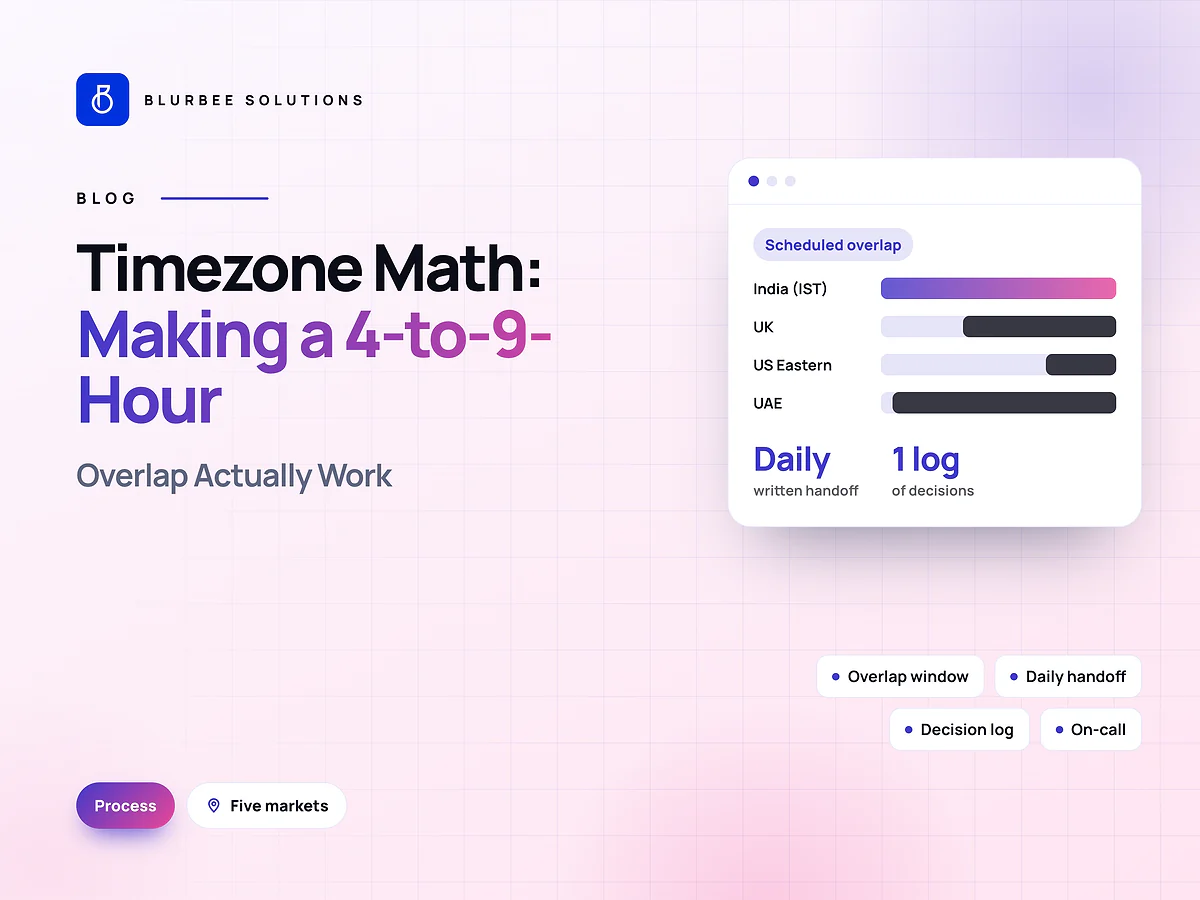
Offshore teams in India overlap with US business hours for a few hours a day. With Blurbee, US clients usually get one to three and a half hours of live overlap each working day, more on the East Coast and less on the West Coast.
Overlap matters less than many teams assume, if work is organized for it:
- Use the overlap for decisions, reviews and unblocking, not status reports.
- Write things down: clear tickets, acceptance criteria, daily written handoffs and a decision log.
- Exploit the time difference: work done overnight is ready for review in the morning, which can shorten cycles.
Our article on time-zone overlap for offshore teams explains how to plan the day.
Talent and skills
India has one of the world's largest pools of software engineers, with depth across web, mobile, cloud, data and AI. That makes it strong for scaling teams and finding specialist skills.
Eastern Europe is known for strong engineering in complex systems, with partial overlap with the US East Coast.
Latin America has a growing talent base with strong overlap, though some specialties are thinner and senior engineers are in high demand.
The US has excellent talent but intense competition for it, especially in AI and senior roles.
In every location, quality varies by company far more than by country. Vet the partner, not the map.
Communication and culture
Most offshore and nearshore failures come from communication, not skill. Reduce the risk by:
- Meeting the actual team, not only sales staff.
- Agreeing on how questions, blockers and disagreements are raised.
- Making it safe for the team to push back on unclear requirements.
- Holding regular demos of working software.
- Keeping one decision-maker on your side who responds quickly.
Risk, legal and data considerations
- Contracts: written IP assignment, confidentiality and clear governing law.
- Data: decide what data can leave the US. Regulated data, such as health or certain financial or government data, may need to stay onshore or be handled under strict controls. See our HIPAA software guide.
- Access: repositories and cloud accounts in your name; least-privilege access for external engineers.
- Continuity: documentation, infrastructure as code and handover terms so you never depend on one vendor.
Which should you choose?
Choose onshore when:
- Regulation or contracts require US-based work or data.
- The work needs frequent in-person collaboration.
- Budget is less of a constraint than proximity.
Choose nearshore when:
- Your process depends on real-time collaboration all day.
- You want lower cost than US rates, with full overlap.
Choose offshore when:
- You want access to the largest talent pools and specialist skills.
- Cost efficiency matters, especially for larger or longer engagements.
- Your team can work with a few hours of overlap and good written communication.
Combine them when it helps. Many companies keep product and architecture leadership onshore, with offshore teams for development, QA and support.
Making offshore work: a checklist
- Start with a small, paid, fixed-scope project to test communication and quality.
- Agree the overlap window and the rituals that use it.
- Give access to your repository, tools and environments from day one.
- Define done: acceptance criteria, tests and review standards.
- Hold a demo every one or two weeks.
- Review the relationship quarterly: delivery, quality, communication and cost.
Our guide to vetting a development partner has a fuller checklist, and our comparison of staff augmentation vs outsourcing helps choose the engagement model.
A sample working day across time zones
Here is how a US East Coast company and an India-based team typically structure a day:
- Early morning, US time (evening in India): live overlap. Standup, decisions, demos and unblocking. Questions from the Indian team's day are answered here.
- US business day: your team reviews the work delivered overnight, tests it in a staging environment and writes feedback and new priorities into tickets.
- US evening (Indian working day): the offshore team works on the agreed priorities, fixes issues raised in review and posts a written handoff before the next overlap.
West Coast companies have less live overlap, so they rely more on written handoffs and recorded walkthroughs, with a short scheduled call a few times a week.
How to compare proposals across locations
When proposals come from different countries, compare them on the same basis:
- Team composition: seniority, roles and who leads delivery.
- Total cost to reach a defined result, including your management time.
- Overlap and communication plan: which hours, which rituals and which tools.
- Process evidence: code review, testing, deployment and documentation.
- Security and data handling: access controls, data location and compliance.
- Contract terms: IP assignment, staffing changes, exit and handover.
- References from clients in your time zone and industry.
A slightly higher rate with a stronger process, clearer communication and a stable team is usually the cheaper choice over a year.
Common mistakes US companies make
- Choosing by hourly rate alone, then paying for rework and management time.
- Expecting full-day availability from a team in a very different time zone.
- Leaving requirements unwritten, so remote engineers guess.
- No single decision-maker, so questions wait for days.
- Skipping the trial project and committing to a large contract on day one.
- Treating the team as a vendor instead of part of the product effort.
Key takeaways
Onshore offers proximity at the highest cost, nearshore offers strong overlap at moderate cost, and offshore offers the largest talent pools at the lowest cost with less overlap. Quality varies more by company than by country, so vet the partner, organize work around the overlap you have, and start with a small paid project.
Security expectations for any location
Wherever your team sits, insist on the same basics: company-managed devices or secure virtual desktops for anyone with production access, multi-factor authentication on every tool, least-privilege access, no real customer data in development, background-checked staff for sensitive work, and a written incident-response process. Ask partners to describe how they meet each one, and include the requirements in the contract.
Whichever location you choose, review the arrangement after the first three months with a short scorecard: delivery against plan, defect rates, responsiveness and how often work had to be redone.
Offshore development with Blurbee
Blurbee is a team of 35+ in Surat, India, delivering software for US companies since 2019, with a named delivery lead, planned daily overlap and written handoffs. We sign an NDA first, start with a two to four week fixed-scope project, and assign code and IP to you in writing. See our web development services, software services across the USA, and our pages for Florida and California.