Hiring App Developers in the Southeast US: Costs, Contracts and Timezones
What app development costs across Florida, Georgia, the Carolinas and Virginia, how offshore compares on total cost of ownership, and how to structure the first 90 days.

The Southeast has a real and growing app market, and it splits into two buyer types with almost nothing in common: hospitality and logistics operators who need field-grade reliability, and Atlanta's payments and fintech sector, which arrives with compliance scope attached before design is discussed.
This is what hiring looks like in both cases, and where offshore fits.
The rate picture
Atlanta and Miami agencies typically quote $110-155 per hour at mid to senior level. Regional studios in Charlotte, Raleigh, Tampa and Richmond run $75-110. Experienced US freelancers are $65-95, though you are buying one skill.
Offshore teams delivering to the Southeast, including ours, sit around $24-48 for a blended team with QA included. As project shapes, a cross-platform app with backend integration is commonly $60,000-180,000 built locally.
The honest caveat: the total cost gap is narrower than the hourly gap. A well-run offshore engagement consumes four to six hours of your time each week in written briefs, a standing call and reviewing work. If your time is the scarce resource, count it. It is still cheaper — usually substantially — but the comparison should be made properly rather than on rate alone.
The platform decision, written down
Before any code, we produce a short platform decision record: the constraints checked, the choice made, the reasoning, and what would cause us to revisit it. An afternoon's work that prevents the same argument recurring in month four with no record of why the first answer was reached.
The constraints that actually decide it:
Deep platform APIs. Background location with battery constraints, CarPlay or Android Auto, widgets, NFC secure element, HealthKit. Bridges exist for most, but each bridge is a dependency someone maintains, and they break in production. Two or more of these being core pushes toward native.
Sustained high frame rates. Games, real-time graphics, continuous-gesture charting. Cross-platform handles ordinary business UI at 60fps easily; this class of work is harder than writing it natively.
Platform-native polish users would notice. For consumer apps competing on feel, yes. For a logistics field app or a B2B tool, no. Be honest about which you are building.
Maintenance team size in year two. Two native codebases mean two OS cycles, two dependency trees, two sets of store requirements. A three-person team maintaining both spends most of its capacity on maintenance.
For most Southeast business apps — hospitality booking, field operations, B2B portals — cross-platform is correct and delivers 60-75% code sharing.
Florida: hospitality, and what it actually requires
Florida hospitality briefs come with three requirements that consumer product teams underestimate.
Multilingual at launch, not later. Spanish is a launch requirement, and often Portuguese and Haitian Creole depending on the market. That is an architecture decision: content structure, string management, layout that survives longer strings, and dates and currency formatted per locale. Retrofitting is expensive.
Peak-season reliability as the only metric. A booking system that is fine in August and falls over during spring break has failed. Load test against real seasonal peaks and know what degrades first.
Integration with something old. The property management or reservation system is usually a decade older than your app and its API reflects that. This is frequently the largest single risk in a Florida hospitality project and it should be validated in week one, not week six.
Georgia: payments, and PCI scope
Atlanta processes a large share of US card payments, and Georgia fintech briefs carry PCI DSS scope from the first architecture conversation.
The single most useful decision available: do not touch card data. Using a tokenising payment provider, so card details go directly from the user's device to the processor and never enter your systems, reduces your PCI scope from an audit to a questionnaire. This is worth designing around even at some product cost.
Where card data must be handled, that is a different project with different timelines, and it needs a compliance reviewer in week one rather than week ten.
The first 90 days
Weeks 1-2. Platform decision record. Architecture. A working build in your repository that does one real thing end to end — authenticates, calls your API, displays real data. Getting to a working build in week two proves the whole pipeline exists.
Weeks 3-8. Feature development in two-week iterations, with a demo on a real device at the end of each. Crash reporting and analytics instrumented from the first build, not added later.
Weeks 9-11. QA across a real device matrix, not just simulators. Store metadata, screenshots, privacy declarations — Apple's privacy questionnaire alone takes longer than teams expect. Accessibility pass.
Week 12. Submission, with buffer. Apple review is typically one to three days, but a rejection resets the clock. A first rejection is normal, not a failure.
Accounts, code and ownership
Apple Developer and Google Play accounts in your company's name, with the vendor added as a delegate. Repository, CI configuration and signing keys yours from day one. This is not distrust; it is that transferring an app between developer accounts later is possible, tedious, and entirely avoidable.
Contractually: NDA before detailed discussion, and explicit assignment of work product to you on payment. Read that clause rather than assuming it.
Do not launch both platforms at once
Check your web analytics for the device split. It is usually less balanced than assumed, and in the Southeast frequently skews Android in logistics and field-workforce contexts and iOS in hospitality.
Launch where your users are. Learn from a month of real usage. Then bring the second platform, which with cross-platform is weeks rather than a second project. The reason is not cost — it is that the first month will change the app, and changing it once is cheaper than changing it twice.
Maintenance is not optional
Both platforms ship annual OS releases that break things. Both stores raise minimum SDK levels and enforce them by refusing updates. An app left alone for eighteen months is not stable, it is accumulating an upgrade debt that eventually blocks your next release entirely.
Budget a quarterly maintenance pass and a larger one after each major OS release, independent of features. It is unglamorous and it is the difference between an app you can update and one you have to rebuild.
The Southeast app market, in numbers
Composite of published US regional rate cards and Blurbee quoted rates, 2026. Indicative bands; scope and seniority move them.
Why Southeast US companies work with Blurbee
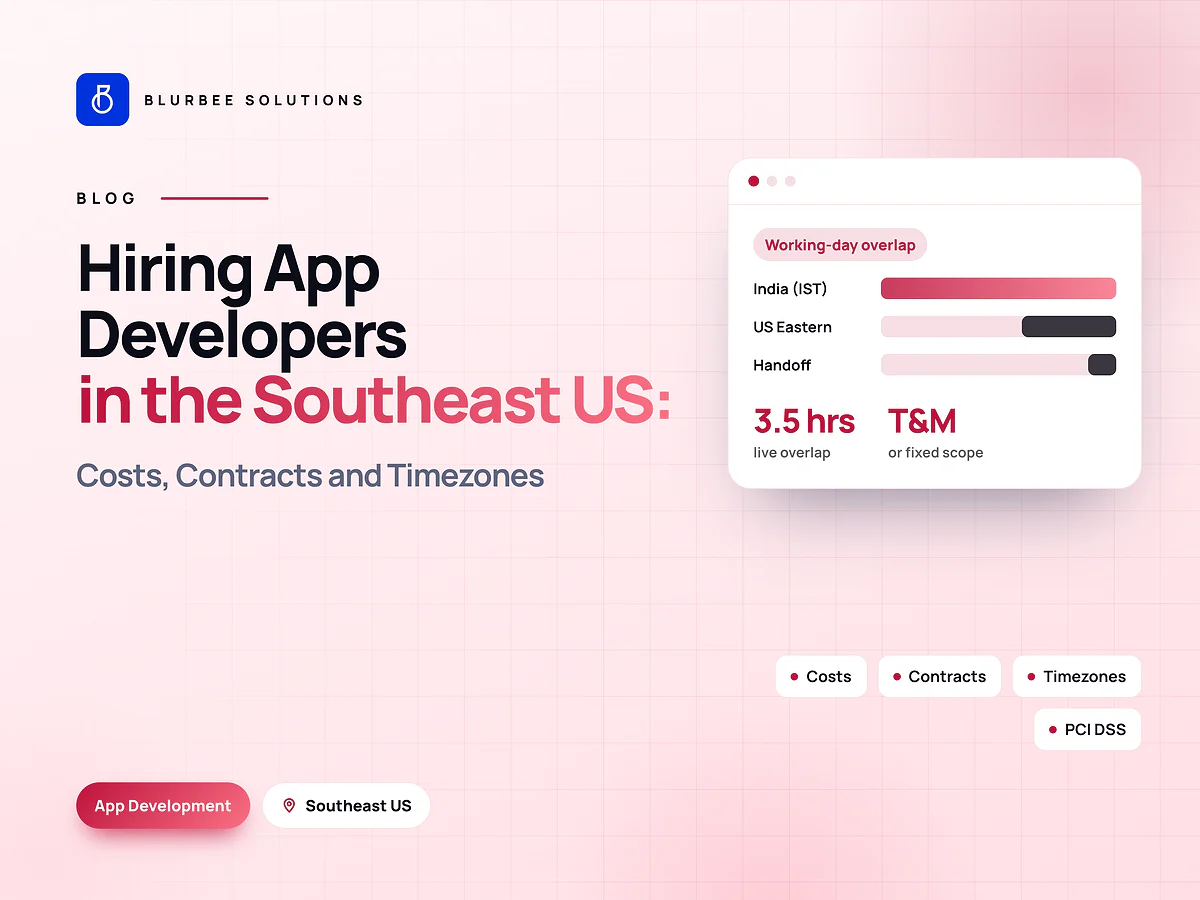
3.5 hours of live overlap with Eastern time, a platform decision written down before any code, and app store accounts that stay in your name. We have shipped for hospitality, logistics and payments clients, which is most of what the Southeast buys.
- Fixed-scope first projectTwo to four weeks, priced as a number rather than an estimate, so you have evidence before a longer commitment.
- One delivery lead, namedYou always know who to ask. No account manager relaying questions to a team you never meet.
- Code and IP are yoursAssigned in writing, handed over with repositories, infrastructure definitions and documentation whether or not you continue with us.
- Performance budgets in CICore Web Vitals and bundle size gate the build. Slow does not ship.
- Accessibility to WCAG 2.2 AAReviewed with automated and manual passes, not claimed on a slide.
- Written overlap disciplineStanding calls inside your working window, everything else asynchronous with a decision log.