DevOps Consulting Services in 2026: What They Include, What They Cost, and When You Need Them
Slow releases, fragile deployments and rising cloud bills usually have the same root cause. This guide explains what DevOps consultants fix and how to get value from them.

If releases happen rarely and nervously, if deployments depend on one person who "knows how it works", or if the cloud bill grows faster than the business, the problem is usually not the developers. It's the delivery system around them: how code is built, tested, deployed, monitored and run.
DevOps consulting fixes that system. This guide explains what DevOps services include, what they cost, and how to tell whether you need them.
Why delivery practices matter more than ever
AI is now part of most development work. Google's DORA research program found AI adoption among software development professionals reached about 90% in its 2025 State of AI-assisted Software Development report, based on a survey of nearly 5,000 technology professionals (DORA, Google). The report also found that AI amplifies an organization's existing strengths and weaknesses: teams with strong delivery practices benefit more, while weak practices turn faster coding into more instability.
Cloud costs are another pressure. Flexera's 2026 State of the Cloud research found respondents estimated 29% of their cloud spend is wasted (Flexera).
Signs you need DevOps help
- Releases are infrequent, manual and stressful.
- Deployments break production, and rollbacks are slow.
- Environments differ, so "it works on staging" means little.
- Nobody can rebuild the infrastructure from scratch.
- Problems are found by customers before monitoring.
- Cloud costs keep rising without a clear explanation.
- Security patches and dependency updates fall behind.
- One or two people hold all the operational knowledge.
What DevOps consulting services include
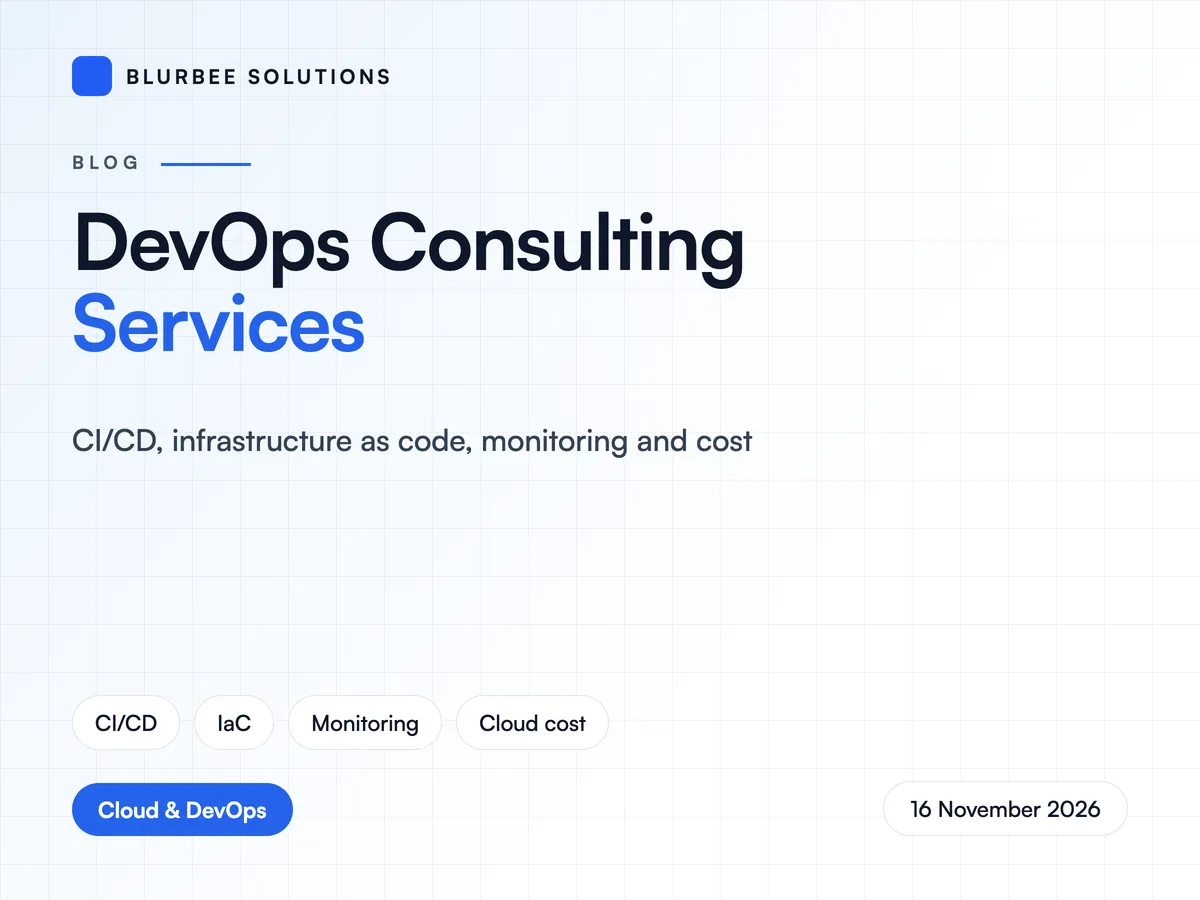
CI/CD pipelines
Automated build, test and deployment for every change, with staging environments and approvals where needed. Releases become small, frequent and reversible.
Infrastructure as code
Servers, networks, databases and permissions defined in code (for example with Terraform or OpenTofu), version-controlled and reviewed like application code. Environments become reproducible.
Containers and orchestration
Packaging applications in containers, and running them on managed services or Kubernetes where the scale justifies it.
Monitoring and observability
Metrics, logs, traces, uptime checks and alerting, so you see problems before customers do.
Security in the pipeline
Dependency and secret scanning, least-privilege access, patching and security checks built into delivery. Our SDLC guide covers the secure development life cycle.
Cloud cost optimization
Tagging, budgets, right-sizing, scheduling non-production environments, storage tiers and commitment discounts.
Reliability and recovery
Backups, tested restores, disaster recovery plans and incident runbooks.
Metrics that show progress
DORA's widely used delivery metrics are a good way to measure improvement:
- Deployment frequency: how often changes reach production.
- Lead time for changes: how long from commit to production.
- Change failure rate: the share of releases that cause problems.
- Time to restore service: how quickly you recover from failures.
Add cloud cost per customer or per transaction, and the time engineers spend on manual operations.
What DevOps consulting costs
Rates vary widely by market. These are the local agency ranges published across our location pages:
| Market | Typical local agency rate (per hour) |
|---|---|
| United States | $75–$220 |
| United Kingdom | £45–£130 |
| United Arab Emirates | AED 120–420 |
| Canada | CA$60–175 |
| India | ₹800–3,600 |
Blurbee's published rates for cloud and DevOps work are $26 to $52 per hour depending on seniority, and a typical cloud and DevOps engagement runs three to ten weeks. Many companies follow an initial project with a small monthly retainer for monitoring, patching and ongoing improvements.
Engagement models
- Assessment: a fixed-scope review with a prioritized roadmap.
- Implementation project: building pipelines, infrastructure as code, monitoring and cost controls.
- DevOps as a service: ongoing operations, monitoring and improvement on a monthly basis.
- Embedded engineers: DevOps specialists joining your team. See our comparison of staff augmentation vs outsourcing.
How to choose a DevOps partner
- Ask for examples of pipelines and infrastructure they've built, and the before-and-after metrics.
- Check experience with your cloud: AWS, Azure or Google Cloud. Our cloud provider comparison helps if you're still choosing.
- Insist that everything lives in your accounts and repositories.
- Ask how they document and hand over, so you're not dependent on them.
- Check their security practices for access to your environments.
What you get from Blurbee
- A DevOps assessment with metrics and a prioritized roadmap.
- CI/CD pipelines for your applications, with automated tests and safe rollbacks.
- Infrastructure as code for your environments, in your repositories.
- Monitoring, alerting and dashboards.
- Cloud cost controls: tagging, budgets and right-sizing.
- Runbooks and documentation, with knowledge transfer to your team.
How Blurbee runs a DevOps engagement
- Assessment (one to two weeks): pipelines, environments, infrastructure, monitoring, security, costs and the team's pain points, with baseline DORA metrics.
- Roadmap: prioritized fixes, quick wins first.
- Implementation: CI/CD, infrastructure as code, monitoring and cost controls, built in your accounts and reviewed with your team.
- Handover: documentation, runbooks and pairing sessions so your team can run and change it.
- Optional ongoing support: monitoring, patching and continuous improvement.
A worked example: from manual releases to daily deploys
Consider a SaaS company releasing once a month, with manual deployments that often break something. A typical first engagement:
- Automated build and test on every pull request.
- Staging environment created from infrastructure as code, matching production.
- Automated deployment to staging on every merge, and to production with one approval.
- Health checks and quick rollback for every release.
- Monitoring and alerting for errors, latency and uptime.
- Cost tagging and budgets for each environment.
Afterwards, releases become small and routine, problems are caught earlier, and the team spends less time on manual operations.
Readiness checklist
- Is all code in version control, with a clear branching approach?
- Are there automated tests, even a few?
- Can you list every environment and how it's built?
- Who has access to production, and is it reviewed?
- Do you know your monthly cloud spend by environment or product?
Key takeaways
DevOps consulting fixes the delivery system around your developers: pipelines, infrastructure as code, monitoring, security and cloud costs. Measure progress with DORA metrics and cost per customer, keep everything in your own accounts, and insist on documentation and handover.
Who works on a Blurbee DevOps engagement
DevOps engagements are led by a senior DevOps or cloud engineer who owns the assessment and roadmap, supported by engineers who build pipelines, infrastructure as code and monitoring, and a security-minded reviewer who checks access, secrets and patching. Our application developers join where pipelines and code changes meet, such as adding tests or making services easier to deploy. A delivery lead keeps you informed with written updates and regular reviews.
Common DevOps mistakes
- Adopting Kubernetes before it's needed, adding complexity without benefit.
- Automating a broken process instead of fixing it first.
- Infrastructure changes made by hand that drift from the code.
- Alerts nobody acts on, so real problems get missed.
- Cloud resources without owners or tags, making costs impossible to manage.
Typical timeline
A DevOps assessment takes one to two weeks. A typical implementation, such as pipelines, infrastructure as code and monitoring for a product, runs three to ten weeks, followed by optional monthly support.
What to prepare before a DevOps engagement
- Read access to repositories, CI/CD tools and cloud accounts.
- A list of applications, environments and how each is deployed today.
- Recent incidents and what caused them.
- Your current monthly cloud bill, broken down if possible.
- The people who deploy and support production now.
Quick glossary
- CI/CD: continuous integration and delivery, automating build, test and release.
- Infrastructure as code: defining infrastructure in version-controlled files.
- Observability: metrics, logs and traces that explain what systems are doing.
- Rollback: quickly returning to the previous working version.
Next steps
Write down how a change gets from a developer's laptop to production today, step by step, and how long it takes. That one page usually reveals the biggest bottlenecks, and it's the best starting point for a DevOps assessment. Add your last few incidents and your current cloud bill, and a good partner can tell you within a week or two where the quickest, safest improvements are.
Good DevOps work also improves the developer experience: faster feedback on every change, fewer late-night incidents and less time spent on repetitive manual steps. Those gains are harder to put in a spreadsheet than cloud savings, but they show up quickly in delivery speed, team morale and the reliability customers notice. Measure both the technical metrics and how your developers feel about releasing.
Start small, prove the improvement with metrics, and expand from there.
If you're unsure where to begin, ask for a short assessment first: it costs little and makes every later decision clearer.
Why companies choose Blurbee for DevOps
Blurbee's cloud and DevOps engineers work across AWS, Azure and Google Cloud, alongside our application developers, so delivery improvements fit how your software is actually built. We're a team of 35+ in Surat, India, working since 2019 with 60+ projects delivered. We start with a fixed-scope review, sign an NDA first, and keep everything in your accounts.
See our cloud and DevOps services, cloud and DevOps across the USA, and our pages for Washington and Illinois. You can also hire AWS developers or Docker developers.