Custom Software Development Cost in 2026: What US Businesses Pay, and How to Budget
Why quotes for the same idea range from tens of thousands to millions of dollars, what US and offshore teams charge, and how to set a budget you can actually defend.

"How much will it cost?" is the first question every buyer asks about custom software, and the hardest one to answer honestly in a single number. Two quotes for the same idea can differ tenfold, and both can be reasonable. One team may be pricing a narrow first release, and the other the complete platform you described in the first meeting.
This guide explains where the money goes, what US and offshore teams charge, and how to set a budget that survives contact with reality.
Why software budgets keep rising
Demand for software talent is not slowing. Gartner forecasts worldwide IT spending of $6.37 trillion in 2026, up 14.2% on 2025, with software spending alone at about $1.47 trillion (Gartner). Every one of those dollars competes for the same engineers.
The US Bureau of Labor Statistics puts the median annual wage for software developers at $133,080 in May 2024, and projects employment to grow 15% from 2024 to 2034, much faster than the average for all occupations (BLS). Agencies price on top of salary, adding benefits, office costs, management, sales and margin, which is why US agency rates are so much higher than the salary alone suggests.
What kind of software are you buying?
Cost depends first on what you are building. These are the categories we see most often:
1. Internal tool or workflow app
A system that replaces a spreadsheet or a manual process: approvals, scheduling, inventory, reporting. Usually a small number of user roles and integrations. This is the most predictable category to price.
2. Customer portal or web application
Accounts, dashboards, self-service, payments and notifications, often tied to your CRM or ERP. The user experience matters more, and so does security.
3. Mobile app
iOS and Android apps, usually with a back end and admin panel behind them. Our mobile app development cost guide covers this category in detail.
4. SaaS product
A multi-tenant product you sell to other businesses, with billing, onboarding, permissions and the operational work of running it for many customers. See our SaaS product development guide.
5. Enterprise system
ERP, large-scale integrations, data platforms and systems with strict audit, compliance or uptime requirements. These are usually delivered in phases over many months.
The nine cost drivers
- Scope of the first release. The single biggest lever. A focused first version that solves one problem well costs a fraction of the full vision.
- Number of user roles. Each role brings its own screens, permissions and edge cases.
- Integrations. Every connection to a CRM, ERP, payment gateway or third-party API needs building, testing and maintaining.
- Business rules and exceptions. The unusual 10% of cases often take most of the effort.
- Data migration. Moving and cleaning years of existing data is routinely underestimated.
- Design depth. A design system and standard components are efficient; heavy custom interaction is not.
- Security and compliance. HIPAA, PCI DSS, SOC 2 and accessibility requirements add design, documentation and testing work.
- Platforms. Web only, or web plus iOS and Android? Each platform adds build and test effort.
- Who builds it, and where. Rates vary enormously by market, as the next section shows.
What developers charge by market
These are the local agency ranges published on our location pages for comparable seniority:
| Market | Typical local agency rate (per hour) |
|---|---|
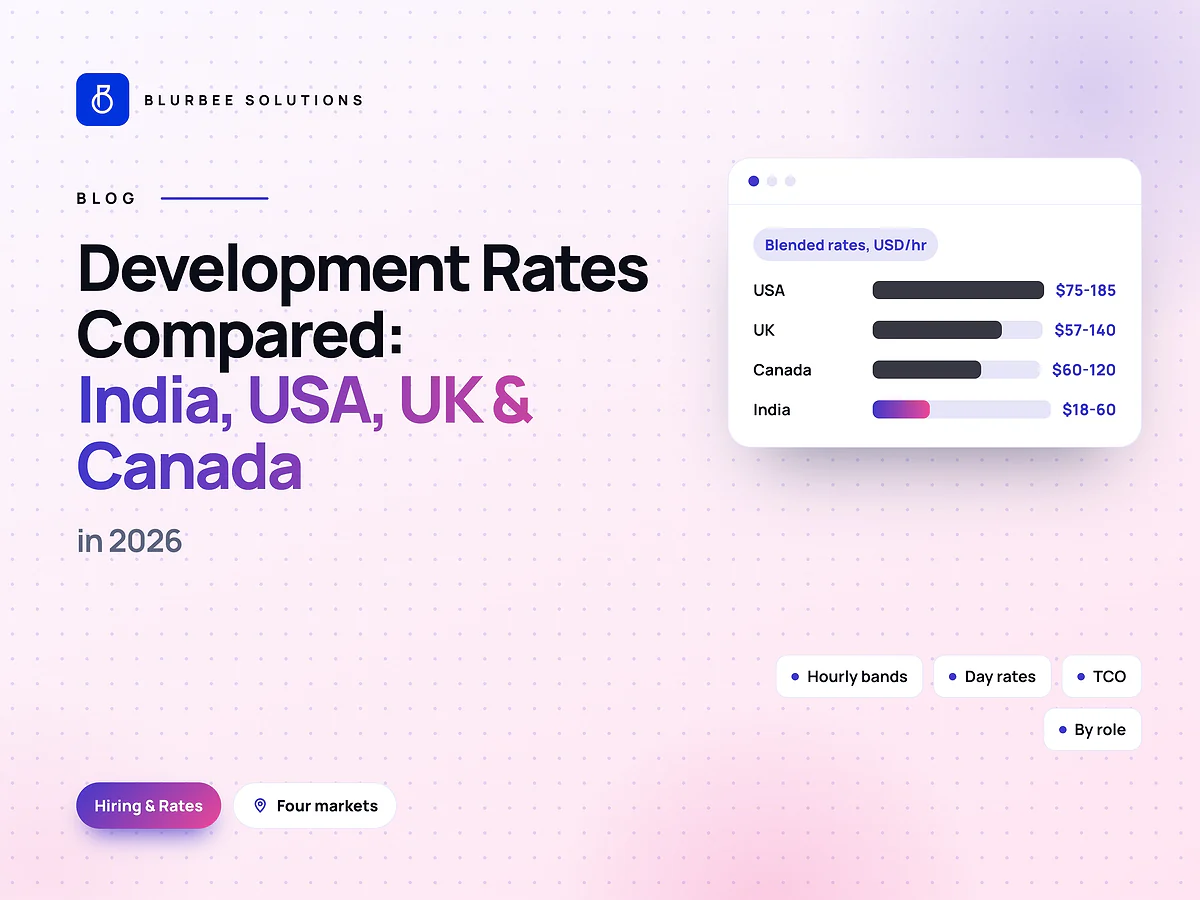
| United States | $75–$220 |
| United Kingdom | £45–£130 |
| United Arab Emirates | AED 120–420 |
| Canada | CA$60–175 |
| India | ₹800–3,600 |
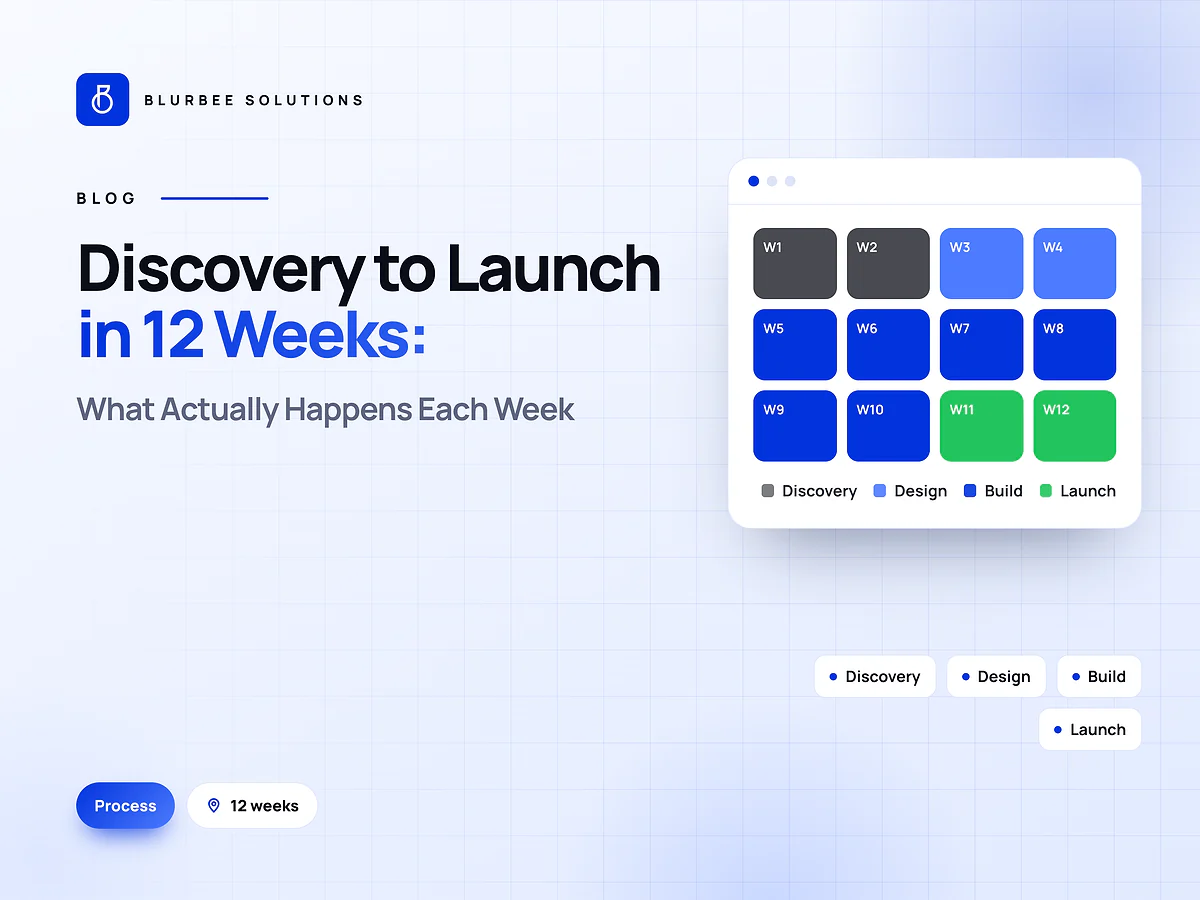
Blurbee's published rates for web development are $22 to $45 per hour, and $24 to $48 for mobile app development, depending on seniority. A typical web development engagement runs six to fourteen weeks, and a typical app development engagement eight to eighteen. Local US bands differ by state; our Texas web development page and New York City page show two examples.
Rates alone are a poor guide. A team that bills less per hour but takes twice as long, or leaves code nobody else can maintain, costs more. Compare total cost to reach a working, maintainable product.
Fixed price, time and materials, or dedicated team?
Fixed price works well for a clearly defined scope, such as a first release or a discovery phase. You know the cost in advance; in exchange, changes go through a formal change request.
Time and materials suits work where the scope will evolve. You pay for the time used, with regular reviews so spending stays visible.
A dedicated team suits long-running products. You get a stable group of people who learn your business, at a predictable monthly cost. Our article on dedicated development teams for US companies compares the models.
Many good engagements combine them: a fixed-price discovery and first release, followed by a dedicated team or time and materials once the product is in use.
The costs nobody puts in the first quote
- Hosting and cloud services, including staging environments and backups.
- Third-party licences: maps, email, SMS, payments, analytics and monitoring.
- App store fees and developer accounts for mobile apps.
- Security reviews and penetration testing before launch.
- Maintenance: bug fixes, security patches, dependency updates and small changes. Plan for this from day one; our article on web app maintenance retainers explains how to keep it predictable.
- Your own team's time for decisions, testing and training. This is real cost, and slow decisions are one of the most common reasons projects run long.
How to set a realistic budget
- Write down the problem, not the features. What should be different six months after launch?
- Fund discovery first. A short, paid discovery phase produces a scope, a technical plan and a reliable estimate. It is the cheapest insurance you can buy.
- Define the smallest useful release. List what users must be able to do on day one, and move everything else to a later phase.
- Add a contingency of 15 to 25%. Unknowns always appear, especially in integrations and data.
- Budget for the first year of running costs, not just the build.
- Agree how changes are priced before work starts.
How location affects working with a US team
Many US buyers assume a local team is needed for good communication. In practice, overlap and written discipline matter more than distance. With an India-based team, US companies usually get one to three and a half hours of live overlap each working day, more on the East Coast and less on the West Coast, used for standups, reviews and demos. Everything else runs on written handoffs and a decision log.
Our state pages, such as California and Florida, list the overlap window, typical local rates and compliance notes for each market.
Red flags in a software quote
- A firm price before anyone has asked detailed questions. Either the scope is being guessed or the risk is being hidden.
- No mention of testing, deployment or documentation. These will appear later as extras.
- Code hosted on the vendor's accounts. You should own the repository and the cloud accounts from the start.
- Vague change-request terms. This is where most budget disputes begin.
- Unrealistically low rates for senior engineers. Ask who will actually do the work.
Build or buy: when off-the-shelf software is the cheaper answer
Before budgeting for custom software, check whether you need it at all. Off-the-shelf SaaS products are cheaper and faster when your process is close to standard, the product covers most of what you need, and per-user fees stay reasonable as you grow.
Custom software pays off when:
- Your process is your advantage, and bending it to fit a generic product would cost you customers or efficiency.
- You're stitching together several tools with spreadsheets and manual copying in between.
- Licence costs keep rising with every user or transaction, and owning the software would cost less over three to five years.
- You need control over data, security, integrations or the roadmap.
A common middle path is to keep proven products for standard functions, such as accounting, email and HR, and build only the layer that makes your business different.
A worked budgeting approach
Rather than one big number, build the budget in phases, each with its own decision point:
- Discovery (fixed price): requirements, user flows, technical plan and a scoped estimate for the first release.
- First release (fixed price or capped): the smallest version that delivers real value to real users.
- Iteration (time and materials or dedicated team): improvements based on what users actually do.
- Run and maintain (monthly): hosting, monitoring, updates and support.
At the end of each phase you decide whether to continue, change direction or stop. That's far safer than committing the whole budget on day one, when you know the least.
How Blurbee prices custom software
Blurbee is a team of 35+ in Surat, India, building custom software for clients in the United States and elsewhere since 2019. We start with a fixed-scope first project of two to four weeks, priced as a number rather than an estimate, and sign an NDA before you share details. You own the code and IP, assigned in writing on payment. See our web development services and web development across the USA for the full scope.