How to Choose the Best Software Development Company in India: A 2026 Buyer's Guide
Every list of top software companies looks different. This guide shows how to judge an IT or software company on evidence: its work, its people, its contract and its price.

Search for the best software development company in India and you will find dozens of "top 10" lists, and hardly any two agree. Some are editorial, some are based on reviews, and some include paid placement. None of them knows your project. A company that is excellent for a Bengaluru SaaS startup may be the wrong choice for a Surat textile manufacturer, and the other way round.
So this guide does not offer another ranking, and we won't claim that we top it. It gives you a way of judging any company, including us, using evidence you can check yourself.
The market you are choosing from
India's technology sector is huge. Nasscom estimates industry revenue of $315 billion in FY26, up 6.1%, with AI revenue of upwards of $10–12 billion (Nasscom Annual Strategic Review 2026). That scale is good news for choice and bad news for clarity. The label "software company" covers large IT services firms, global capability centres, mid-sized product engineering firms, small agencies and freelancers working under a company name.
Your first job is to narrow that field down to the type of company that suits your project.
IT company or software development company?
People search for both terms as if they mean the same thing. They often don't.
- A software development company builds products: web applications, mobile apps, SaaS platforms, integrations and AI features.
- An IT services company can mean almost anything, from hardware supply and office networks to cloud hosting and large-scale outsourcing.
- A managed IT provider looks after your computers, networks and support tickets, usually on site.
Blurbee is in the first group, with cloud, DevOps and maintenance alongside. We don't supply hardware or on-site desktop support. If that is what you need, a local managed IT firm will serve you better, and you should find that out before you shortlist anyone.
Which size of company fits you?
Large IT services firms suit multi-year programmes with heavy procurement and global delivery. Smaller projects can struggle to get senior attention.
Mid-sized engineering companies (roughly 30 to 300 people) suit most custom software projects. They are big enough to offer design, QA and DevOps in-house, and small enough that your project matters to them.
Small agencies and freelancers can be excellent and affordable for websites and small apps. The risk is continuity: what happens if your one developer leaves?
Blurbee has 35+ people and has been working since 2019, which puts us at the smaller end of the middle group. That's a good fit for many first builds and modernisation projects. It is not a good fit if you need several hundred engineers at once.
What software development costs by city
Location changes the price of local agencies, though much less than scope does. These are the bands published on our city pages for comparable seniority:
| City | Typical local agency rate (per hour) |
|---|---|
| Bengaluru | ₹1,500–₹3,600 |
| Mumbai | ₹1,400–₹3,200 |
| Gurugram | ₹1,400–₹3,200 |
| Hyderabad | ₹1,300–₹3,000 |
| Delhi | ₹1,200–₹2,800 |
| Pune | ₹1,100–₹2,600 |
| Chennai | ₹1,100–₹2,500 |
| Ahmedabad | ₹900–₹2,200 |
| Kolkata | ₹900–₹2,200 |
| Chandigarh | ₹800–₹2,000 |
We don't publish a Surat band, because we don't have comparable survey data for it. Blurbee's own web development rates are $22 to $45 per hour depending on seniority, and a typical web development project runs six to fourteen weeks.
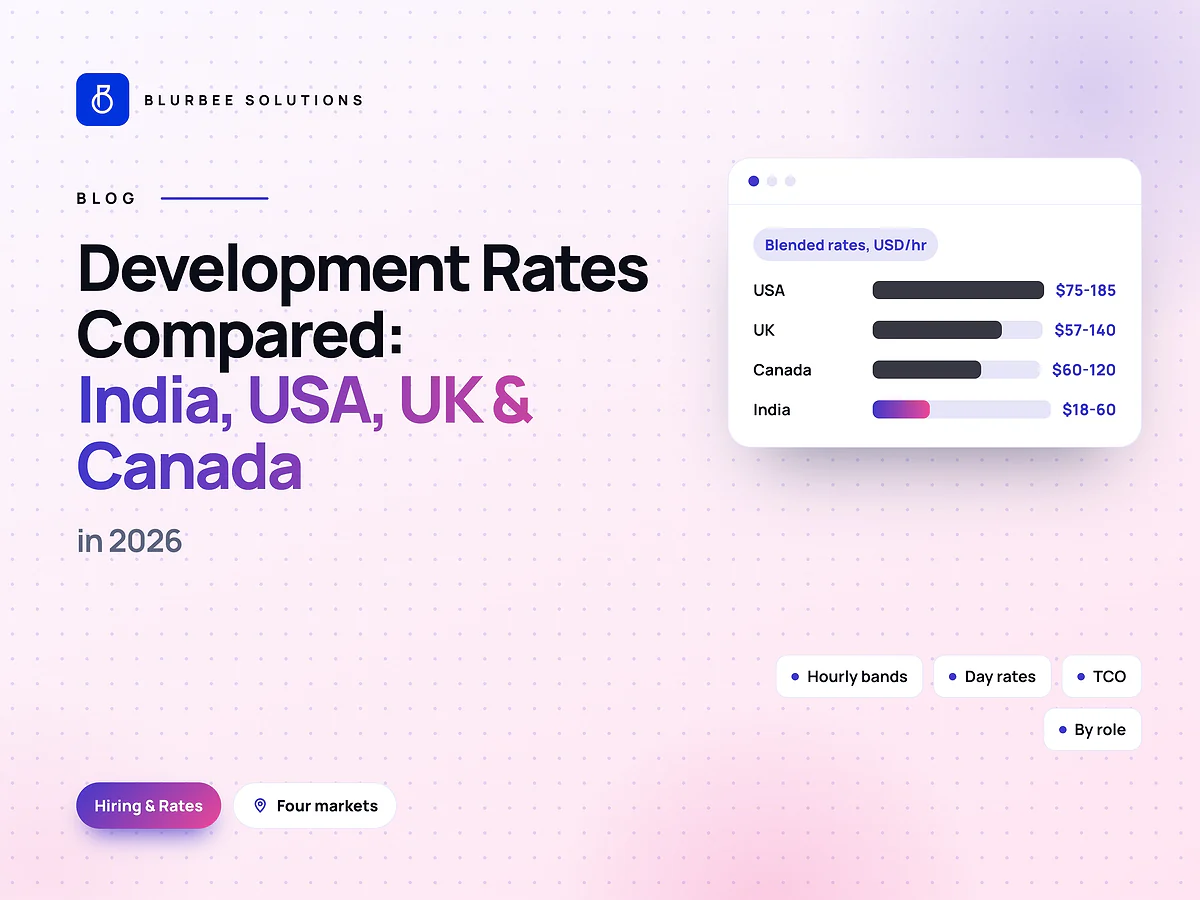
An hourly rate on its own tells you very little. A cheaper team that takes twice as long, or leaves behind code nobody can maintain, costs more. Our comparison of development rates goes further into this.
Eight checks that separate strong companies from weak ones
- Relevant, working software. Ask for a live product or a demo from a similar project, not just a logo wall. Ask what went wrong on it, too: a good team will have a clear answer.
- A conversation with the actual lead. Meet the person who will run your project. If you only ever meet sales staff before signing, expect the same afterwards.
- Written ownership of code and IP. The contract should assign code, designs and documentation to you. Repositories and cloud accounts should be in your name from the first day.
- A small first project. A fixed-scope project of two to four weeks tells you more than any proposal, and it limits your risk if the fit is wrong.
- Testing and release process. Ask how code is reviewed and tested, how many environments exist, and how a bad release gets rolled back.
- Documentation and handover. Could another team pick this up in a month? Ask for an example.
- Security and data handling. Ask about access control, secrets, backups and how client data is kept separate.
- Honest scope pushback. The best sign of all is a company telling you what not to build first.
Red flags to watch for
- A price given before anyone has understood your requirements. Nobody can price software they haven't scoped.
- "We can do everything." Strong firms can tell you what they don't do.
- Reviews you can't trace. Look for named clients on reputable review sites, and if you can, phone one of them.
- Code kept on the vendor's accounts. You should never have to ask permission to see or move your own code.
- No named person responsible. A rotating cast of account managers usually means nobody is accountable.
- A rank in a list as the main proof. Being listed may simply mean being paid for.
What changes from city to city
Being "based in India" is one thing, but buyers' needs differ widely across the country, and a good partner should understand yours:
- Mumbai: regulated workflows for financial firms, where RBI and SEBI expectations shape audit trails and vendor reviews.
- Bengaluru: technically demanding buyers, often extending an existing product or building an MVP.
- Hyderabad: life sciences, healthcare and capability centres, where traceability is part of the deliverable.
- Pune and Chennai: systems that link factories to offices, for automotive and engineering suppliers.
- Delhi and Gurugram: distribution networks, education, fintech and internal tools for multinational offices.
- Ahmedabad and Surat: manufacturers and traders moving off spreadsheets, with GST at the centre of most workflows.
- Kolkata and Chandigarh: replacing long-running legacy systems, and building CRMs for education, immigration and healthcare firms.
Should you insist on a company in your own city?
Only if you need people on your premises regularly. For most software projects, the things that matter are a shared time zone, a named lead and disciplined written communication, and every Indian company shares IST.
A local team does make sense when you need frequent on-site workshops, shop-floor observation or access to systems that can't leave your building. Otherwise, widen your search. It usually improves both the talent and the price. If you do want to meet in person, plan it around the moments that matter, such as discovery and go-live.
Compliance to raise before you sign
India's data protection regime is now moving from law to practice. The government notified the Digital Personal Data Protection Rules on 14 November 2025, with an eighteen-month period for phased compliance. Penalties run up to ₹250 crore for failing to maintain reasonable security safeguards (PIB).
Any company building software that handles personal data should be able to explain how it will support consent notices, access controls, breach handling and data retention. If they look blank when you raise the DPDP Act, keep looking. This is general guidance, so take legal advice on your specific obligations.
How to run a short, fair selection
- Write one page. Cover the problem, the users, the must-haves, your budget range and your deadline.
- Shortlist three companies. More than that wastes everyone's time.
- Hold a one-hour call with each, and include the person who would lead the work.
- Ask for a written scope, not only a price, so that you can compare like with like.
- Check two references from similar projects.
- Start with a paid, fixed-scope first project with your preferred company, and judge the result.
Contract terms worth reading twice
The contract shows you how a company expects things to go wrong. Before you sign, read these clauses carefully:
- IP assignment. Check when ownership transfers, and that it covers code, designs, documentation and anything built specifically for you.
- Change requests. How is new scope priced and approved? Vague terms here lead to the most arguments later.
- Exit and handover. What will you receive if you leave, and how much notice is required? A fair contract lets you leave with everything you've paid for.
- Staff changes. Can they replace your lead without telling you? Ask for notice and an overlap period.
- Support after launch. Define what's covered, for how long, and how quickly they respond.
- Confidentiality and data. Sign the NDA before you share details, and agree data-processing terms before any real data moves.
Is Blurbee the right company for you?
We may be, if you want a team of 35+ with a named lead, a fixed-scope start, an NDA before you share details, and code and IP assigned to you in writing. Our office is at Unique Square in Katargam, Surat, and we serve the rest of India remotely in the same time zone. We have no office in other cities, and if you need people on site daily, we'll say so and suggest you look locally.
To see what we do, start with our IT services by city or software development across India.