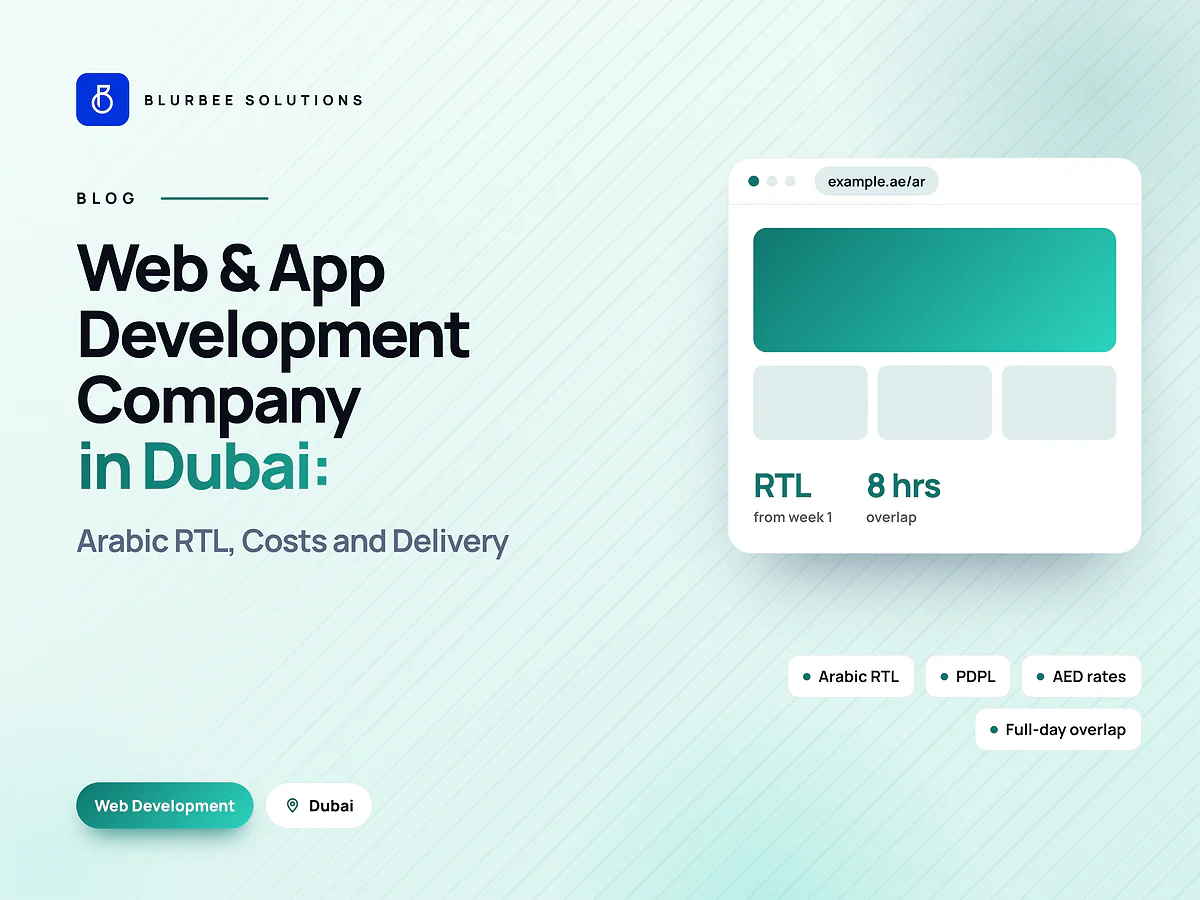
Web and App Development Company in Dubai: Arabic RTL, Costs and Delivery
What building for Dubai actually requires: Arabic RTL as an architecture decision, PDPL and DIFC data rules, realistic AED rate bands, and a full working-day overlap.

Dubai projects fail in a specific and avoidable way: the product is built in English, Arabic is scheduled for the end, and then somebody discovers that flipping direction breaks the navigation, the icons point the wrong way, the charts read backwards, and the Arabic text is being rendered in a fallback font that looks visibly wrong to every Arabic reader.
The fix is not better translators. It is deciding the architecture in week one.
Arabic RTL is an architecture decision
The most common misconception is that right-to-left support is a mirrored stylesheet. It is not. Direction affects considerably more than horizontal alignment:
Layout direction, obviously — but also the reading order of every grouped element, so a card with an image left and text right becomes image right and text left.
Icon and arrow orientation. A "next" arrow must point left in Arabic. A back chevron flips. Progress indicators reverse. Icons depicting handedness or reading direction need alternates. Icons that are direction-neutral, like a search magnifier, must not flip — and knowing which is which is a design decision, not an automatic transform.
Form field alignment, including labels, placeholders, validation messages and required-field markers.
Table column order. The first column sits on the right in Arabic, which means the natural reading sequence of a data table reverses.
Chart axes and scroll direction. A bar chart's baseline moves. A timeline runs right to left. Horizontal carousels reverse. These are the ones most often missed because they live in third-party components.
Mixed-string rendering. Arabic text containing an English brand name, a number, or a URL needs bidirectional isolation, or the punctuation ends up on the wrong side of the string. This is where a superficially working RTL implementation reveals itself.
What the architecture actually requires
Six decisions, all taken before significant UI exists.
CSS logical properties throughout. margin-inline-start rather than margin-left, padding-inline-end rather than padding-right, inset-inline rather than left and right. Written this way, direction flips with a single dir attribute rather than a parallel stylesheet somebody has to maintain.
Externalised strings. No user-visible text hardcoded in components. Violated most often in error messages, validation text, email templates and generated PDFs — the places nobody remembers until translation begins.
A typeface with real Arabic support. Not a Latin font with an Arabic fallback. Arabic requires correct glyph shaping, where letter forms change depending on position in the word, and proper diacritic positioning. Get this wrong and the text is legible but conspicuously amateur.
Layouts that survive both directions. Arabic text length differs from English — sometimes shorter, sometimes longer — and any fixed-width element designed around one language will break in the other.
Correct dir attributes and bidirectional isolation for mixed-language content.
Locale-aware numbers and dates. Arabic-Indic versus Western Arabic numerals is a choice with audience implications, and it should be made deliberately.
A retrofit of all this touches nearly every view. It costs roughly what rebuilding the front end costs, which is why the week-one conversation matters more here than almost anywhere.
Do not machine-translate customer-facing Arabic
Gulf Arabic conventions, register and terminology are things machine translation handles inconsistently. In a market where Arabic is not a courtesy but the language of a large share of your audience and your regulators, poor Arabic reads as carelessness about the market itself.
Our approach: build the architecture so professional translation drops in cleanly, then recommend a UAE-based reviewer for the final pass. The architecture is our job; language quality needs someone for whom it is theirs.
Which language leads
Worth deciding deliberately rather than defaulting to English because the design was made in English.
Government-facing and consumer services generally lead Arabic. B2B and expat-facing services often lead English. Dubai's demographics make either defensible.
What is not defensible is one language being visibly more complete or more current than the other. A half-finished Arabic version is worse than a well-executed English-only product, because it signals the market was an afterthought.
Rates
Dubai agencies typically quote AED 260-400 per hour at mid to senior level. Mid-size studios run AED 180-290. Experienced freelancers are AED 150-220, though you are buying one skill rather than a team.
Offshore teams delivering to Dubai, including ours, sit at AED 88-176 for a blended team including QA and a delivery lead.
One thing worth knowing about this market: a substantial share of Dubai agency delivery is itself subcontracted to South Asian teams. You are frequently comparing a local margin applied on top of an offshore cost base rather than comparing two different kinds of work. That is not a criticism — local account management has real value — but it should inform how you read a quote.
As project shapes: a bilingual marketing site with a CMS is commonly AED 55,000-160,000 locally. A web application with authentication, payments and an admin panel starts around AED 220,000.
PDPL, DIFC and ADGM: three regimes, not one
This catches people out, and the deciding factor is not where your customers are.
UAE Federal Decree-Law 45/2021 (PDPL) governs personal data across the emirates: lawful basis, purpose limitation, data subject rights, and breach notification.
DIFC operates its own regime under DIFC Data Protection Law 5/2020, which is closer to GDPR in structure and includes its own cross-border transfer mechanisms.
ADGM has its own regulations again.
Which applies depends on where your entity is registered. A DIFC-registered company serving customers across the UAE is under DIFC law for its own processing. Establish this in week one, because it determines the data processing agreement, the transfer mechanism for India-based delivery, and potentially the hosting region.
Hosting: usually flexible, sometimes not
There is no blanket requirement that private-sector data stay in the UAE.
Where residency does apply: government-linked entities generally require in-country hosting and vendor registration before technical discussion begins. Financial free zone entities may have their own requirements. And a substantial number of Dubai buyers require it contractually regardless of the legal position, particularly anyone downstream of a government entity.
If it applies, AWS, Azure and Oracle all operate UAE regions. Retrofitting a region constraint after architecture is expensive and occasionally impossible, so establish the requirement before anything is designed.
The closest working relationship we have
IST is only 1.5 hours ahead of Gulf Standard Time. We share a full working day.
This is genuinely different from every other market we serve. There is no overlap window to schedule around, no end-of-day handoff delay, no question that waits until tomorrow. A problem raised at 11am Dubai gets worked on at 11am Dubai. Real-time pairing is available all day rather than for a scheduled hour.
The one adjustment: the UAE weekend has been Saturday and Sunday since the 2022 change, with a half-day Friday in the public sector. Our week runs Monday to Friday, so we overlap four and a half to five days. We plan around Friday afternoons rather than treating them as normal working time.
Dubai specifics worth naming
Real estate and proptech is the largest single source of software demand here, and it comes with integration requirements against DLD systems and property management platforms whose interfaces are older than the products being built on them.
Logistics and trade work is document-heavy and judged on handling time per shipment rather than on interface polish.
Payment methods matter more than in Western markets. Card penetration is high but so is cash on delivery for e-commerce, and regional wallets and buy-now-pay-later options have real share. Design the checkout for the actual mix rather than the one your reference site in London uses.
Start with one flow, in both languages
For bilingual work we recommend making the first fixed-scope project a single complete flow built properly in Arabic and English — a sign-up or a core transaction, end to end, including the confirmation email and any generated document.
Two to four weeks. It proves the RTL architecture holds, surfaces the layout and font problems while they are cheap, and produces a template everything afterwards follows. It is the cheapest way to find out whether the approach works before the whole product depends on it.
The Dubai market, in numbers
Composite of published UAE agency rate cards and Blurbee quoted rates converted at prevailing rates, 2026. Indicative bands only.
Why Dubai businesses work with Blurbee
IST is only 1.5 hours ahead of Gulf Standard Time, so we share a full working day — no handoff delay, no overlap window to schedule around. And we treat Arabic RTL as an architecture decision in week one rather than a mirrored stylesheet at the end.
- Fixed-scope first projectTwo to four weeks, priced as a number rather than an estimate, so you have evidence before a longer commitment.
- One delivery lead, namedYou always know who to ask. No account manager relaying questions to a team you never meet.
- Code and IP are yoursAssigned in writing, handed over with repositories, infrastructure definitions and documentation whether or not you continue with us.
- Performance budgets in CICore Web Vitals and bundle size gate the build. Slow does not ship.
- Accessibility to WCAG 2.2 AAReviewed with automated and manual passes, not claimed on a slide.
- Written overlap disciplineStanding calls inside your working window, everything else asynchronous with a decision log.