Web and AI Services for Wales and Northern Ireland
How businesses in Cardiff, Swansea and Belfast access web, app and AI capacity, including Welsh Language Standards as a content architecture decision rather than translation.

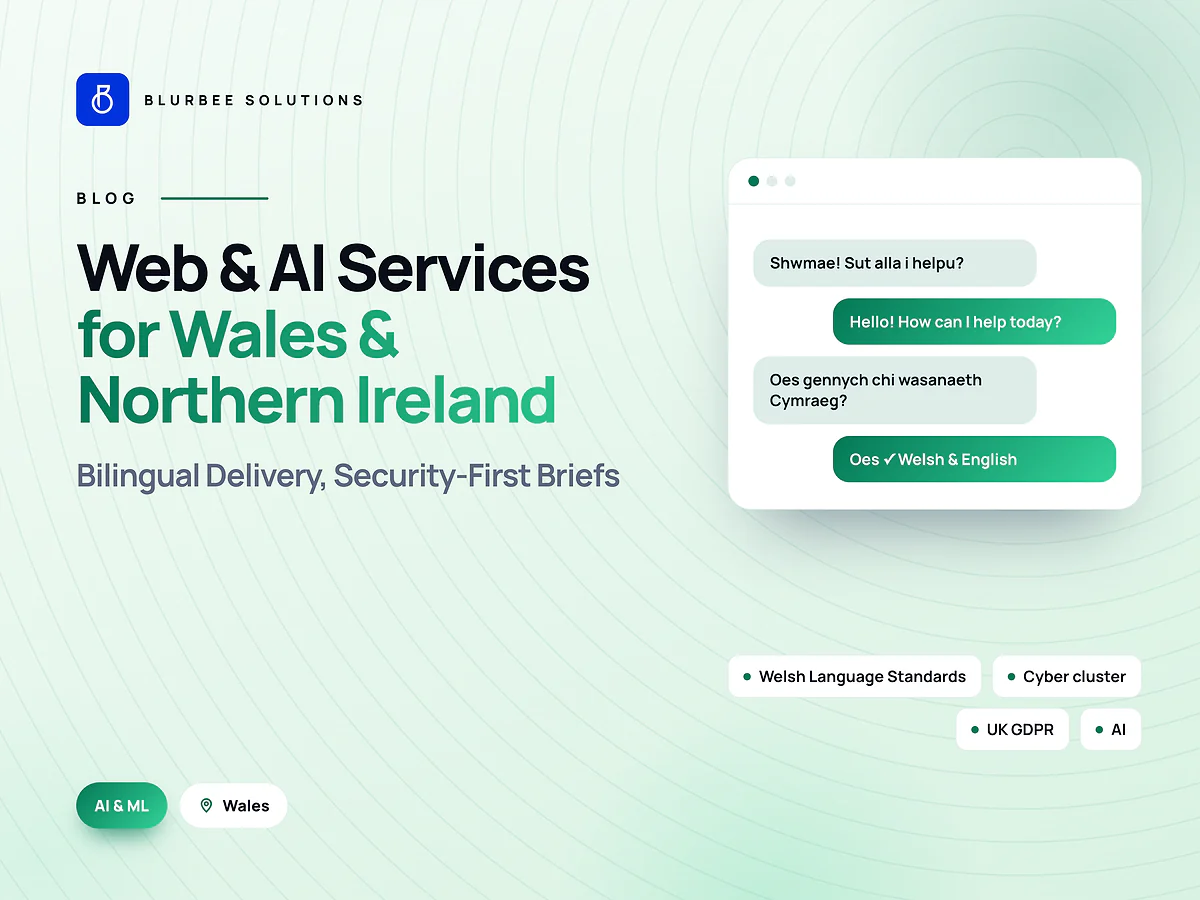
Wales and Northern Ireland get grouped together in vendor coverage maps and have almost nothing in common as markets. Wales has a statutory bilingual duty that shapes product architecture. Northern Ireland has a cybersecurity cluster that shapes how briefs arrive. Both have small senior engineering pools, which is the one thing they share.
Rates
Cardiff agencies typically quote £55-90 per hour at mid to senior level. Belfast studios run £50-85. Swansea and regional Welsh studios sit at the lower end.
Offshore teams delivering to either, including ours, are £18-36 for a blended team including QA and a delivery lead.
As with Atlantic Canada, the binding constraint in both markets is usually capacity rather than price. The senior pool is small enough that hiring is frequently not an available option in a useful timeframe, which is why extension arrangements are common here.
Welsh Language Standards: a product requirement
This is the most consequential regional difference and the one most often mishandled.
Under the Welsh Language (Wales) Measure 2011, designated public bodies must treat Welsh no less favourably than English. For a digital service that means the Welsh version is equally complete, equally current, equally easy to reach, and not visibly secondary.
The duty applies to designated public bodies directly. If you supply them, it flows to you contractually. And a substantial number of Welsh private organisations choose bilingual delivery regardless, because a monolingual English service reads as not really serving the market.
What that means in build terms is a content architecture decision, not a translation task:
Externalised strings. No user-visible text hardcoded in components. This is violated most often in error messages, validation text, email templates and generated PDFs — the places nobody remembers until translation starts.
Layouts that survive expansion. English to Welsh typically expands text by 20-30%. Buttons, navigation, table headers and any fixed-width element designed around English will break. Test with the longest expected string.
Locale-aware formatting for dates and numbers.
Language choice persisting everywhere — the interface, transactional emails, generated documents, support interactions. Emails are the most commonly missed.
URL structure supporting both languages, with correct hreflang, so both versions are indexable and shareable.
Decide all five in week one. A retrofit touches nearly every view and costs roughly what rebuilding the front end costs.
Do not machine-translate Welsh
For anything user-facing, machine translation is not adequate. Welsh has initial consonant mutations and register conventions that automated translation handles badly, and in a bilingual-duty context poor Welsh is worse than no Welsh — it signals the obligation was treated as a box to tick.
Our approach: build the architecture so professional translation drops in cleanly, then recommend a Welsh-language reviewer for the final pass. The architecture is our job. Language quality needs someone for whom it is theirs.
Belfast: the security-first brief
Northern Ireland has a real cybersecurity cluster, concentrated in Belfast, and it changes how projects start.
Briefs frequently arrive with threat modelling expectations already stated and an in-house security reviewer involved from the beginning. This is genuinely good. The questions are better, they come early, and secure design review is treated as expected practice rather than something a supplier sells you.
What that means practically: expect to discuss authentication design, data classification, secret management and dependency policy in the first two weeks, and expect those answers to be examined. A supplier who treats security as a late-stage line item will not get far here.
The cross-border question
UK GDPR governs processing in Northern Ireland. The Republic of Ireland operates under EU GDPR.
Where data moves between the two — and for many Northern Irish businesses it does, because the commercial geography does not respect the border — both regimes are in play, and the transfer mechanisms need to be correct in each direction. An Irish subsidiary sending data north, or a Belfast business serving Dublin customers, needs this looked at rather than assumed.
Worth a specific legal read early. It is not usually difficult, but it is easy to get wrong by default.
AI work at this scale
The realistic set, for organisations of the size that predominate in both markets:
Document extraction from known form types — grant applications, supplier invoices, certificates, forms — into structured fields. Needs a few hundred labelled examples. Measured in handling time and error rate against manual entry. The most reliable first project available.
Retrieval over your own document corpus with citations, so staff can ask questions in natural language and get answers grounded in your actual documents. Needs a corpus that is current and a clear model of who may see what.
Ticket and email classification and routing. Needs twelve months of history with eventual resolution attached.
Summarisation with a human review step. Low risk because the review is built in.
All four share the property that makes them deliverable in a quarter: the data already exists, and the output feeds a decision a person already makes.
What does not work as a first project: anything needing data you do not yet collect, anything where the output is the final unreviewed decision, and anything where nobody can name the metric that would prove it worked.
Bilingual AI needs the language question settled first
This deserves its own note because it catches people out.
Retrieval over a bilingual corpus needs to know which language the query is in and which documents are authoritative in each language. If your Welsh and English documents say slightly different things — which happens, because they were translated at different times — the system needs a rule about which wins.
Generation into Welsh from a general-purpose model is not reliable enough for public-facing output. The honest design retrieves and presents human-authored Welsh content rather than generating Welsh text. That is a real constraint on what an AI feature can do here, and it is better acknowledged in the design than discovered in review.
Sector notes
Welsh public sector and health. Bilingual duty, accessibility to WCAG 2.2 AA as a statutory requirement for public bodies, and procurement processes with their own eligibility routes.
Welsh advanced manufacturing. Integration-heavy work against existing plant systems, with the OT network separation discipline that implies.
Northern Irish agri-food. Traceability and supply-chain data, with cross-border complexity where product moves to the Republic.
Northern Irish fintech. Security-first briefs, vendor review, and audit trails as deliverables.
Start with one flow, in both languages
For bilingual work specifically, we recommend making the first fixed-scope project a single complete flow built properly in both languages — a sign-up or a core transaction, end to end, including the confirmation email and any generated document.
Two to four weeks. It proves the architecture holds, surfaces the layout problems while they are cheap to fix, and produces a template that everything afterwards follows. It is the cheapest way to find out whether the approach works before the whole product depends on it.
What shapes a Welsh or Northern Irish project
Composite of published UK rate cards and Blurbee quoted rates converted at prevailing rates, 2026. Indicative bands only.
Why Welsh and Northern Irish teams work with Blurbee
We treat Welsh as a first-class language in the architecture from week one, not a translation pass at the end — and in Belfast we expect the security-first brief and turn up with answers rather than surprise.
- Fixed-scope first projectTwo to four weeks, priced as a number rather than an estimate, so you have evidence before a longer commitment.
- One delivery lead, namedYou always know who to ask. No account manager relaying questions to a team you never meet.
- Code and IP are yoursAssigned in writing, handed over with repositories, infrastructure definitions and documentation whether or not you continue with us.
- Performance budgets in CICore Web Vitals and bundle size gate the build. Slow does not ship.
- Accessibility to WCAG 2.2 AAReviewed with automated and manual passes, not claimed on a slide.
- Written overlap disciplineStanding calls inside your working window, everything else asynchronous with a decision log.