Software Development Companies in Toronto and Across Ontario
How Ontario businesses evaluate software development partners: Canadian data residency, PIPEDA obligations, bank-grade vendor review and realistic CAD rate bands.

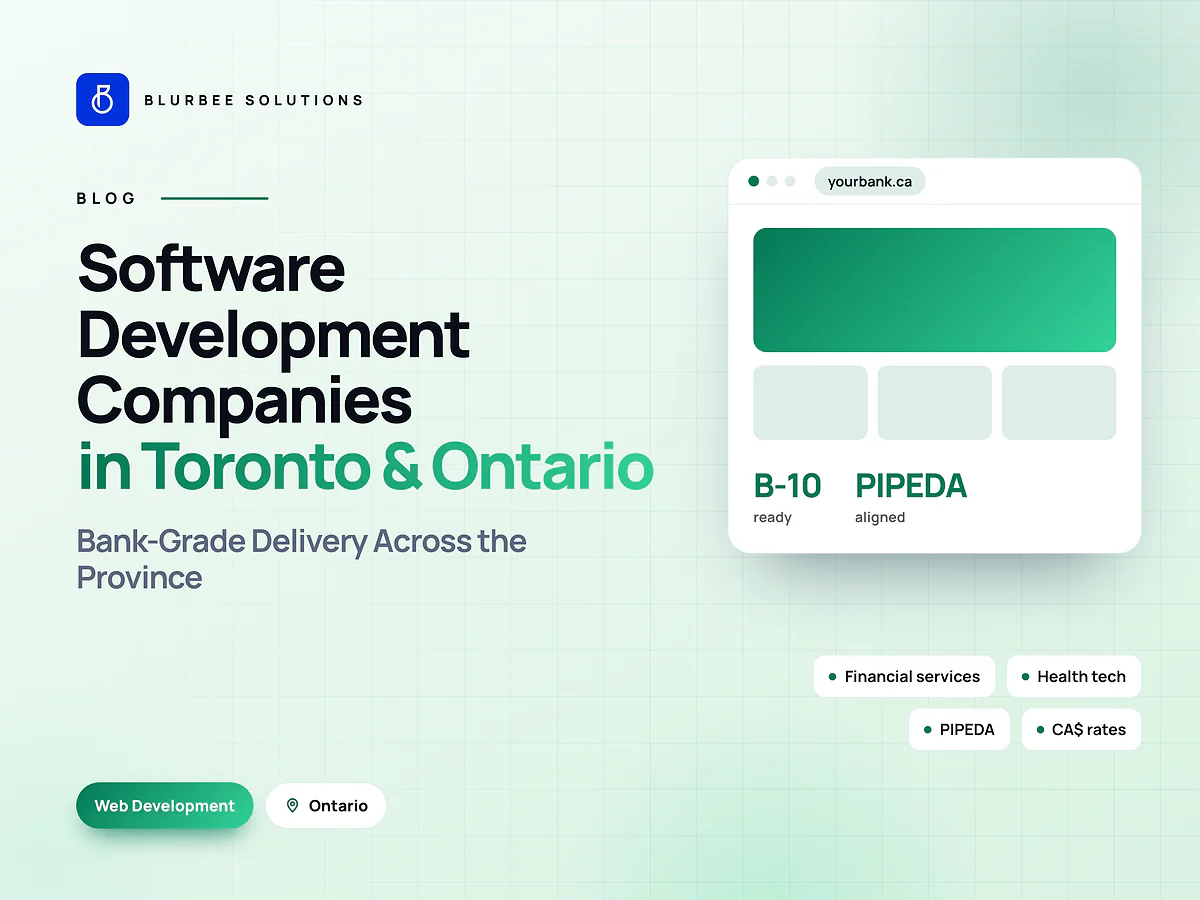
Ontario buyers apply bank-grade vendor review even when they are not banks. That is the defining characteristic of this market, and it comes from Toronto being the second-largest financial centre in North America by employment — the norms of that sector have become the regional default.
Understanding that changes how you should evaluate vendors, and what you should expect a competent one to have ready.
The rate picture, in Canadian dollars
Toronto agencies typically quote CA$120-165 per hour at mid to senior level. Regional studios in Ottawa, Waterloo and London run CA$85-120 — a genuine 25-30% discount for comparable seniority, which is the main reason Toronto companies look outside the city at all.
Experienced Canadian freelancers are CA$70-105, though you are buying one skill rather than a team.
Offshore teams delivering to Ontario, including ours, sit around CA$33-66 for a blended team including QA and a delivery lead. As project shapes: a web application with authentication, payments and an admin panel is commonly CA$90,000-250,000 built locally.
Vendor review: what to have ready
If you are the buyer, this is your leverage. If you are procuring on behalf of a regulated employer, these are the questions you will be required to ask.
Security questionnaire. How credentials are stored — a managed secret store, or environment files in a repository? Whether engineers work on company-managed devices with disk encryption. What access is granted to whom, and how it is revoked at offboarding.
SOC 2 or equivalent evidence. Many Toronto buyers require it. A vendor without SOC 2 is not automatically disqualified, but they need a credible account of the equivalent controls.
Insurance certificates. Professional liability and cyber, at stated limits.
A data processing agreement with subprocessor disclosure. Every service the data passes through, named. This is where gaps usually appear — error tracking and observability tools that capture request payloads are a well-trodden route for personal data to reach a subprocessor nobody listed.
Incident response and business continuity. What happens, who is notified, in what timeframe.
Send your questionnaire early. A question a vendor cannot answer honestly is far better discovered in week one than at contract stage.
Data residency: it depends, and the answer is knowable
There is no blanket Canadian requirement that data stay in Canada. PIPEDA permits cross-border transfer provided you apply comparable protection and are transparent with individuals that it happens.
What does create residency requirements: public-sector contracts, health data under provincial legislation, and — very commonly — the buyer's own internal policy, which is a contractual requirement even where it is not a legal one.
If residency applies, it is straightforward. All three major cloud providers operate Canadian regions, and we host there. What matters is establishing the requirement before architecture rather than after, because retrofitting region constraints is expensive and occasionally impossible.
PIPEDA, practically
Four obligations that translate into engineering work:
Meaningful consent for the purposes data is used for. That means a consent record with a purpose attached, not a checkbox.
Safeguards proportionate to sensitivity. Encryption in transit and at rest, access control, and the ability to demonstrate both.
Breach reporting to the Office of the Privacy Commissioner and to affected individuals where there is real risk of significant harm. This requires knowing what was accessed, which requires audit logging designed in advance.
Transparency about cross-border transfer. If data goes to India, your privacy notice says so.
The recurring engineering requirement, as with most privacy regimes, is a deletion process someone can actually execute end to end. Design it in.
Accessibility: AODA is a legal requirement here
The Accessibility for Ontarians with Disabilities Act requires designated organisations to meet WCAG 2.0 Level AA on public websites and web content. This is a legal obligation, not a best practice, and it is enforced.
We work to WCAG 2.2 AA as standard, which exceeds the requirement, with both automated tooling and manual passes — keyboard navigation, focus order, contrast, screen reader labelling, motion preferences. Findings come as a list with severity attached rather than a compliance claim on a slide.
If a prospective vendor treats accessibility as an optional line item in an Ontario proposal, they have not understood the market.
French: usually not, but check
Ontario's French Language Services Act applies to designated provincial government services rather than private business, and Quebec's Charter obligations do not extend here.
Where it does become relevant: if you serve customers in Quebec, if you are in a federally regulated sector, or if you sell to the Government of Canada. In those cases bilingual delivery is a content architecture decision — string management, layout that survives longer French text, dates and currency per locale — rather than a translation task appended at the end.
Establish this in week one. Retrofitting bilingual support into a finished product is genuinely expensive.
Ontario beyond Toronto
Ottawa. Federal government adjacency means procurement processes, security clearance questions, and bilingual requirements appear more often. Some of this work is not available to offshore delivery, and it is worth establishing that early.
Waterloo. A real product and engineering cluster with strong internal capability. Engagements here are usually capacity extension rather than greenfield, which means fitting existing platform standards.
London, Hamilton, Windsor. Manufacturing and health systems, with the integration-heavy briefs that come with both. Windsor's automotive adjacency brings OEM security questionnaires passed down the supply chain.
The overlap and how we run it
Eastern time gives 3.5 hours of live overlap, 09:30-13:00 ET — the most comfortable of the North American windows. One standing call inside it, then asynchronous work with a written handoff at the end of each India day covering what moved, what is blocked, and what needs a decision.
We do not ask our team to work Canadian afternoons. A team working past midnight leaves within two quarters, and you would pay for that in turnover and lost context.
Start small
A fixed-scope first project of two to four weeks, one real feature or integration, in your repository, milestone payment.
For Ontario buyers specifically, this has an additional benefit: it lets your security and procurement people run their process on a small engagement before a large one depends on the outcome. That is usually easier internally, and it means the review happens with real evidence rather than a questionnaire.
The Ontario market, in numbers
Composite of published Canadian rate cards and Blurbee quoted rates converted at prevailing rates, 2026. Indicative bands only.
Why Ontario companies work with Blurbee
We have completed the vendor security review that Toronto financial services applies, we can host in a Canadian region when residency requires it, and we quote in a way that survives procurement — assumptions listed, delivery lead named, exit terms written.
- Fixed-scope first projectTwo to four weeks, priced as a number rather than an estimate, so you have evidence before a longer commitment.
- One delivery lead, namedYou always know who to ask. No account manager relaying questions to a team you never meet.
- Code and IP are yoursAssigned in writing, handed over with repositories, infrastructure definitions and documentation whether or not you continue with us.
- Performance budgets in CICore Web Vitals and bundle size gate the build. Slow does not ship.
- Accessibility to WCAG 2.2 AAReviewed with automated and manual passes, not claimed on a slide.
- Written overlap disciplineStanding calls inside your working window, everything else asynchronous with a decision log.