Software Development Partners for South Central US Companies
A guide for companies from Texas to Tennessee on choosing a development partner: local agencies, staffing firms and offshore product teams compared honestly.

The South Central states span two markets that could hardly be less alike. Energy majors in Houston and the Gulf Coast procure software the way they procure capital equipment: long cycles, heavy documentation, formal review. Austin and Nashville software companies expect a proposal in a week and a working prototype in a month.
Most bad partner decisions in this region come from applying one region's playbook to the other's buyer. Below is how the three partner types actually differ, and how to choose between them.
The three models, honestly
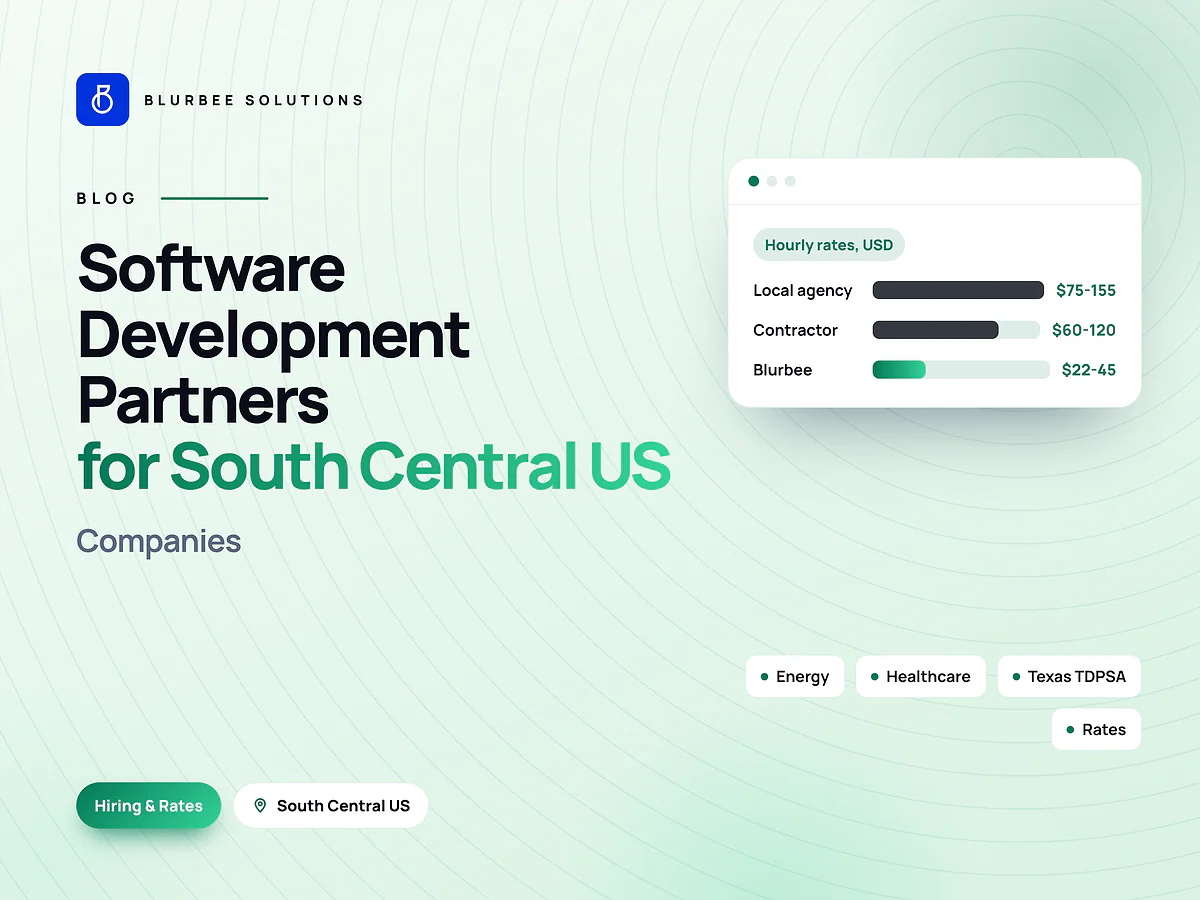
Local agency, $110-155 per hour. You get design, engineering and QA under one accountable party, working your hours, in your legal jurisdiction. This is the right choice when your internal engineering leadership is thin, when the project needs several disciplines, and when the ability to sit in a room matters — which for some energy and public-sector work it genuinely does.
What you are paying for is coordination and accountability. What you should verify is that the senior people who pitched are the ones delivering, because that substitution is as common here as anywhere.
Staffing firm, $55-110 bill rate. You get one person, placed, and the management burden stays entirely with you. This works well when you have a strong engineering lead who knows exactly what they need and simply lacks hands. It works badly when nobody internally is setting technical direction, because a placed contractor will build what they were asked for, which is not always what was needed.
The economics look attractive against agency rates. The hidden cost is your own engineering leadership time, and the fact that continuity is not guaranteed — when the contractor leaves, the context leaves with them.
Offshore product team, $24-48 blended. You get a full team including QA and a named delivery lead, at roughly a third of local agency rates, with 2.5 hours of daily overlap. This works when you can commit four to six hours a week to written direction and review, and it fails when you cannot.
Offshore is not a way to avoid managing a project. It is a way to get more engineering per dollar in exchange for more of your own structure and clarity.
Texas: two buyers, one state
Energy. Capital-project software, where the schedule is set by the asset rather than the sprint. Well-level data models that no off-the-shelf product fits cleanly. Gulf Coast clients who build for hurricane season, which means failover, data durability and a documented recovery time objective are first-conversation topics rather than late-stage concerns.
The operational technology point matters here as much as in manufacturing: OT networks must not be reachable from business networks, and any bridge is deliberate, documented and monitored. A vendor who does not raise this unprompted has not worked in the sector.
Software and semiconductors. Austin and Dallas, moving fast, usually with platform standards already in place. Here the value is in fitting existing standards rather than proposing better ones, and the proposal timeline is days rather than months.
Establish which buyer you are dealing with, or which you are, before the first proposal. The document that wins one loses the other.
Tennessee: healthcare operations
Nashville is the centre of US for-profit healthcare operations, and Tennessee software work is disproportionately revenue cycle: claims, eligibility, prior authorisation, billing integration.
This is specialist territory. It means working against clearinghouse formats and payer-specific rules, handling denials and resubmission logic, and treating the audit trail as a deliverable rather than a log file. HIPAA business-associate agreements are standard, and the security review that accompanies them is real.
A generalist team can do this work, but not without a domain expert on your side or theirs. If a proposal for revenue-cycle work does not mention the clearinghouse, the estimate is missing a workstream.
Louisiana, Oklahoma, Kentucky
Louisiana. Energy and petrochemicals, ports and shipping. The hurricane-season point again: failover and durability first, features second.
Oklahoma. Energy, with well-level data models, plus aerospace maintenance where traceability requirements land on the software as well as the parts.
Kentucky. Louisville's air-cargo hub means logistics software here is judged on how it behaves during the overnight sort, not during the business day. Load profile is wildly uneven and testing must reflect that.
Privacy: TDPSA and TIPA
Texas's Data Privacy and Security Act and Tennessee's Information Protection Act are both in force. Neither is as demanding as California's regime, but both create consumer access, correction and deletion rights, and Texas requires recognition of universal opt-out signals.
The practical requirement is a deletion process someone can actually execute, not a policy page describing one. That is an engineering requirement with a data-model implication, and it is cheaper to design in than to add.
For healthcare, HIPAA applies regardless of state and overrides the general question.
How to evaluate, whichever model you pick
Ask what went wrong on a comparable project. Every real project has something. A team that cannot name theirs has either not shipped much or is managing you.
Read one pull request in week two. Insist that work arrives as pull requests into your repository rather than as bulk deliveries. If nobody on your side reads code, buy two hours of an independent senior contractor's time.
Speak to the engineers by name. Not to assess them in an hour, but to confirm they exist and know your project.
Ask for a client who did not renew. The answer, or the refusal to answer, tells you a great deal.
Check the assumptions section. A proposal that does not state what it assumed — page count, integration count, who supplies content, what happens if an API is undocumented — is a guess with a number attached, and every gap becomes a change request.
Start with a trial project
Two to four weeks, fixed scope, one real feature, your repository, milestone payment. This applies to all three partner types, including local agencies.
At the end you have working software and direct evidence about estimating accuracy, code quality, and what happens when something slips. That last one is the most valuable and the hardest to get any other way.
Exit terms, before you sign
You own the code on payment, assigned in writing. On exit you receive repositories, infrastructure definitions, design files, documentation and credentials, with a walkthrough for whoever takes over.
Read the notice period and the termination clause specifically. A partner unwilling to define what happens if this does not work out has usually had that conversation go badly before, and there is no reason to be the next instance.
The three partner types, and what they cost
Blurbee analysis of the three models, 2026. Rates are indicative mid-to-senior bands.
Why South Central companies work with Blurbee
We are a product team, not a staffing firm, which means we bring a delivery lead and tell you when a plan is wrong. For energy and healthcare clients specifically, we scope the compliance work as its own workstream rather than discovering it at review.
- Fixed-scope first projectTwo to four weeks, priced as a number rather than an estimate, so you have evidence before a longer commitment.
- One delivery lead, namedYou always know who to ask. No account manager relaying questions to a team you never meet.
- Code and IP are yoursAssigned in writing, handed over with repositories, infrastructure definitions and documentation whether or not you continue with us.
- Performance budgets in CICore Web Vitals and bundle size gate the build. Slow does not ship.
- Accessibility to WCAG 2.2 AAReviewed with automated and manual passes, not claimed on a slide.
- Written overlap disciplineStanding calls inside your working window, everything else asynchronous with a decision log.