Software Development Companies in Kolkata: Rate Cards, Models and Red Flags
How to compare software development companies in Kolkata: what the rate bands actually are, which engagement model fits your project, and the red flags in a proposal.

Kolkata's development market is cheaper than Bengaluru's for real reasons and worse than Bengaluru's in specific, narrow ways. Knowing which is which is most of what you need to buy well here.
The rate bands, honestly
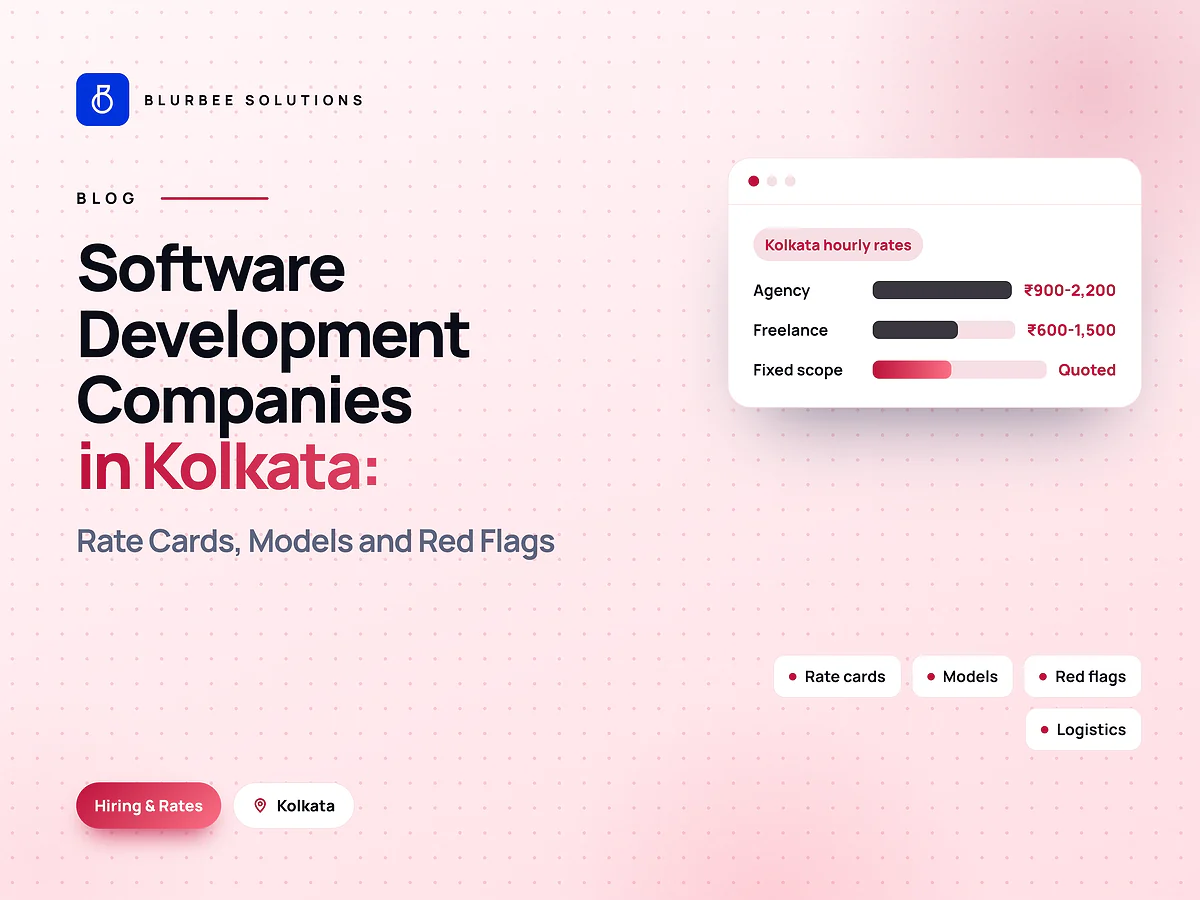
Across the Kolkata market, hourly rates run roughly ₹700-2,200. Established agencies with design, engineering and QA in-house sit at ₹1,300-2,200. Mid-size studios are ₹900-1,500. Experienced freelancers are ₹700-1,100, though you are buying one skill rather than a team, which matters more than the rate for anything involving design, backend and QA together.
That is 20-35% below Bengaluru or Mumbai for comparable seniority. The difference is commercial rent and salary levels, plus less competition for engineers from funded product companies. It is not a quality gap in general web and application work.
It is a real gap in two specific areas: large-scale distributed systems experience, and applied machine learning beyond integration work. Those pools are genuinely thinner in Kolkata than in Bengaluru or Hyderabad. If your project depends on either, verify specifically rather than assuming the market average applies.
Kolkata's actual specialisms
Two clusters produce work you will find better represented here than elsewhere.
Logistics and port operations. Kolkata's port-adjacent economy generates document-heavy operational software: freight documentation, customs workflows, container and yard tracking. Teams here have dealt with ICEGATE integration and its authentication and message-format constraints. If your project is in this space, local experience is worth paying for.
Education technology. A large education sector has produced real depth in learning platforms, assessment systems and content delivery at low bandwidth. The last of those is a genuinely useful specialism.
Choosing the engagement model
Fixed price, fixed scope. Correct when the specification is genuinely settled: a defined set of screens, a known integration, a rebuild of something documented. Wrong when discovery is required, because the vendor must price the unknown, and they will either pad the number or protect margin later by cutting quality. Watch for the second — it shows up as QA disappearing from the plan in week eight.
Time and materials. Honest for exploratory work, dangerous without a cap. Insist on a weekly hour ceiling and a written change-approval step, or your budget becomes a monthly conversation instead of an agreed number.
Dedicated team. Right when you have continuous work and someone internally setting direction. Expensive when you do not, because you pay for capacity that waits on your approvals.
Discovery then build. A fixed-price discovery phase producing a real specification, then a fixed price for the build against it. This is what we recommend for a first engagement with any vendor: a small, bounded amount at risk to eliminate the largest source of estimating error.
Reading the proposal
Four things separate a proposal written to deliver from one written to win.
Assumptions are listed. How many pages, how many integrations, who supplies content, which browsers, what happens if a third-party API turns out to be undocumented. No assumptions section means the estimate is a guess and every gap becomes a change request.
The delivery lead is named. A person, with a role and stated availability — not "a dedicated project manager." If nobody is named before signing, nobody is accountable after.
QA and accessibility are line items. If testing does not appear in the cost breakdown, it is not planned, and you will do it after launch. Accessibility to WCAG 2.2 AA should be a stated deliverable, not an assurance.
Your dependencies have dates. A timeline showing only vendor activity is fiction. Content, approvals, credentials and third-party access sit with you, and a competent vendor will have said so with dates attached.
The eight red flags
Roughly in order of how much they should concern you:
- No written IP assignment, or ownership retained by the vendor.
- Full payment demanded before work begins.
- A portfolio where every item carries identical tags and none links to a case study.
- Testimonials with no name, company or attributable role.
- A detailed quote arriving within an hour of a first conversation.
- Hosting, licences or third-party costs bundled without disclosure.
- No QA, accessibility or performance line item.
- Reluctance to introduce you to the engineers who will do the work.
No single flag is proof of a bad team. Three or more together usually is.
The fourth deserves particular attention in this market. A page of testimonials that all say the same thing, attributed to "Verified Client" or a first name only, is worse than no testimonials — it signals that the vendor could not obtain a single attributable reference, or did not think it mattered.
The senior-pitch, junior-delivery problem
This is the most common disappointment in the Kolkata market and it is entirely preventable.
Senior people pitch. Junior people deliver. This is fine if it is disclosed and priced accordingly — that is how agencies work everywhere. It is a problem when the rate reflects the senior team and the output reflects the junior one.
Ask three questions before signing. Who specifically will write the code, by name? What is their experience? Who reviews their work, and how often? Then ask to speak to the person named. A vendor who cannot arrange a twenty-minute call with your future lead developer is telling you something.
Start small, on purpose
A fixed-scope first project of two to four weeks — one integration, one meaningful feature, a performance pass on something live — produces evidence no reference call can. You see how they estimate, how they write code, how they communicate when something slips, and what handover actually looks like.
At the end you should have working software in your own repository, a written record of decisions, and a clear view about continuing. If a vendor resists starting small, that is information too.
Payment and contract basics
Normal terms are a 20-30% mobilisation advance, then milestone invoices against delivered work, net 15 or net 30. Full payment up front is not normal. Equally, expect to pay something before work starts — a vendor carrying all the risk prices that risk into the number.
Read the exit clause specifically. What notice applies, what you receive on termination, who holds credentials in the interim. Vendors reluctant to define this have usually had exits go badly, and you do not want to be the next data point.
Kolkata rate bands and project shapes
Composite of published Kolkata rate cards and market surveys, 2026. Indicative bands; seniority and contract length move them materially.
Why Kolkata businesses work with Blurbee
We quote with assumptions listed, name the delivery lead before you sign, and price a small first project so you can judge us on delivered work rather than a proposal. Everything below is what we would want to know if we were buying.
- Fixed-scope first projectTwo to four weeks, priced as a number rather than an estimate, so you have evidence before a longer commitment.
- One delivery lead, namedYou always know who to ask. No account manager relaying questions to a team you never meet.
- Code and IP are yoursAssigned in writing, handed over with repositories, infrastructure definitions and documentation whether or not you continue with us.
- Performance budgets in CICore Web Vitals and bundle size gate the build. Slow does not ship.
- Accessibility to WCAG 2.2 AAReviewed with automated and manual passes, not claimed on a slide.
- Written overlap disciplineStanding calls inside your working window, everything else asynchronous with a decision log.