Prompt Engineering in Edinburgh: The Difference Between a Prompt and a Prompt System
Why Edinburgh fintech and health-tech teams need a prompt system, not clever prompts: evaluation sets, versioning, FCA Consumer Duty and GBP costs.

Edinburgh's New Town is full of organisations that are careful by nature: asset managers, insurers, banks, and a health-data and AI community shaped by the university's informatics school. When these teams adopt language models, the question is never just "does it work?" It is "how do we know it works, and how will we know if it stops?"
That question is the difference between a prompt and a prompt system.
A prompt is text. A prompt system is a process
A prompt is a block of instructions sent to a model. It can be excellent. It can also break when the model is upgraded, when inputs change, or when someone edits a sentence to fix one case and quietly breaks three others.
A prompt system wraps that text in the same discipline as any other production software:
- Versioned templates in source control.
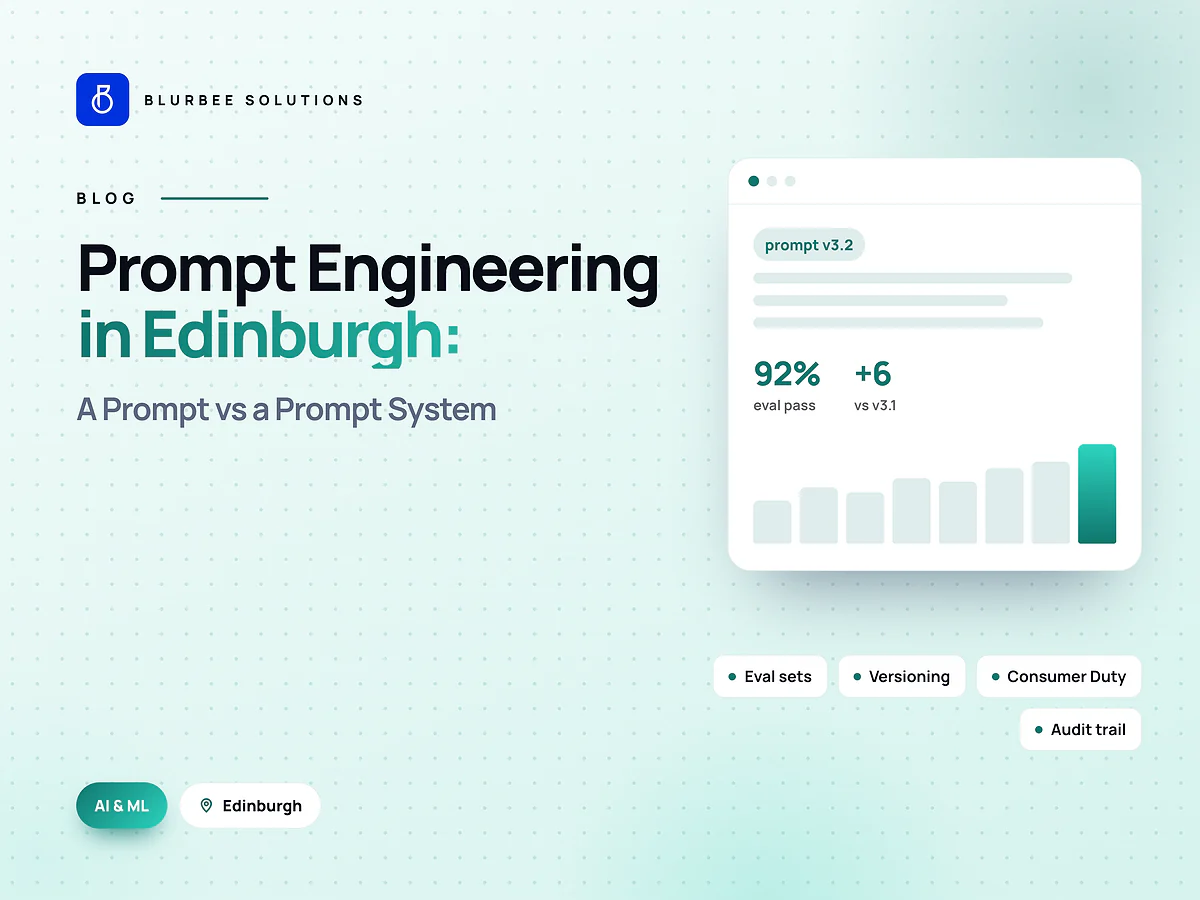
- An evaluation set of real inputs and accepted outputs.
- Automatic scoring on every change.
- Structured outputs validated against a schema.
- Review before release, like any code change.
- Monitoring and logging in production.
The craft of writing good instructions still matters. It just stops being the only thing standing between your customers and a bad answer.
Why regulated Edinburgh needs the system
Consumer Duty. Since 31 July 2023, FCA-regulated firms must deliver and evidence good outcomes for retail customers. If a model drafts customer letters, summarises complaints or answers questions, its outputs fall inside that duty. "We tested it on a few examples" is not evidence. A scored evaluation set and release records are.
Model risk. Larger firms have model risk or AI governance functions that ask how outputs are validated, how changes are approved and how drift is detected. A prompt system answers those questions with artefacts rather than assurances.
Health data. Health information is special category data under UK GDPR. Edinburgh health-tech teams need a lawful basis, minimisation and safeguards, which in practice means redacting identifiers before model calls where possible and knowing exactly where each provider processes data.
Building the evaluation set first
Everything depends on it. We collect 50 to 200 real inputs, anonymised where needed, and record the output a competent person would accept for each. Include easy cases, hard cases and the ones that have gone wrong before.
Then score each output with the right method:
- Schema validation for structured fields.
- Rules for required disclosures, forbidden phrases and length.
- Similarity to reference answers.
- Model-graded rubrics for open-ended text, spot-checked by people.
Report by category. An average that rises while one category, such as vulnerable-customer cases, falls is a red flag a single number hides.
Versioning, review and release
Prompts live as templates in version control, next to the code that uses them. A change goes through a pull request with its evaluation results attached. Production logs record the prompt version and model version for every output, with personal data redacted, so any answer can be traced.
Model upgrades are releases: run the evaluation set on the new model, compare by category, adjust, roll out gradually, and keep the ability to switch back.
Public sector and procurement
Scottish public-sector frameworks commonly require Cyber Essentials Plus, and public bodies are encouraged to be transparent about algorithmic tools. A prompt system makes that transparency practical: you can describe what the model is asked to do, how it is tested and how humans stay involved.
Rates in Edinburgh
Edinburgh agencies typically charge £55-105 per hour for mid to senior engineering. Our blended AI team is £24-47. We keep five hours of live overlap with UK working hours, so reviews with risk and compliance colleagues happen live.
What a risk committee usually asks
When Edinburgh firms take an LLM feature to a model risk or compliance committee, the same questions come up:
- What exactly is the model asked to do, and what is it not allowed to do?
- How is quality measured, on what data, and by whom?
- What happens when a prompt or model changes?
- How are vulnerable customers and complaints handled?
- Where does customer data go, and for how long?
- Who can switch the feature off, and how fast?
A prompt system answers each with an artefact: the template, the evaluation results, the release log, the escalation rules, the data flow and the kill switch.
Start with two weeks
The first fixed-scope project builds the evaluation set from your real inputs, scores your current prompts, moves them into versioned templates, and delivers the first measured improvement, plus a short document your risk committee can review. For the general method, see prompt engineering as a system, not a skill; for testing models more broadly, see how we test a model before it ships.
Prompt systems in regulated Edinburgh, in numbers
Blurbee's assessment of maturity on each dimension, scored out of 10 for a typical regulated team. Opinion based on our engagements.
Why Edinburgh teams build prompt systems with Blurbee
Edinburgh's asset managers, insurers and health-data teams need evidence before AI reaches customers. We build prompts as versioned, tested, reviewable systems that a model risk function can sign off.
- Fixed-scope first projectTwo to four weeks, priced as a number rather than an estimate, so you have evidence before a longer commitment.
- One delivery lead, namedYou always know who to ask. No account manager relaying questions to a team you never meet.
- Code and IP are yoursAssigned in writing, handed over with repositories, infrastructure definitions and documentation whether or not you continue with us.
- Performance budgets in CICore Web Vitals and bundle size gate the build. Slow does not ship.
- Accessibility to WCAG 2.2 AAReviewed with automated and manual passes, not claimed on a slide.
- Written overlap disciplineStanding calls inside your working window, everything else asynchronous with a decision log.