MVP Development in 2026: How to Build a Minimum Viable Product That Proves Something
A practical guide for founders and product teams: how to scope an MVP, what it costs, how long it takes and how to tell whether it worked.

A minimum viable product is not a cheap version of your full product. It is the smallest thing you can build that tests your riskiest assumption with real users. Many founders forget the second half of that sentence, and spend six months and most of their runway building a polished product that nobody asked for.
This guide explains how to scope, build and judge an MVP, whether you are a startup founder or a product team inside a larger company.
Why MVPs matter
Building the wrong thing is one of the most common ways startups fail. In CB Insights' analysis of startup post-mortems, the most-cited reasons for failure were running out of cash or failing to raise new capital (38%) and no market need (35%) (CB Insights). Both are made worse by spending too much, too early, on a product the market hasn't validated.
An MVP attacks both problems. It spends less, and it tells you sooner whether people want what you are building.
What an MVP is, and what it isn't
An MVP is:
- Focused on one core problem for one type of user.
- Good enough that people can use it for real, not just look at it.
- Instrumented so you can see what users actually do.
- Built to be changed, extended or thrown away.
An MVP isn't:
- A prototype or a clickable mockup. Those are useful earlier, but they don't test real behavior.
- A "version 1" with every feature at lower quality.
- An excuse for poor security or code that can't be maintained.
Start with the riskiest assumption
Before you list any features, write down the assumptions your business depends on. For example:
- Small dental practices lose enough revenue to no-shows to pay for a fix.
- They will connect their scheduling system to a new tool.
- Automated reminders reduce no-shows enough to notice.
- Practice managers will pay a monthly subscription.
Then ask: which one, if wrong, kills the business? That is what your MVP must test first. Everything that doesn't help test it can wait.
How to scope the first release
- Pick one user and one job. "Practice managers who want fewer no-shows" is a scope; "dental software" is not.
- Map the shortest path to value. What is the minimum sequence of steps a user needs to get the benefit?
- Cut ruthlessly. Admin dashboards, complex permissions, multiple integrations, reporting, settings pages and onboarding flows can usually be manual or basic at first.
- Do things that don't scale. Onboard users by hand, run some processes manually behind the scenes, and use off-the-shelf tools where you can.
- Define success up front. Choose two or three measures, such as activation, weekly use or conversion to paid, with target numbers.
Choosing the technology
The best MVP stack is the one your team can move fastest in, and that won't trap you later.
- Web first if your users work at a desk or you need to iterate very quickly. A responsive web app reaches everyone without app store review.
- Cross-platform mobile (Flutter or React Native) if your users live on their phones. See our Flutter vs React Native comparison.
- Managed back-end services for authentication, storage and notifications, so you don't build what you can rent.
- A mainstream framework such as React or Next.js on the front end and Node.js or Python on the back end, so hiring and handover stay easy. Our React vs Next.js vs Angular comparison helps with that choice.
- AI features through APIs rather than training your own models, unless the model itself is the product.
Avoid exotic technology, premature microservices and heavy infrastructure. You can re-architect after you have proven demand.
What an MVP costs and how long it takes
Cost depends on platforms, integrations and how much of the product must be automated from the start. As a guide, Blurbee's published rates are $22 to $45 per hour for web development and $24 to $48 for mobile app development, depending on seniority. A typical web project runs six to fourteen weeks, and a typical app project eight to eighteen.
Most well-scoped MVPs sit at the lower end of those ranges. The things that push the cost up are:
- Building for web, iOS and Android at once.
- Integrations with several external systems.
- Payments, compliance or healthcare data from day one.
- Complex roles and permissions.
- Real-time features such as chat, live tracking or collaboration.
US local agency bands on our location pages typically run from $75 to $220 per hour. Our custom software development cost guide explains how to budget across phases.
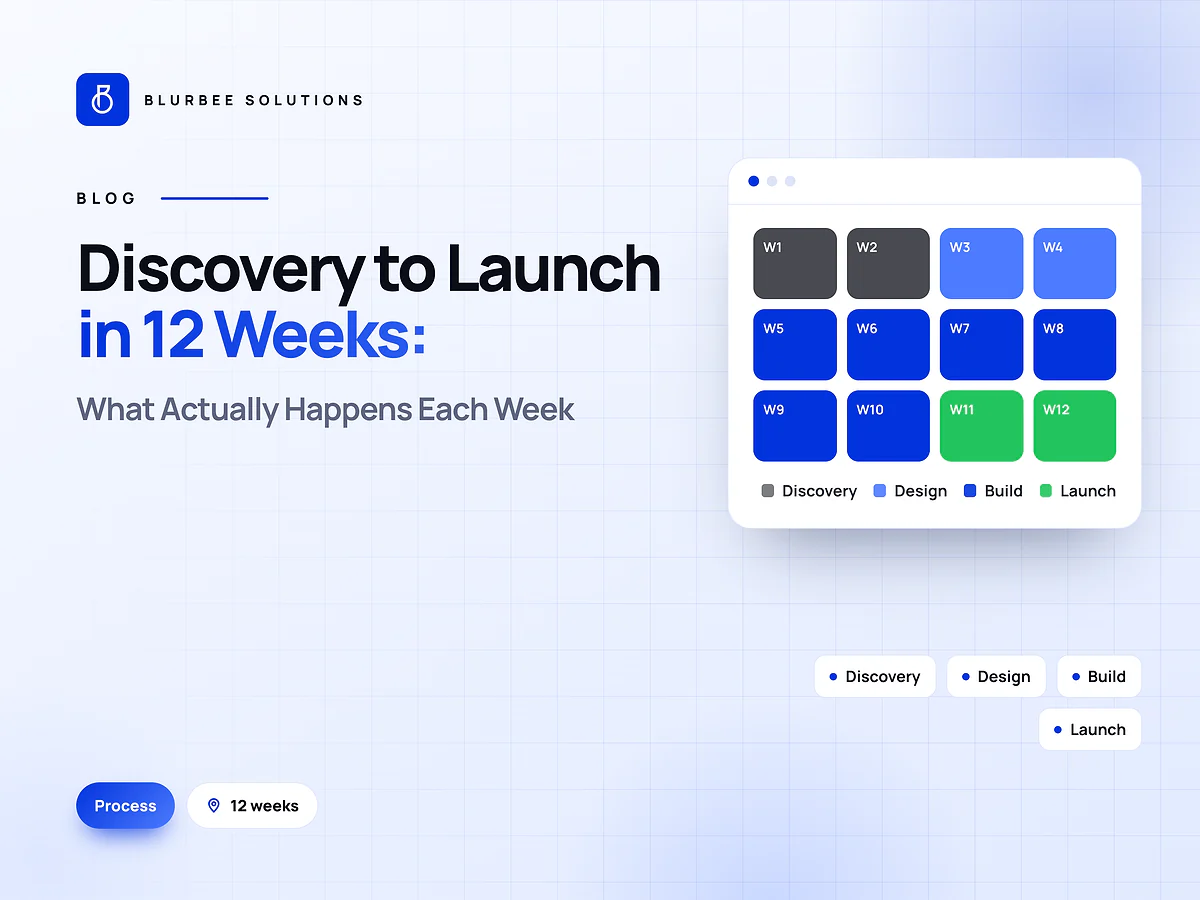
Building it: a typical 12-week plan
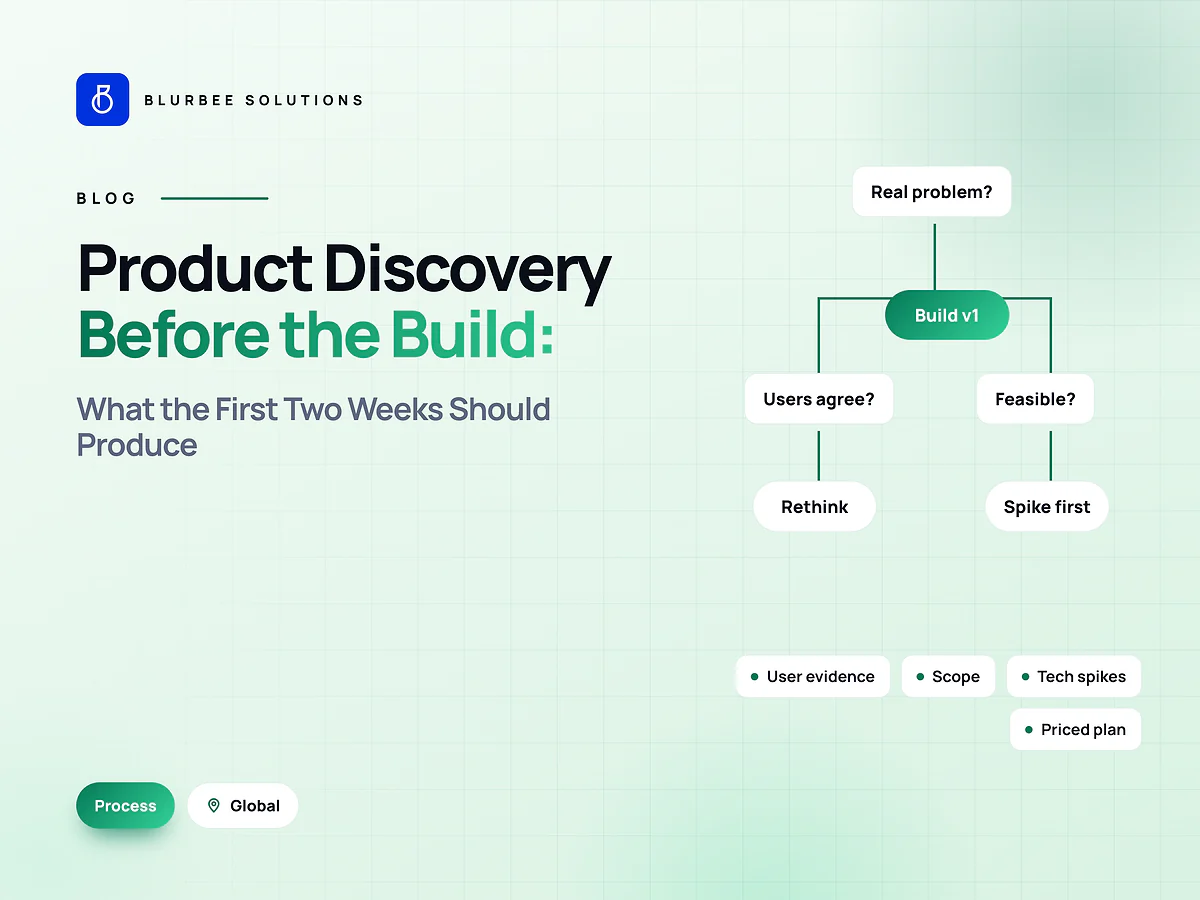
- Weeks 1–2: discovery. Assumptions, user flows, prioritized scope, technical plan and design direction. Our article on the first two weeks of product discovery describes this phase.
- Weeks 3–4: design and setup. Key screens, a simple design system, repository, environments and deployment pipeline.
- Weeks 5–10: build in short sprints, with a working demo every week or two.
- Weeks 11–12: test, launch to a small group, and fix what they find.
This mirrors the plan in our discovery to launch in 12 weeks article.
Measuring whether it worked
Launch is the start of the experiment, not the end of the project.
- Activation: what share of sign-ups reach the moment of value?
- Retention: do they come back next week, and the week after?
- Engagement with the core feature, not just page views.
- Willingness to pay: pre-orders, paid pilots or conversion from trial.
- Qualitative feedback: talk to users every week. Watch them use it if you can.
Decide in advance what result means "continue", "change direction" or "stop". Without that, every result looks promising.
Common MVP mistakes
- Building for everyone. A product for everyone is a product for no one in particular.
- Polishing before validating. Animation and perfect design can wait; clarity can't.
- Skipping analytics. Without data, you are guessing.
- Ignoring security basics. Even an MVP needs proper authentication, encrypted data and safe handling of personal information.
- Throwaway code you can't throw away. If the MVP succeeds, you'll build on it. Keep the code clean enough to extend.
- Outsourcing the thinking. A development partner can challenge your scope, but the founder must own the problem and the users.
No-code, low-code or custom code?
No-code and low-code tools can be a smart way to test an idea, especially for internal tools, simple marketplaces and content-driven products. They let non-developers build quickly and cost little to start.
Their limits appear as you grow: performance, complex business logic, integrations, data ownership, and pricing that scales with users or records. Many teams start with no-code to validate demand, then rebuild in custom code once they know what users want.
Choose custom code from the start when:
- The product itself is your competitive advantage.
- You need complex logic, integrations or real-time features.
- You handle sensitive data that needs strict security and compliance.
- You expect to raise investment, where technical due diligence will examine your stack.
After the MVP: what comes next
If the MVP shows real demand, the next stage is turning an experiment into a product:
- Fix what users told you, before adding new features.
- Strengthen the foundations: automated tests, monitoring, backups and security reviews.
- Automate the manual steps you used behind the scenes.
- Improve onboarding so users reach value without your help.
- Plan the roadmap around the measures that showed traction.
If the MVP doesn't show demand, that's a result too. Talk to users about why, and decide whether to change direction or stop, while you still have runway.
How to work with an MVP development partner
A good partner should challenge your scope, not just accept it. Expect them to ask which assumption you're testing, who the first users are and how you'll measure success. Be wary of anyone who agrees to build every feature on your list without question.
Agree up front on:
- A prioritized backlog with a clear line between the first release and later.
- A weekly demo of working software.
- Your access to the code repository, project board and test environments from day one.
- Ownership: code, designs and accounts in your name, assigned in writing.
- What happens after launch: support, fixes and the next phase.
Founders who stay closely involved, attending demos, testing builds and talking to users, consistently get better MVPs than those who hand over a specification and wait for launch day.
Building an MVP with Blurbee
Blurbee helps US founders and product teams scope, design and build MVPs, from a fixed-scope discovery through to launch, with a named delivery lead and daily overlap with US time zones. We sign an NDA first, and the code and IP are yours. See our mobile app development services, SaaS development across the USA and our app development page for Texas.