Mountain West Tech Teams: When to Hire Offshore Engineering Support
Why Colorado, Utah, Arizona and Nevada companies extend engineering offshore, which roles work remotely and which do not, and how the timezone gap is actually managed.

Mountain West companies extend offshore for a reason that is more specific than cost: hiring senior engineers in Denver, Boulder and Salt Lake takes months, and the funding environment rewards visible progress per dollar. A team that needs three more engineers now, not in the third quarter, has a limited set of options.
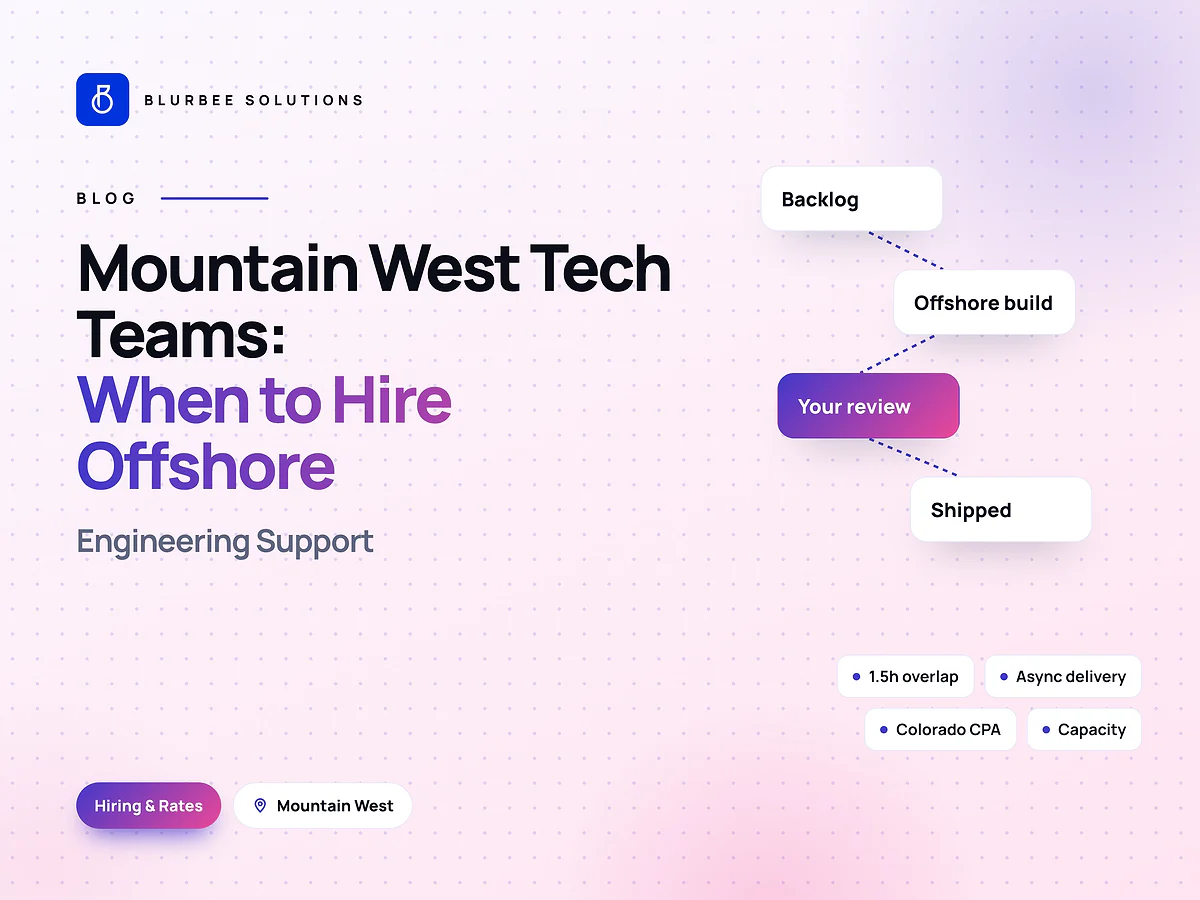
The 1.5-hour overlap with India sounds like the smallest of the US windows, and in practice this region handles it better than either coast. Here is why, and what it takes.
The overlap, honestly
IST is 11.5 hours ahead of Mountain time. The live window is roughly 08:30-10:00 MT, which is evening in India.
That is enough for a standing call and for real-time work when something is genuinely stuck. It is not enough for a meeting culture, and any attempt to build one will cost you the offshore team within a quarter.
What makes it work here: Mountain West teams are already comfortable with asynchronous work. Denver and Boulder have a stronger written culture than San Francisco or New York — more decisions in documents, fewer in hallways — and that is precisely the muscle an offshore arrangement requires. Teams that already write things down adapt to offshore in a week. Teams that decide everything verbally struggle regardless of the timezone.
The structure that works
One standing call inside the window. Everything else asynchronous, with two artefacts.
A written handoff at the end of each India day. What moved, what is blocked, and what needs a decision from you. This is the single highest-value document in an offshore engagement — it converts the time difference from pure cost into something close to neutral, because work happens overnight and you wake to an account of it.
A decision log. Every material decision, with the reasoning and the date. Across a time difference, "we discussed that on a call" is not a record, and the same question resurfacing in month four with no written answer is how offshore engagements erode.
Neither is elaborate. Both are the difference between an arrangement that compounds and one that leaks.
Which roles extend, and which do not
Extend well: backend and API work, frontend build against agreed designs, QA and test automation, mobile builds, platform and DevOps work. What these share is clear inputs, verifiable outputs, and no dependence on spontaneous conversation to make progress.
Keep in-house: product management, without exception. Whoever decides what gets built and in what order needs to be present where priorities are actually set, and those conversations happen in your building, often informally. An offshore product manager is a message relay with a title.
Also keep in-house anything whose actual job is walking over to ask someone. If a role's daily work is unblocking things by finding the right person, distance breaks it.
Mixed: design. Visual and interaction design extends fine against a clear brief. Discovery research with your customers does not, unless your customers are somewhere the offshore team can reach.
The economics, adjusted properly
Denver and Salt Lake senior engineering through agencies runs $85-165 per hour. A blended offshore team including QA and a delivery lead sits at $24-48.
The honest adjustment is your own time: four to six hours a week for written briefs, the standing call, and reviewing work. If you are a founder also running sales, that is a real cost and worth naming rather than discovering in month two.
It remains a large saving. It is not free, and pretending otherwise is how offshore arrangements get set up to disappoint.
Onboarding: offshore exposes what was already broken
The most common reason an offshore engineer takes six weeks to become productive is not distance. It is that your onboarding has always depended on someone explaining things at a desk, and nobody noticed because there was always someone at the desk.
Three things fix it:
A README that works from a clean checkout, on a machine that has never seen your project. Test this on someone new. It is almost never true the first time.
An architecture note explaining why things are as they are — not what the code does, which the code says, but which decisions were deliberate and which are accidents nobody has cleaned up.
A first task that is small, real and shippable. Not a tutorial project. Something that goes to production in week one, so the whole pipeline gets exercised while the stakes are low.
Doing this work has value even if you never hire offshore. Offshore just makes it non-optional.
Regional notes
Colorado. The Colorado Privacy Act applies and requires support for universal opt-out signals such as Global Privacy Control — a genuine engineering requirement rather than a policy line. Aerospace and defence-adjacent work in Colorado Springs may carry export-control constraints that rule out offshore delivery entirely; establish this on the first call.
Utah. Silicon Slopes SaaS companies typically scale go-to-market before engineering, so the usual brief is a platform under load with technical debt taken on deliberately. That is good offshore work: bounded, measurable, and not dependent on product discovery.
Arizona. The Phoenix semiconductor build-out has pulled industrial software work into the state, most of it integration rather than greenfield. Integration work extends offshore well provided access to the systems is arranged in advance.
Nevada. Gaming systems are regulated by the Gaming Control Board and the certification path dictates release cadence. This changes the engagement shape considerably and needs to be scoped as its own workstream.
Montana and Idaho. Field operations assume patchy coverage, which makes offline tolerance and sync conflict handling a design problem rather than a feature. Decide it before the data model exists.
Test for judgement, not just capability
Ask any prospective offshore partner what they would change about your plan, in the first call. A team that has no opinion has either not read the brief or does not intend to push back, and both are expensive.
The trial project is where you verify it properly. One engineer, one month, one bounded piece of real work in your repository, reviewed by your team. You learn how they estimate, how they write code, whether they raise problems early or absorb them silently, and what happens when something slips.
If it goes badly, it cost you a month. If it goes well, you have someone who already understands your codebase and a basis for scaling that is evidence rather than optimism.
The overlap arithmetic, and what it means
Blurbee delivery experience across 2019-2026 engagements. Ratings reflect how much co-location and spontaneous conversation each role depends on.
Why Mountain West teams extend with Blurbee
Mountain time gives 1.5 hours of live overlap, which sounds thin and works well — because Denver and Salt Lake teams are already comfortable operating asynchronously. We write the handoff, keep the decision log, and tell you when a plan is wrong.
- Fixed-scope first projectTwo to four weeks, priced as a number rather than an estimate, so you have evidence before a longer commitment.
- One delivery lead, namedYou always know who to ask. No account manager relaying questions to a team you never meet.
- Code and IP are yoursAssigned in writing, handed over with repositories, infrastructure definitions and documentation whether or not you continue with us.
- Performance budgets in CICore Web Vitals and bundle size gate the build. Slow does not ship.
- Accessibility to WCAG 2.2 AAReviewed with automated and manual passes, not claimed on a slide.
- Written overlap disciplineStanding calls inside your working window, everything else asynchronous with a decision log.