Model Fine-Tuning in Dubai: When Fine-Tuning Beats Prompting (and When It Doesn't)
When fine-tuning beats prompting for Dubai teams: Arabic and Gulf dialect quality, cost at scale, Arabic-first models, PDPL and DIFC rules, AED budgets.

Fine-tuning is having another moment in Dubai. DIFC fintechs and Business Bay e-commerce teams are being told that training a model on their own data is how serious companies do AI. Sometimes that is true. Often a well-designed prompt or retrieval setup does the job for a fraction of the cost and effort.
This guide explains when fine-tuning beats prompting in the Dubai market, when it doesn't, and how to decide with numbers rather than hype. For the general framework, see fine-tuning vs prompting vs RAG.
What fine-tuning changes
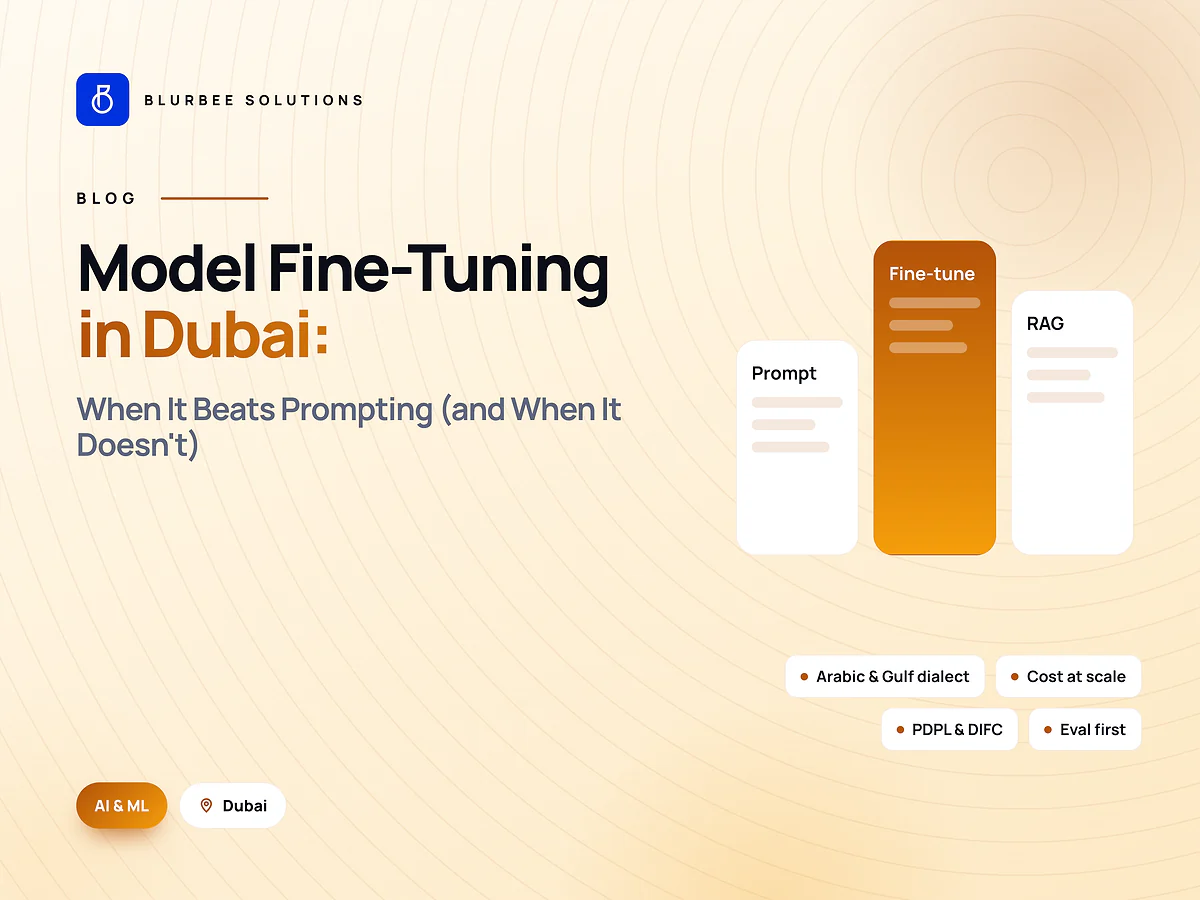
Prompting changes the instructions you send. Retrieval changes the knowledge available. Fine-tuning changes the model itself by training it further on your examples. It is good at shaping behaviour, format, tone and narrow skills. It is poor at adding facts that must stay current.
When fine-tuning wins in Dubai
Arabic and Gulf dialects. General models handle Modern Standard Arabic reasonably, but quality varies on Gulf dialects, messages that switch between Arabic and English mid-sentence, and Arabizi, Arabic written in Latin script with numbers for some letters. Customer messages in Dubai contain all three. Fine-tuning on your own labelled messages can close the gap.
High volume at low cost. E-commerce and fintech teams classify, route and extract from very large numbers of messages, transactions and documents. A fine-tuned smaller model can often match a large general model on a narrow task at a fraction of the per-request cost and latency.
Strict format and tone. Regulated communications with required structure, or a brand voice that must be consistent in two languages.
When it doesn't
Knowledge that changes. Product catalogues, prices, policies and regulations change. Fine-tuned facts go stale and need retraining. Retrieval lets you update a document instead.
Little labelled data. Useful fine-tuning typically needs hundreds to thousands of consistent examples.
No evaluation set. Without a baseline, you cannot show that fine-tuning improved anything.
Arabic-capable models worth testing
The UAE has produced its own open-weights models. The Technology Innovation Institute in Abu Dhabi developed the Falcon family, and Jais, from Inception and MBZUAI, was built specifically for Arabic. Arabic-first models can be strong starting points for fine-tuning, and open weights mean they can be hosted inside the UAE. We test them against general models on the same evaluation set rather than assuming either is better.
Data rules: PDPL and DIFC
Which regime applies depends on where your entity is registered, not where your customers are.
- Onshore Dubai companies follow the federal PDPL, Decree-Law 45/2021.
- DIFC entities follow DIFC Data Protection Law 5/2020, which includes provisions on autonomous and semi-autonomous systems.
Training on customer data is processing. Establish the lawful basis, minimise and redact where possible, and decide whether training must happen inside the UAE. AWS, Azure, Oracle and local providers offer UAE regions for that.
How we decide
- Build an evaluation set from real, anonymised data, in both languages and dialects you serve.
- Test the best prompting approach, including good examples and structured outputs.
- Add retrieval if failures are about missing knowledge.
- Fine-tune only if a measured gap remains, and compare quality, cost per request and latency.
What fine-tuning really involves
Data preparation and labelling are usually the largest part. Then a training pipeline with versioned data, evaluation of every model version, deployment, monitoring and retraining when the base model changes. It is an ongoing capability. For keeping trained models healthy in production, see MLOps from notebook to production.
Rates in Dubai
Dubai agencies typically charge AED 180-400 per hour. Our blended AI team is AED 110-220. A measured comparison of prompting and fine-tuning typically takes two to four weeks. IST is only 1.5 hours ahead of Gulf Standard Time, so we share a full working day.
A worked example: routing customer messages
A Dubai e-commerce company receives customer messages in English, Arabic, Gulf dialect and Arabizi, and wants them routed to the right team.
The evaluation set holds a few hundred real messages in each style, labelled by the support team. A general model with good prompting reaches decent accuracy in English but drops noticeably on Gulf dialect and Arabizi. A smaller model fine-tuned on a few thousand labelled messages closes most of that gap and costs far less per message at their volume.
The decision rests on the per-language numbers and the cost per thousand messages, not on which approach sounds more advanced. The figures here are illustrative; yours come from your own messages.
Start with the comparison
The first fixed-scope project builds the evaluation set, tests prompting and, if justified, fine-tuning on your data, and reports quality, cost and latency for each. Then you decide with numbers.
Fine-tuning in Dubai, in numbers
Blurbee's illustrative comparison of relative quality, scored out of 10, for a bilingual customer-message classification task. Real results depend on data.
Why Dubai teams fine-tune models with Blurbee
We fine-tune when the evaluation numbers say so, not because it sounds advanced. For Arabic and Gulf-dialect work we measure each language separately, and we share your full working day.
- Fixed-scope first projectTwo to four weeks, priced as a number rather than an estimate, so you have evidence before a longer commitment.
- One delivery lead, namedYou always know who to ask. No account manager relaying questions to a team you never meet.
- Code and IP are yoursAssigned in writing, handed over with repositories, infrastructure definitions and documentation whether or not you continue with us.
- Performance budgets in CICore Web Vitals and bundle size gate the build. Slow does not ship.
- Accessibility to WCAG 2.2 AAReviewed with automated and manual passes, not claimed on a slide.
- Written overlap disciplineStanding calls inside your working window, everything else asynchronous with a decision log.